This site is dedicated to bringing you interesting information about the community of St. Jacques which is located on the north side of Fortune Bay in the province of Newfoundland and Labrador, Canada.
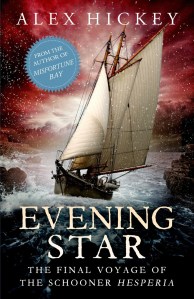
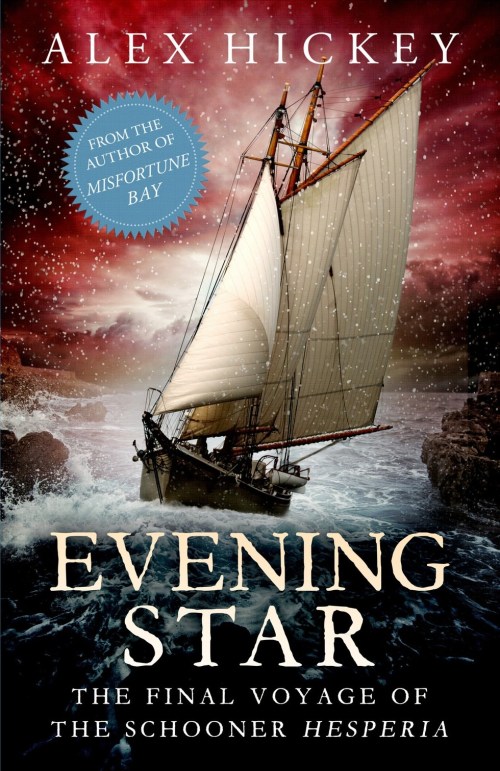
Life, love, and longing all flow through the pages of Evening Star: The Final Voyage of the Schooner Hesperia. Open the covers to meet sea captain, Abe Skinner and Kate Emberley, his wife of thirty-one years, as they navigate through a crisis that brings the course of their lives into sharp focus. Along the way, you’ll see them as young lovers who sit by the ocean and plan their wedding. Experience the joy of owning the world as they sail into a life that will deliver three daughters, a son, and a grandchild whose presence fills their later years.
Travel back in time to experience life in a small outport on the coast of Newfoundland during World War I, a time when conflict on the world stage affects even the smallest of children, challenges relationships, and tests the limits of a couple’s bonds. Witness the strength of extended family, the support of neighbours and the shared anguish of a community. Meet the crew of the Hesperia and the women in their lives as they meet one challenge after another.
See the relationship of Kate and Abe through each other’s eyes, their reflections and fears. Learn about their daughters, the men they married and the twists and turns their lives have taken as they move into worlds seemingly far away from that of their parents. Empathize with the love of a mother for her only son as she anxiously awaits his next letter and combs the newspapers seeking anything about the fate of her soldier fighting in France.
Kate was twenty-one when she married twenty-nine-year-old Abe. Their life together emerges as the story unfolds to test the resolve of even the strongest relationship. In a world fraught with harsh realities, danger, unpredictable forces of nature and an event that changes the course of their lives forever, Kate finds enormous strength to carry on.
Evening Star: The Final Voyage of the Schooner Hesperia is published by Flanker Press Ltd, Paradise, NL sales@flankerpress.com . Pick up your copy at any Coles/Indigo bookstores and at various other locations throughout Newfoundland and Labrador, or online at those and other vendors such as Amazon.ca.
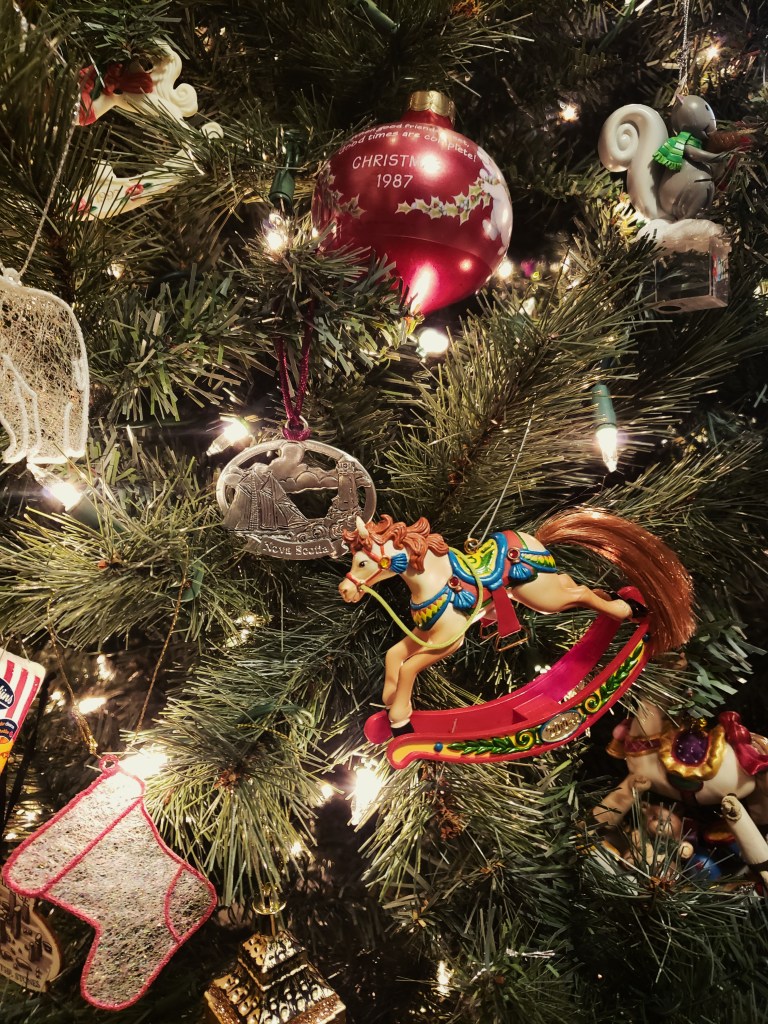
December social media posts are decorated with images of Christmas Trees. There’s no contest for best tree, best decorated tree, most innovative tree or silliest tree, yet their proliferation suggests otherwise. There was a time, and may still be in some homes, when neighbours and friends were invited to ‘drop over to see our tree.’ That invitation wasn’t an offer to come, stand and gawk at the evergreen standing in the corner of the living room, but to come socialize, to enjoy each other’s company during the Season. That seems to have changed a bit with the arrival of Facebook, Instagram and the like. Now, it seems it is about ‘seeing the tree.’
Don’t get me wrong. Seeing the tree is always a visual delight. It is astounding how a simple, often gangly, otherwise mundane object is transformed by human hands into such a beauteous installation in the midst of someone’s home — to stands in stark contrast to everyday life. In my memory, it has always been so, whether the tree came from the nearby forest or out of a box. I don’t recall ever seeing two decorated trees looking alike for most of my lifetime. I have seen them in recent years, as promoters and designers vie to create attention with their suggestion of, ‘how to decorate your tree.’
There are ribbon trees, upside-down trees, white trees, themed trees, huge bows, burlap, fibre-optic, and single-colour decorated trees. You’ve seen them too. There have been years when there seems to be an attempt to decorate a tree to look like everyone else’s. Go figure. I am not suggesting that when the invitation to drop by to see the tree was accepted that there weren’t subjective and aesthetic judgements made about how well or how badly the neighbours tree was decorated, for there certainly were. I’ve seen Christmas trees that were more oval than triangular, their branches extending well into the room, squeezing you back to the doorway. Others were skinny and sparse, prompting me to wonder what the person was thinking when that tree was chosen among a forest full of choices. I must confess I’ve had to turn one side of a tree to the wall to hide its sparse branches or disguise the thin spots with artificial greenery, a time or two, myself.
The perfect Christmas tree is not what someone tells us it should be. It’s not a formula to follow or a kit to assemble with directions that lose meaning in translation. If not, what is it? I believe it’s the tree that tells a story of the family or person who decorates it. It’s the tree that bends its branches under the weight of souvenirs of vacations, family visits, favourite places, people remembered, and commemorations. That Christmas tree also proudly displays handmade baubles and bows from children’s creative hands; boldly shows off items from Christmases past, from trees of childhood or those of family members whose hands no longer decorate. Such a tree stands tall in my eyes with its worn top that’s withered over time and offers its welcoming branches as a place to share precious memories.
Resting on its sweetly scented needles or hanging below their canopy are miniature, framed photographs of special people, lovingly painted odd coloured walnut husks, crocheted stars and balls starched to perfection, and bells from the collars of family pets. In between them hang twirling ballerinas, team emblazoned hockey sticks, hand-written scrolls, fifteen-year-old letters to Santa, colourful plastic childhood cartoon characters and special, never-to-be-forgotten cards. And, if you like, toss a few strands of tinsel here and there in remembrance of aunts and grandmothers whose love of that shiny, stringy material still haunts your memory.
That’s the story of Christmas told in the charms and treasures of those who are in it, a stage to gaze upon when the lights are dim, think about in quiet moments, and shed a joyful tear at having been part of that incredible plot.
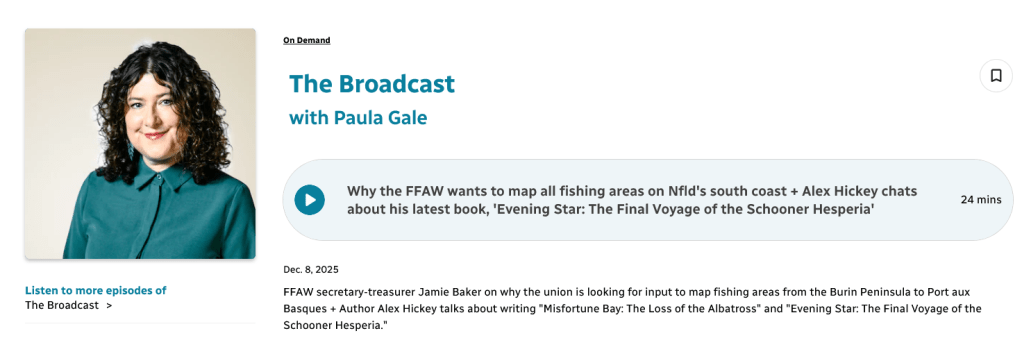
Last week, I had the privilege of visiting the studio of CBC Radio in St. John’s for an interview with Paula Gale of the Fisheries Broadcast. The Broadcast has been on the air at CBC since 1951, bringing Newfoundland and Labrador residents stories of life at the edge of the great Atlantic Ocean. The host was most welcoming, resulting in a very comfortable conversation. The interview was broadcast on December 8th, 2025. We discussed both Misfortune Bay and Evening Star, research practices, the writing process and my upcoming books for 2026.
Click on the screenshot below to access the Interview.
Here is another way to access the interview. Click or copy and paste into your browser.
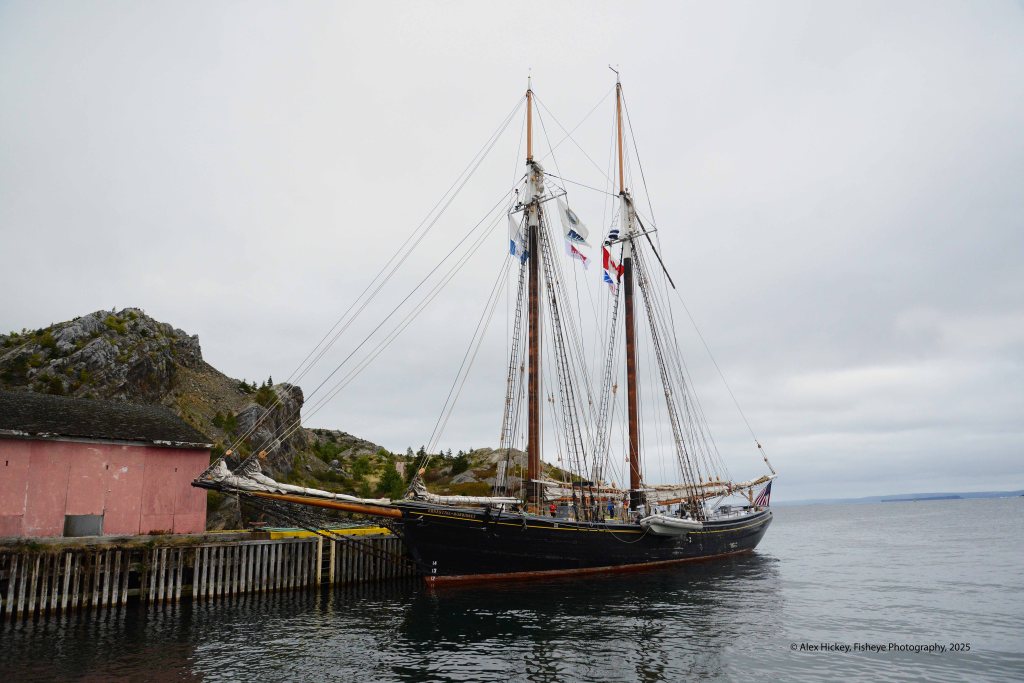
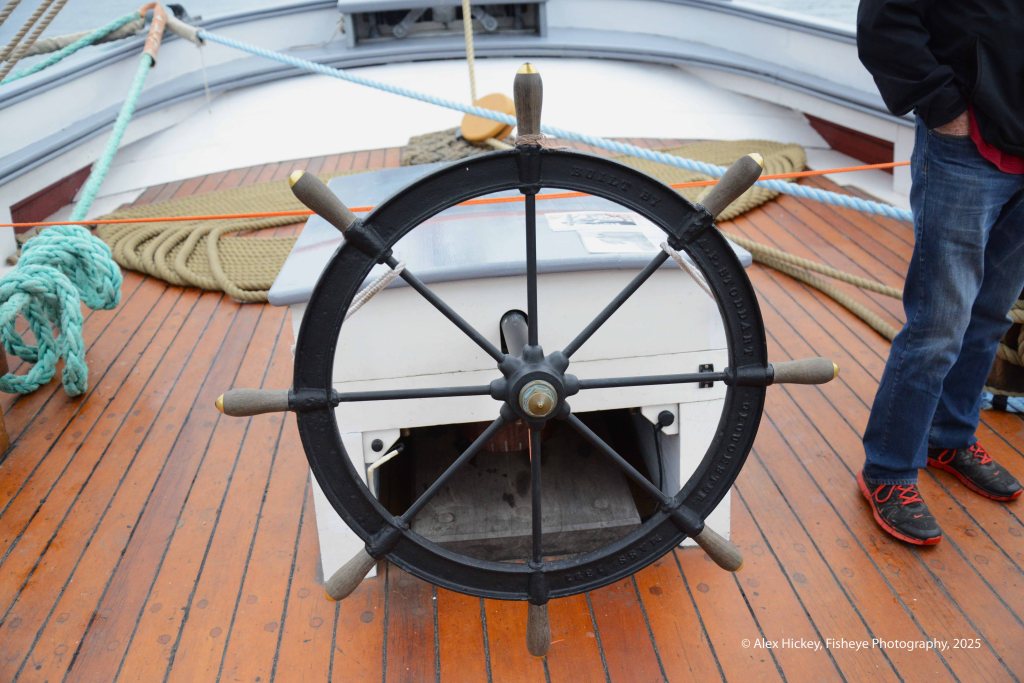
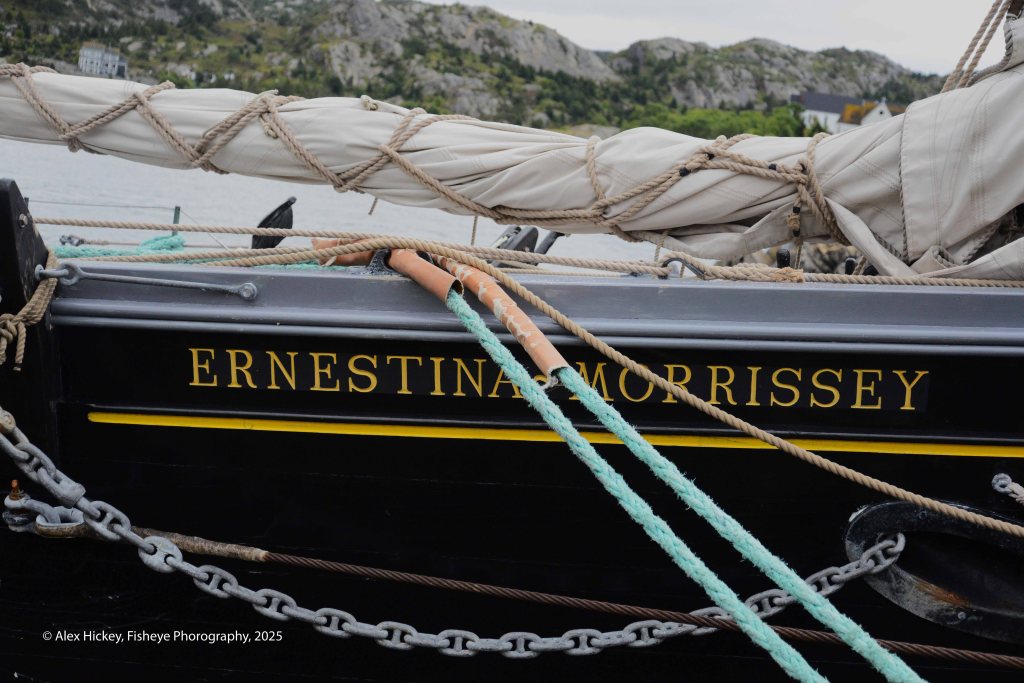
On the eve of releasing my book, Evening Star: The Final Voyage of the Schooner Hesperia, I had the profound experience of walking the deck of another schooner built around the same time as the Hesperia. After several years of reading, researching and writing about schooners that first step onto the deck of the Ernestina Morrissey in Brigus, NL, was like entering a time travel portal. When my foot made contact with that worn deck moving with the motion of the sea, the visceral response was beyond words. In an instant, the forces of the universe that cause tides and the great oceans of the world to exist in a continuous state of movement were shared with me through that vessel.
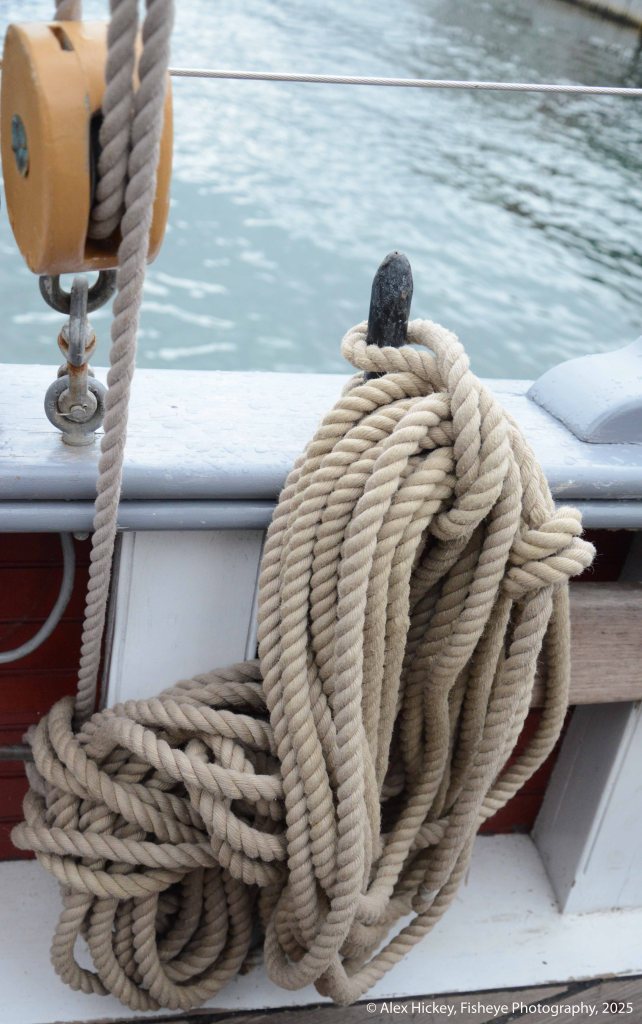
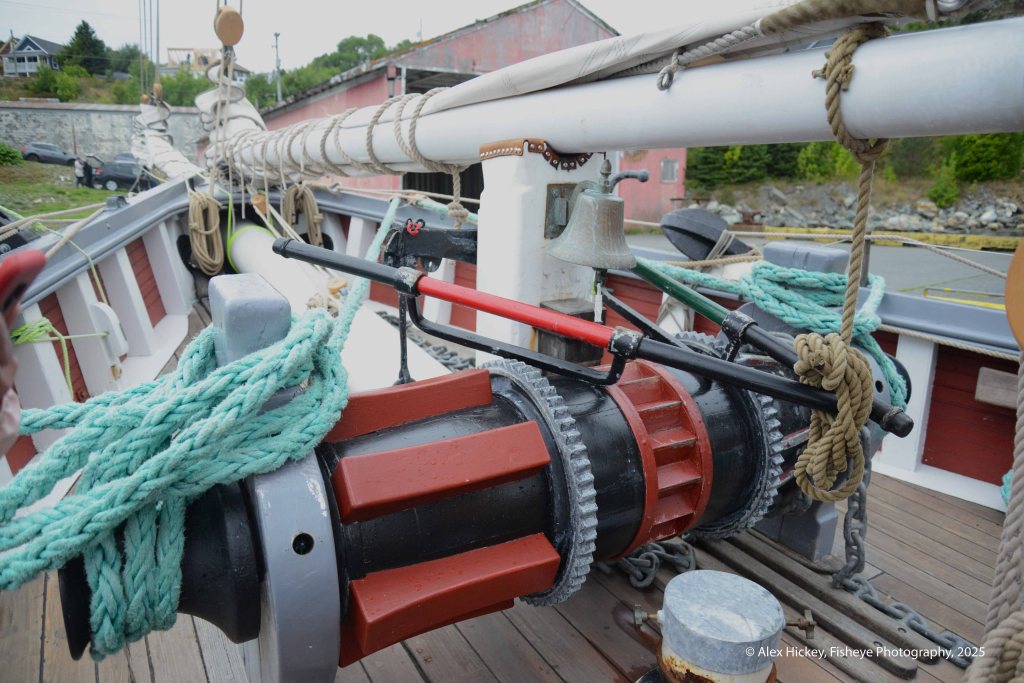
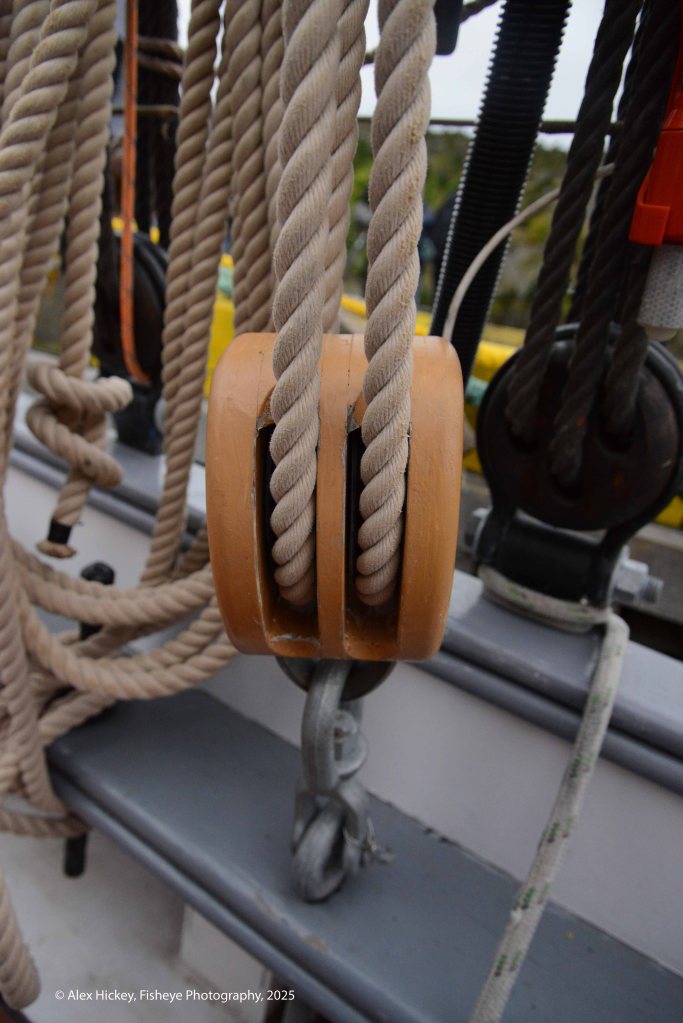
I have often heard sailors, and those familiar with the sea, remark that schooners are living things. I am doubtful that anyone has ever been able to fully explain what is meant by that. Yet, when you look around the deck of one, at the masts, the ropes, rigging and sails, the shape of the hull and the manner in which it sits atop the water, there’s a suggestion that it is waiting for someone to make the first move. Even at dockside, with the subtle rise and fall of waves, it keeps alive its symbiotic relationship with the sea. The motion never ends as it awaits the casting off of a hawser, the raising of a sail, a swing of the boom and a hand at the helm.
When I was writing Evening Star, an imagined account of an actual event that took place in 1916 off the south coast of Newfoundland, I stood in the boots of Captain Abe Skinner of the Hesperia and imagined the experience of sailing between St. Jacques in Fortune Bay and Sydney, Cape Breton, Nova Scotia, thence to St. Pierre and Miquelon in December. I read about life at sea at that time, talked to sailors and consulted experts. I studied marine charts, the language and lore of the sea, the origin, actions and consequences of storms, and the events of that time period on the east coast of North America. It was all informative and helped with recounting that voyage.
The sea is no stranger to me. I’ve seen it from above and below its surface, moved across it in vessels that ranged from small dories to a Canadian Navy ship, and vicariously lived on it through the storytelling of those who did so in all seasons and under all conditions. I know about it, but I don’t truly know it as do those whose lives have been spent upon and under it. There is one thing, though, that we all have in common. That is the rhythm of the ocean felt through the ship itself. It is a feeling of knowing that defies description. You can look at someone experiencing it with you, and smile, for they know what you are feeling. There’s no need to speak. That’s where the living ship comes in. Its communication is elemental, profound, and primordial.
When the deck of the Morrissey rose to meet the sole of my foot I was once again standing in the boots of Captain Abe Skinner.
Evening Star: The Final Voyage of the Hesperia, is published by Flanker Press and available online and in bookstores as of October, 2025.
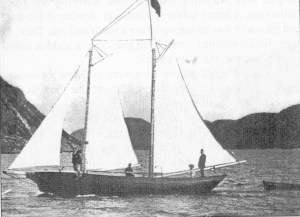
The end of July 2025 marks the 109th anniversary of the collision off Belleoram Back Cove in Fortune Bay which sent the Albatross to the bottom, taking with it the body of Isaac Burke, lightkeeper from St. Jacques Island, who likely died on impact when the bow of the S.S. Hump sliced through the mid-section of the twenty-seven foot medical schooner of Dr. Conrad Fitz-Gerald. Like most unexpected events their world changed in a fraction of a second. Alec Tibbo and his brother George, both of St. Jacques, were tossed into the dark night water along with Fitz-Gerald. Fortunately the three survived, but not without facing great peril.
The Albatross was conducting a search for the yacht, Caribou, owned and captained by Phillip Ryan, telegraph relay operator from Long Harbour, Fortune Bay which Burke had witnessed capsize several hours earlier. The Caribou had been transporting Customs and Welfare Officer, Harry Clinton of St. Jacques, around the Bay to visit clients. No sign of the two men or the Caribou was ever found.
Aboard the S.S. Hump was a crew of men from the Fortune Bay area, primarily St. Jacques and Belleoram. One of them, the Purser, was Isaac Burke’s son, Charles. Another, was Barry Lynch, a close family friend of the Burkes. Harry Clinton was Isaac Burke’s brother-in-law. These would have been relatively common, unnoticed relationships in any community. However, in a small town of several hundred people, these relationships become quite pronounced when tragedy strikes.
Clinton and Ryan had two daughters each, while Burke had eight children. The immensity of how this event affected people of the community is hard to fathom these many years later; yet, from experiences in our own lives, we can project and empathize. Beyond the loss of human life, the community’s revered Doctor lost his mobile medical clinic which he sailed throughout Fortune Bay to tend to the sick. Aboard the Hump was a crew who knew these men; some knew their families. All of them served the people who lived along that section of the south coast of Newfoundland. The shock waves reverberated through all of those communities.
Author – Alex Hickey
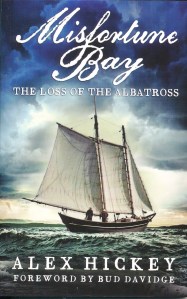
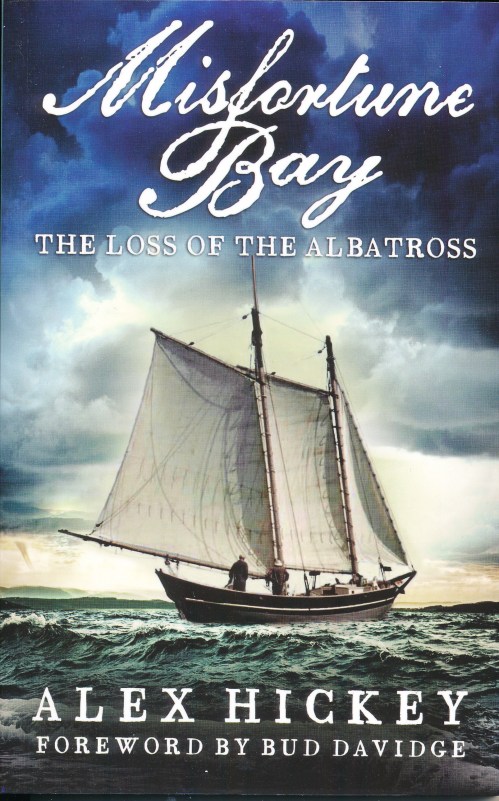
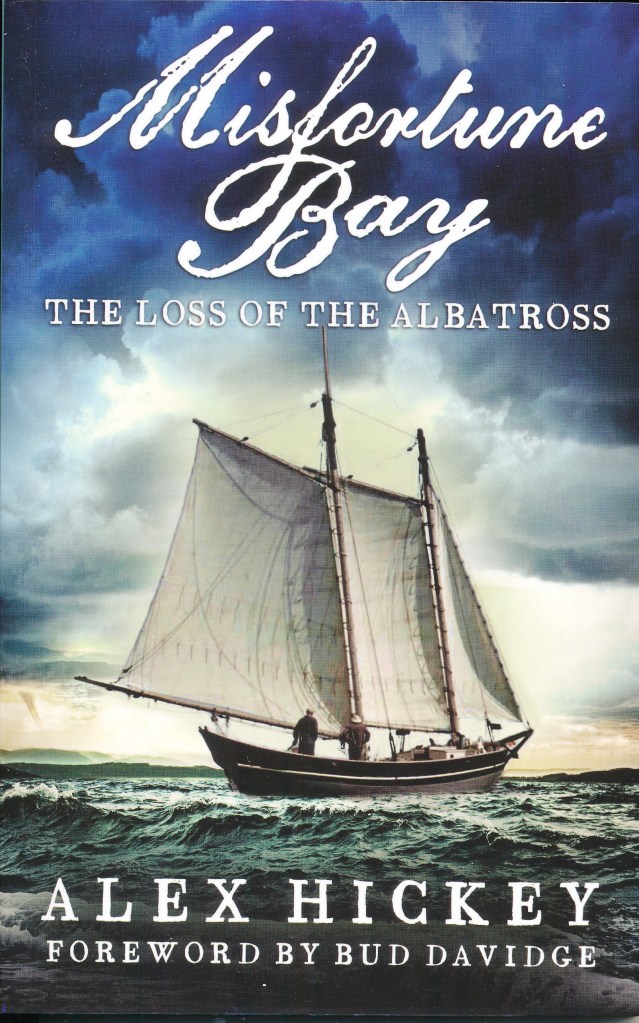
My book, Misfortune Bay: The Loss of the Albatross, is a humble effort to share that story, to keep its impact alive in current memory, and to introduce younger generations to those events. The South Coast is often referred to as ‘the forgotten coast.’ It isn’t so much forgotten as under-told. We have stories, heritage, history and a strong living culture. Unlike other parts of Newfoundland and Labrador, many of our stories have remained local. In this book I hope I have contributed to shedding a little light on Fortune Bay. If you haven’t read it yet, it is available at Public Libraries across the Province, local bookstores, many Gas Stations and online at your favourite booksellers. If none of these are accessible to you, get in touch with me through my Blog, All Things St. Jacques and we will work something out.
When we read, write, take photographs, explore the environment, and think about world events or family matters, we do so with a point of view, a way of viewing things. It’s the standpoint or position from which we look at things. If the thing before us is complex we may look at it from multiple points of view to achieve a better understanding. When I was writing Misfortune Bay: The Loss of the Albatross, I spent a lot of time thinking about the main characters and the people who loved them and who they loved in turn. Tragic events such as the one that befell the men in this story didn’t happen in isolation from their wives, mothers or children.
Keturah Fitz-Gerald, wife of Conrad, is away visiting her family in the hometown of her parents in Cape Breton at the time of the incident. Her presence is felt through her formal flower garden, Conrad’s reflections about where she sat at the table, and flashbacks and memories of the narrator and other events such as having one of her sons overseas fighting in WWI. We see her in earlier times and get to know her before the tragedy takes place. That way, as readers, we can infer her response, consider how she might have felt, and think about how she might have reacted when the news reached her. We place ourselves in her point of view.
The Tibbo brothers, Alec and George are married. We meet Elizabeth, Alec’s wife, through his recollection of her making his favourite meal of boiled salt-back pork and cabbage. That recollection serves to bring her alive. We see her as a woman of humour who enjoys the repartee between them. We also find out she is from Harbour Breton, where her experiences with food were different., Bridgette, married to George, is a more serious woman of Scottish ancestry, a midwife who has birthed many of the children of her community. When we meet her she is attending pregnant Monica Lynch, wife of Barry, engineer on the Hump, whose ship will come into conflict with the Albatross on which Bridgette’s husband is serving that night. She comes across as a bit austere, a hard worker, empathetic, intuitive and very competent.
Fanny Clinton is introduced to the reader at the point when she and her daughters find out that the vessel carrying her husband, Harry, has capsized. She finds confidence in putting on her husband’s cardigan and the warmth from her children’s bodies. We witness her biting down hard and retaining composure to give her daughters strength, and then turn to her religious beliefs to find solace and support.
Bess Burke was a Hearn who grew up in Harbour Breton. The events that unfold for her happen through her looking out the windows of her kitchen. She likes black tea, unlike other women in the community, sips it even when it gets cold and likes to think of where in the world the tea was grown. Most of what we learn about her is through her thoughts and actions. She has a large family, one of whom is Purser on the Hump. She is also revealed through her husband’s reflection of her presence with him, the light keeper on St. Jacques Island, who is a volunteer member of Fitz-Gerald’s crew searching for Clinton and Ryan.
Marcella Ryan is a mother of two girls, whom we meet through reference. Our knowledge of Marcella comes about indirectly through the story of her unfortunate death, its impact on her husband, Phillip and how that event affects the narrator and the guide, Stephen Bernard, who witnessed the incident. Although she comes to us through the point of view of these men, our true understanding of her as a mother and wife lies in the circumstances of where she lives. This pushed the reader to see her life from her point of view.
As we approach a day which for many celebrates the roles of mothers in our lives, it is important to remember the mothers of our past.
In Misfortune Bay I attempted to bring out the personalities and views of these women as wives, mothers and sisters. I didn’t invent them. They were real people who lived, loved and contributed to the lives of many, supported their community, worked for others and themselves, and saw the world through their own eyes. Based upon interviews, written recollections of them, and records of their lives and the lives of their peers, I re-imagined them. Are my characterizations completely accurate? Probably not! However, I have attempted to capture enough of them for you, the reader, to see them, to glimpse the lives they lived and to reflect on the story from their points of view.
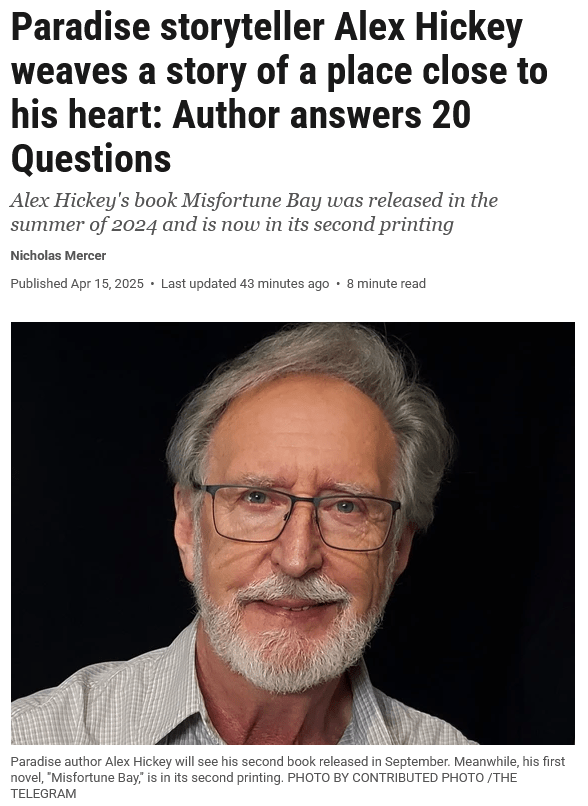
The Telegram’s Nicholas Mercer conducted a Twenty-Question interview with me for the April 15th edition. It was a delightful activity and a most enjoyable interview with Nick. I’ve done interviews with him before, and every time it has been as professional as it gets. He brings to the conversation insight and genuine interest. Below is an image, a screenshot, of the lead to the story. At the bottom of the image is a direct link to the story.
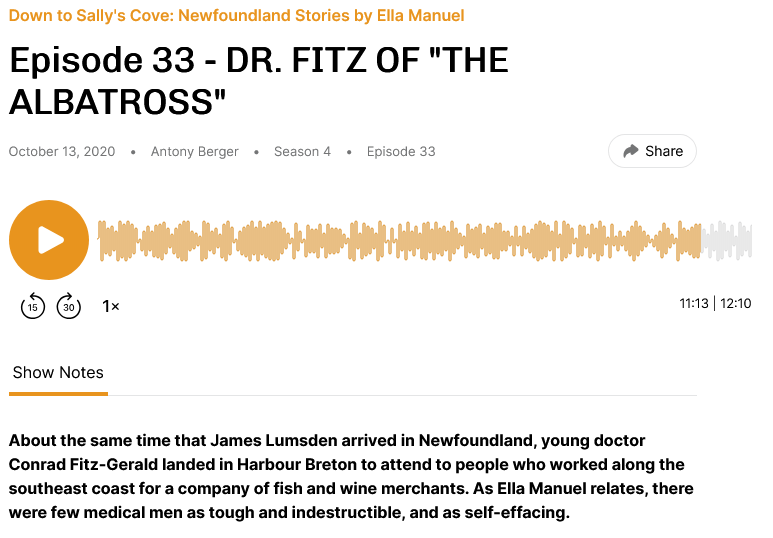
Antony Berger published No Place for a Woman in 2020. This was a collection of writings by his mother, Ella Manuel. Later, he created a Podcast Series around that book, called Down to Sally’s Cove. One of these podcasts features a piece on Dr. Conrad Fitz-Gerald of St. Jacques. My book, Misfortune Bay: The Loss of the Albatross, from Flanker Press Ltd, tells one story of this man that took place in 1916.
Ella Manuel was born in Lewisporte. She left there in the 1920’s and eventually returned to Newfoundland in 1945 and settled in Bonne Bay. She wrote articles for newspapers and magazines as well as radio scripts. She worked the CBC from 1953 to 1969 and through radio became known across the country. Besides writing radio commentaries and pieces on social issues, she had several fictional works for young people appear in anthologies.
These are stories of remarkable men and women; travels on fishing vessels and coastal steamers; medics, missionaries, and military men who came from England in the late 1800’s; and many other tales that reflect the culture, tradition and language of Newfoundland.
Only one recording of her broadcasts still exists, so her stories are being read by Antony Berger.
In Episode 33 of this podcast series, Ella Manuel gives us a wonderful description of Conrad Fitz-Gerald as a man, a sailor and a doctor. She captures the spirit and dedication of this medical pioneer who unselfishly dedicated his life’s work to serving the people of Fortune Bay from his land-based clinic and from his thirty-foot custom-designed medical schooner, The Albatross, built for him by master builder John Cluett of Belleoram. From 1873 to 1900 he worked out of Hr. Breton. Upon retirement, he relocated to St. Jacques, a more central location that gave him better access to most communities around the bay. There, he built a three-story home and medical clinic and ministered to people until he died in 1939. Conrad, and his wife Keturah Partridge, are buried in a corner plot in the graveyard of St. Michael and All Angel’s Church in St. Jacques, Newfoundland.
Have a listen to Anthony Berger read this extraordinary piece of insight into this remarkable man.
Once we get the sugars of Halloween out of our system many of us turn our attention to Christmas for our next fix. Oh, and it’s sugary alright. Depending on how you view Christmas it’s a time for some of the most saccharine moments, nostalgic images, traditions, rituals, religious observances, giving and receiving, an occasional Scrooge, card exchanges, gatherings of family and friends and reminiscing of Christmases past. We are never very deep into November when the first seasonal songs hit the radio airwaves, not to mention the advertising or stores stocked with decorations and toys. Though some complain that it starts too early, others have been waiting for months to get started. There are those who will say, ‘By the time Christmas gets here, it’s over.’ Others prolong it well into the New Year. Whether it is the three days of December 24-26, the traditional 12 days or the entire month of December, all share a common thread – music.
Why is it that most of the songs we hear on the radio, add to our playlists, or sing together at this time of year are standards from earlier years. It’s not uncommon to hear a 1940’s version of White Christmas, juxtaposed with a 60’s version of Little Drummer Boy or an 80’s rendition of Silent Night. Many of the current mixes and remixes, though they may carry contemporary rhythms, are new treatments of songs we’ve heard many times before. That’s not to say there haven’t been any new Christmas songs in recent years, for there have been many. Some have caught our attention while many more linger on the periphery.
It feels a little trite to say that Christmas is not like it was, for that’s absolutely true. People change, customs evolve, institutions come and go, rituals fall out of practice, new attractions displace old ones and sales efforts by manufacturers of Christmas paraphernalia are updated to keep their products fresh. I have several decades of Christmases to remember. None of them were the same. Time marches to a louder and more persistent beat than that of the Little Drummer Boy and people whom, as children, we thought would be with us forever, make their involuntary exits. Presence is valued at Christmas thus absences are vividly noticed. Yet, we go on and Christmas is adjusted to a new reality each time.
Our favourite Christmas songs and those we attribute to others also change. I really don’t know what my mother’s favourite song was. However, I have heard several such as An Old Christmas Card, Silent Night, Winter Wonderland and Silver Bells put forward as her favourite. Whichever song it was, and in which year it was recorded, matters little for we never seem to let them go. As a child I was fascinated by Western films, especially those with singing cowboys such as Gene Autry. My ears perk up every year when I hear Up On the Rooftop. It takes me back. And that is the secret of success for most Christmas Songs.
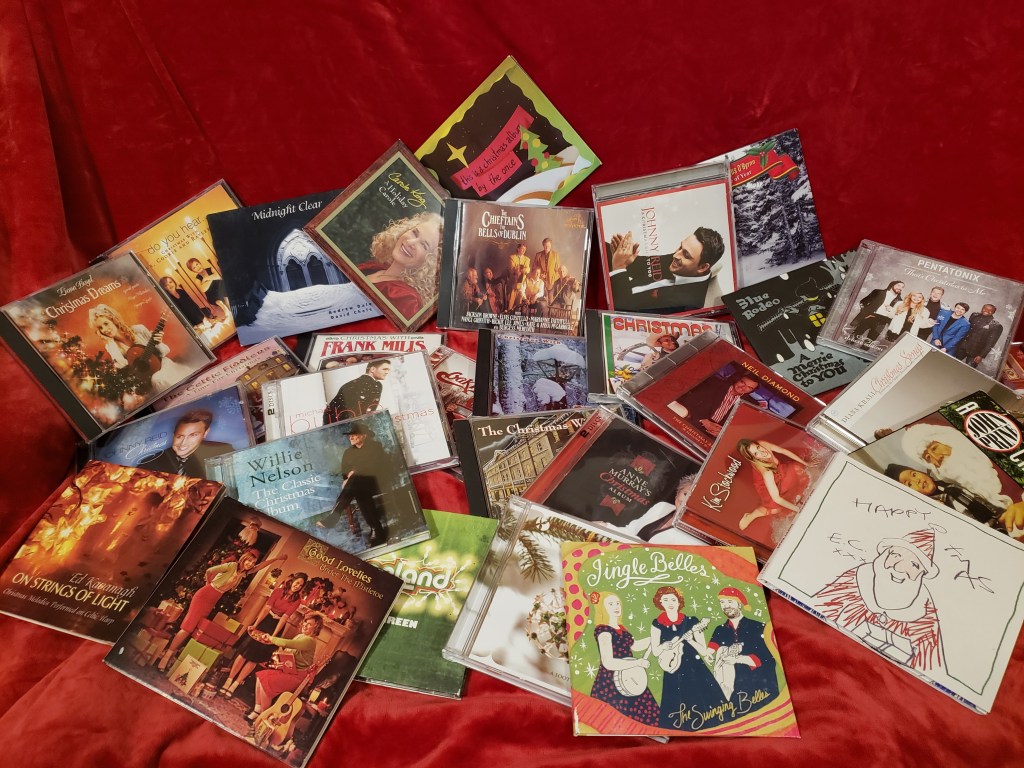
They take us back to earlier times, evoke memories, cause us to recall special events, stimulate warm feelings and remind us of people we love. That’s why it is so challenging for recording artists to establish new favourites. The competition is quite stiff and the familiar is ingrained in our emotions. People will bemoan the fact that there don’t seem to be very many new Christmas songs. The next time you hear that, check out their music collection whether it be LP’s, CD’s, or streaming lists. You won’t be surprised at what you’ll find.
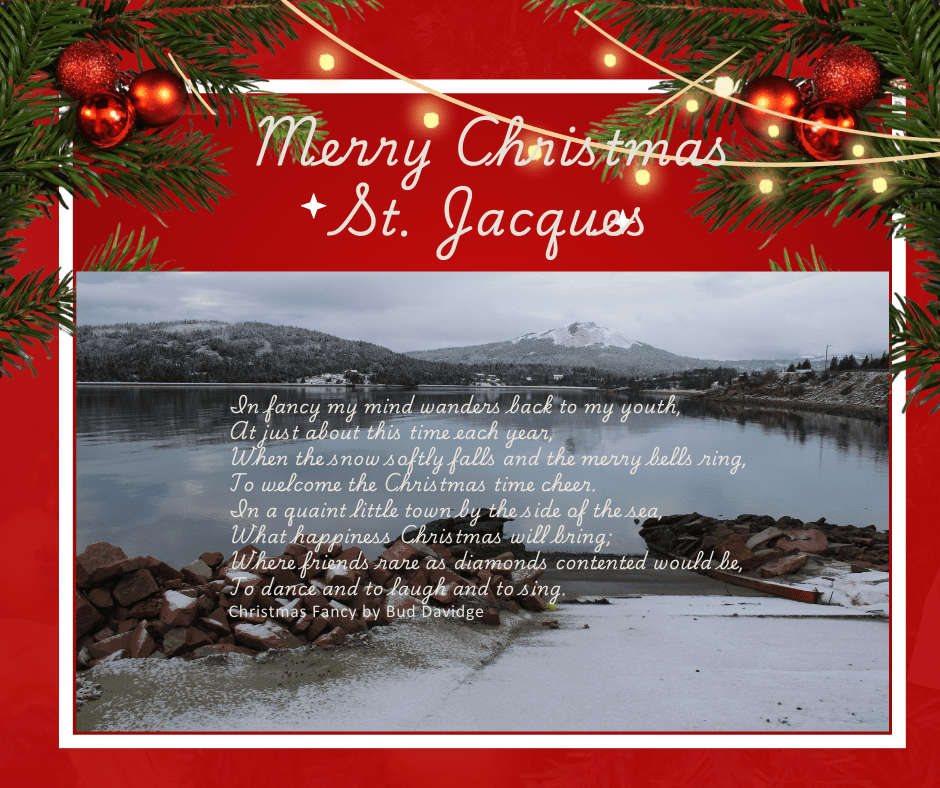
Country singer Jim Reeves has been dead for 60 years, yet when we hear him say “I don’t know why I get to feeling sentimental about this time every year,” most of us can identify with the observation. It’s part nostalgia, a little bit of longing for the past and the childhoods we have constructed for ourselves. Here at home in Newfoundland we have elevated a song by Bud Davidge to ‘classic status’ so much so that it can be heard at almost any time of year when families get together. “Any Mummers Allowed In,” is frequently used to open the floodgates of Christmas music on local radio stations. Children and adults of all ages can sing along, sway and smile, even if they’ve never seen a mummer or experienced mummering at any point in their lives. It’s more than a local favourite. For those who have experienced it, the opening line, ‘Hark, what’s the noise outside the porch door,” evokes a past steeped in faces of yesterday, of simpler times, of entertainment that came from within communities devoid of mainstream media influences. Davidge has written many other comparable and better Christmas songs but this one has struck a chord in the lives of many.
It is the song, yet it isn’t the song. It’s what the song evokes. Like the “Mummers Song,” when it reaches back and brings something forward in our memory we latch on to it. Others, like this year’s new Christmas songs may take twenty years to become fondly remembered and played in rotation. When you hear the first few piano notes of “A Charlie Brown Christmas,” how can you not smile. The power of song to bring alive the Christmas feeling is unrivaled. This year as you listen to your favourites give some thought to why they are your favourites. What do they bring to mind? Why? Have a conversation with a friend about the impact those songs have on you and the Christmas Spirit. Most of all, sing! Sing to the top of your voice in the shower. Attend a musical performance. Join in a sing-a-long at a neighbour’s house. Sing your favourites and squeeze every bit of joy out of them that you can.
It is strange how a man believes he can think better in a special place. I have such a place, have always had it, but I know it isn’t thinking I do there, but feeling and experiencing and remembering. It’s a safety place. Everyone must have one, although I never heard a man tell of it. John Steinbeck
Where are you when your eyes fix blankly on prospect, your brain disengages, untethered sounds drift in and out of consciousness, air passing through your nostrils is laden with subtle scents, sensations, and memories, and time sheds its heavy cloak?
The experience can be triggered by a sound, a thought, a comment, a feeling, a word, a painting … and when it happens we are whisked away from our physical presence into a place where no one else exists. We become oblivious to those around us and return only when the spell is broken by an intrusion. Steinbeck’s ‘special place’ is part of this. All of our special places are. Some of them are geographic, others cultural, while more are emotive, the product of imagination.
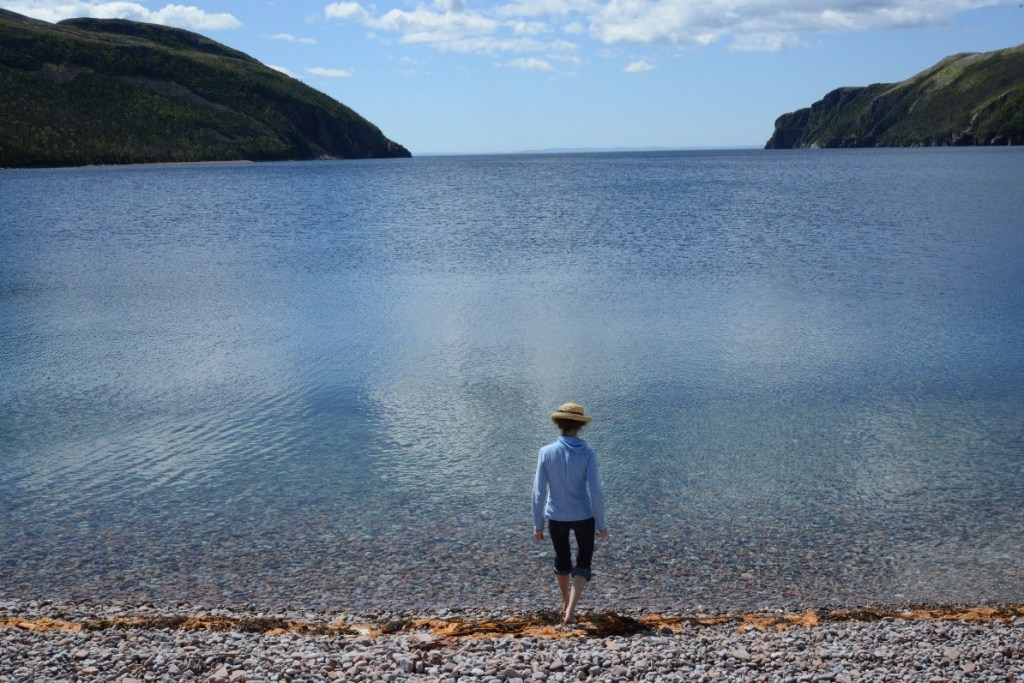
The seaport of St. Jacques in Fortune Bay is one of my ‘special places.’ Just being there enhances my sense of being, reminds me of who I am and the forces that shaped me thus. It is there I find myself staring off into space ‘feeling and experiencing and remembering.’ Nearby is the resettled harbour of Blue Pinion whose pebbled beach seems to have been created solely for sitting and staring. I share it with many who venture down the trail from the highway, however, rarely is there anyone else to be seen when I visit. It’s a place I like to take visitors. On a sunny day, summer or winter, the ocean invites one’s eyes to see beyond the horizon, to invoke that place Milton described where Eden and all the coast in prospect lay.
Jessica Levman wading in Blue Pinion Harbour. Photo Credit Alex Hickey
One of the people I took there last year was a dear friend, a spirited and intuitive artist, a teacher, one whose curiosity soars beyond the immediacy of the environment and encompasses meaning, feeling, and transcendence. Jessica Levman lives and works in Toronto most of the year where she combines studio production with a passion for teaching children. She, too, has a special place, both geographic and emotive where her city-based feet frequently sprout wings and fly. Overlooking the wild, tumultuous harbour of Flatrock, Newfoundland, Jessica can gaze over the top of her easel at an uninterrupted vista that stretches from Newfoundland to the Azores where swelling waves of the North Atlantic pulse like a Tantric heartbeat against a resistant granite shore.
Whales slap their formidable tails at her, the Grand Banks roll perpetual dense walls of fog up the hillside to envelop her shelter, fierce winds whip the sea into a frenzy and spew salt spray across her windows, while on other days the elasticity of the ocean relaxes and settles into a mirror of the sky. All the while her eyes record, her heart reflects and her hands create. Recently, she exhibited a body of such work at the Emma Butler Gallery in St. John’s. The show, organized in three views, Widening Circles, Surge, and Flatrock Tapestries, offered challenges to all senses
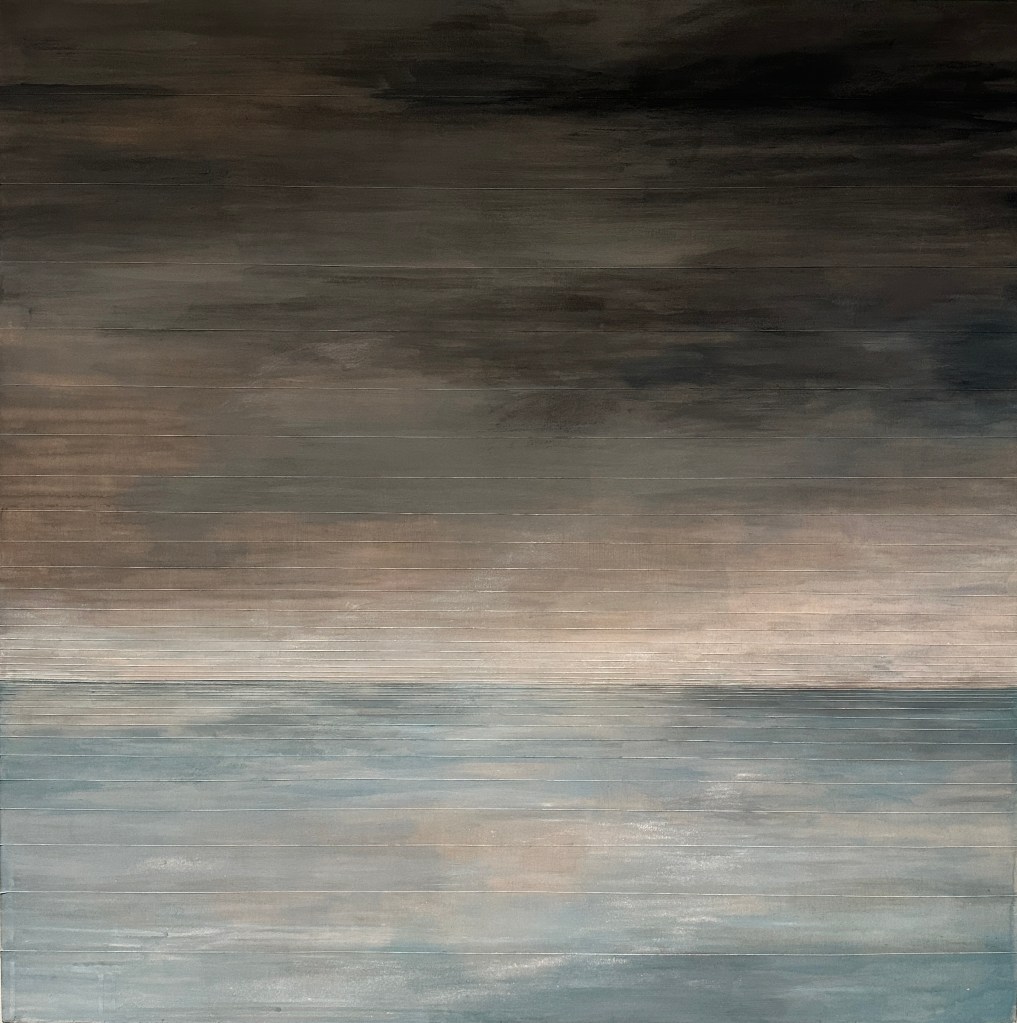
Joseph Addison wrote in Remarks on Several Parts of Italy (1718), “There is a very noble prospect from this place: on the one side lies a vast extent of seas, that run abroad further than the eye can reach: just opposite stands the green promontory of Surrentum, and on the other side the whole circuit of the bay of Naples” (p. 348). Whether Jessica is standing on a beach in Blue Pinion or leaning against a veranda post in Flatrock her intense gaze gathers, analyzes, and interprets. Visible in her mind are all those elements and forces which lie below the surface of the sea and beyond the blue of the sky. Days, weeks or months later they emerge back into the world and are given three dimensional presence on two dimensional surfaces. I sat for a full ten minutes on a bench at the Butler Gallery before a work titled, ‘Widening Circles VI, 2023.
Widening Circles VI, 2023 Gouache, acrylic, chalk pastel and string on wood panel 36 x 36
My view was blocked now and then by twenty-seven second intervals but not enough to break my concentration. After a while, sea and sky began to flip, stretch into one another and flow up and down the panel. Strings, visible upon close examination, vibrated at my distance, harp-like, resonating with sinew and bone inviting me to see, hear, smell and gingerly sway to the barely visible rhythms of the ocean. Their progression into the sky addled my thoughts of what constitutes a horizon line. For an instant, I felt like the artist was playing a game of cat’s cradle with me, shifting the lines each time they coalesced. Then I realized that she was asking me to see differently, to challenge my everyday assumptions of sight and explore with her how these lines blur and morph when you look below the surface or above the blue. They were an entrance, a ladder to either climb or descend. I walked around the gallery, lost in thought, then returned for my twenty-seven seconds and a smile.
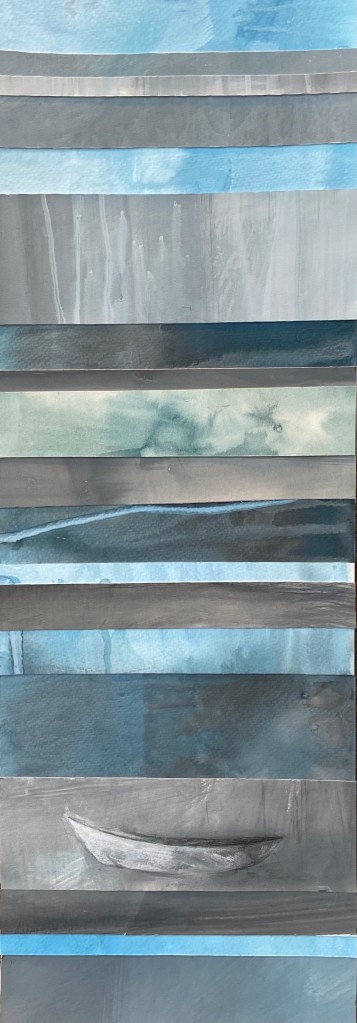
Flatrock Tapestry II, 2021 Chalk pastel, gouache, acrylic and collage on paper 28.5 x 9.5
The Flatrock Tapestries were well-titled – suggestive and inviting. In the same manner in which the Bayeux Tapestry chronicles 900 years of Norman occupation of England, these lead us through the artist’s occupation of her special place and provides us with a graphic glimpse into the collective body of work which has emerged during that occupation. The unique story-line of each piece, echo not only the artist’s journey but, places before us images which speak distinctly for the environment – the sea, its people, their boats, their habitat and that of the fish they seek, all steeped in elusive shades of blue. It’s much the same blue one sees at the horizon, between earth and space, and in the waves which wash Newfoundland’s shore. One can stare at it for days and believe it tangible yet every glass of water from the ocean is transparent and the horizon retains its distance with each step.
Acrylic, watercolour, conté, charcoal, gouache and chalk pastel are all enlisted to work together to capture the atmospheric and marine environment which dominates the view from her studio. Each piece is composed of even, horizontal strips of paper collaged into a unique story. Read them individually, forward, backward, up or down, or as a complete body of work; the ending is the same – you stand in awe of the visual capture of what it means to stand on this shoreline and absorb its wild beauty.
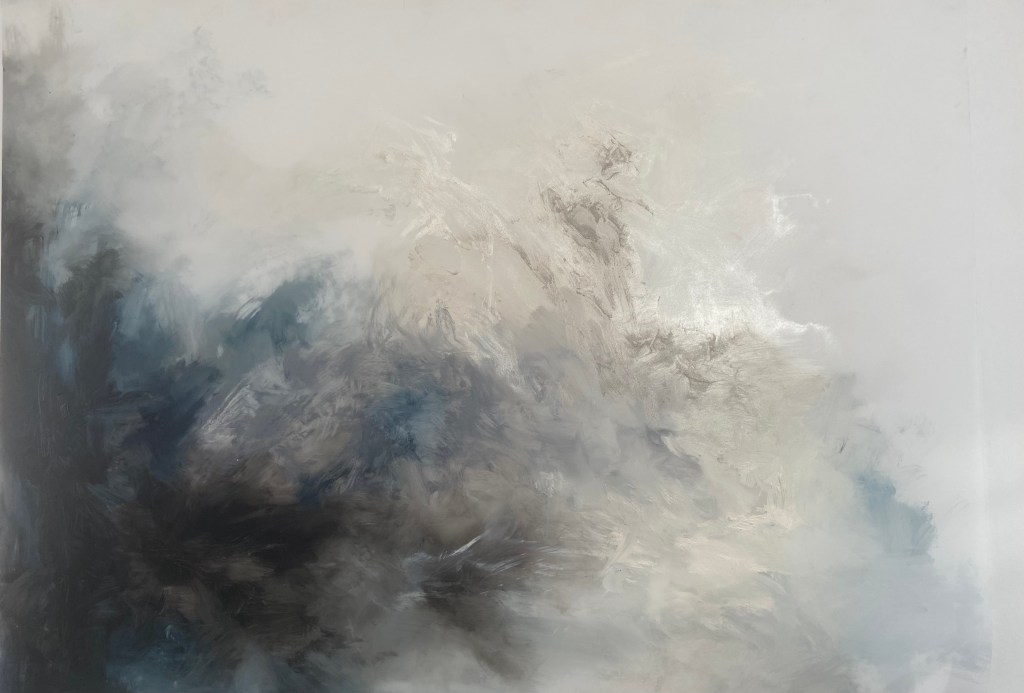
Then there’s the third element of this visual feast – The Surge Series, which the artist says, “was inspired by the Newfoundland spring, a world full of movement and force as nature wakes up, unfolds or unpacks itself, circling back to life … to reflect this vitality and vibrancy, the feeling of being alive.” There is little room to argue with this for all of the images are abstract, reconstructions of sight, thought, imagination and emotion. At Opening Night I listened to two viewers standing before a piece titled Requiem.
Requiem, 2023 Oil and oil stick on mylar 19 x 25
Question: What do you think this one is all about? I admit I don’t know much about abstract art. This one is perplexing.
Answer: The title gives us a clue – Requiem. The questions is requiem for what? When I look at it I see the aftermath of a large ocean wave having hit bluntly and forcefully against a rocky shoreline and smashing itself into a mass of foam and droplets. We are seeing it from below the point of impact hence the darkened shades. It is no longer a wave, despite it having all of its constituent parts. It has been transformed by the shoreline and the impact. It looks nothing like its former self. The gradual, flowing, lifting shape of water that rose into a majestic wave has been decimated by its foe. On the one hand it is the end while on the other a new beginning. The water will retreat, reform and try again. This time it will look different. So, to go back to the question, a requiem for what? Is it a testimonial to the wave, what waves have done with erosion, what waves have done to coastal habitats, or what waves have done to human lives?
The artist is asking us to think about these things. She is not offering an answer and it’s in that space between question and answer that she places us, the viewers.
I smiled inwardly and waited for them to move to the next piece so I could think about what I’d just heard. It was while I examined the details of Requiem that I realized how successful Jessica Levman had been in penetrating our consciousness as viewers. All of us in that space, that day, were undergoing change, an awakening like springtime in Flatrock. Amid the primordial forces that shape those special places, we find sanctuary.
I was taken back to Blue Pinion where families lived, worked, cried and laughed during the 1800’s, to the quiet call to reflection that bounced off the water, the beach and the hillsides. I remembered the day Jessica Levman stood at the ocean’s edge, then waded ankle-deep into the edge of the harbour, the ripples from her feet widening across the flat calm surface. Her choice to stand in that water, in that place, at that time on that day made the place special to her. Seeing her work at the exhibit in the Emma Butler Gallery reminded me of the extraordinary beauty of the environment around us here on the south coast of Newfoundland and how all of us have special places to go in our bodies, our minds and in our hearts.


 All Things St. Jacques, NL