Alex Hickey, 08/16/2024
It is strange how a man believes he can think better in a special place. I have such a place, have always had it, but I know it isn’t thinking I do there, but feeling and experiencing and remembering. It’s a safety place. Everyone must have one, although I never heard a man tell of it. John Steinbeck
Where are you when your eyes fix blankly on prospect, your brain disengages, untethered sounds drift in and out of consciousness, air passing through your nostrils is laden with subtle scents, sensations, and memories, and time sheds its heavy cloak?
The experience can be triggered by a sound, a thought, a comment, a feeling, a word, a painting … and when it happens we are whisked away from our physical presence into a place where no one else exists. We become oblivious to those around us and return only when the spell is broken by an intrusion. Steinbeck’s ‘special place’ is part of this. All of our special places are. Some of them are geographic, others cultural, while more are emotive, the product of imagination.
The seaport of St. Jacques in Fortune Bay is one of my ‘special places.’ Just being there enhances my sense of being, reminds me of who I am and the forces that shaped me thus. It is there I find myself staring off into space ‘feeling and experiencing and remembering.’ Nearby is the resettled harbour of Blue Pinion whose pebbled beach seems to have been created solely for sitting and staring. I share it with many who venture down the trail from the highway, however, rarely is there anyone else to be seen when I visit. It’s a place I like to take visitors. On a sunny day, summer or winter, the ocean invites one’s eyes to see beyond the horizon, to invoke that place Milton described where Eden and all the coast in prospect lay.
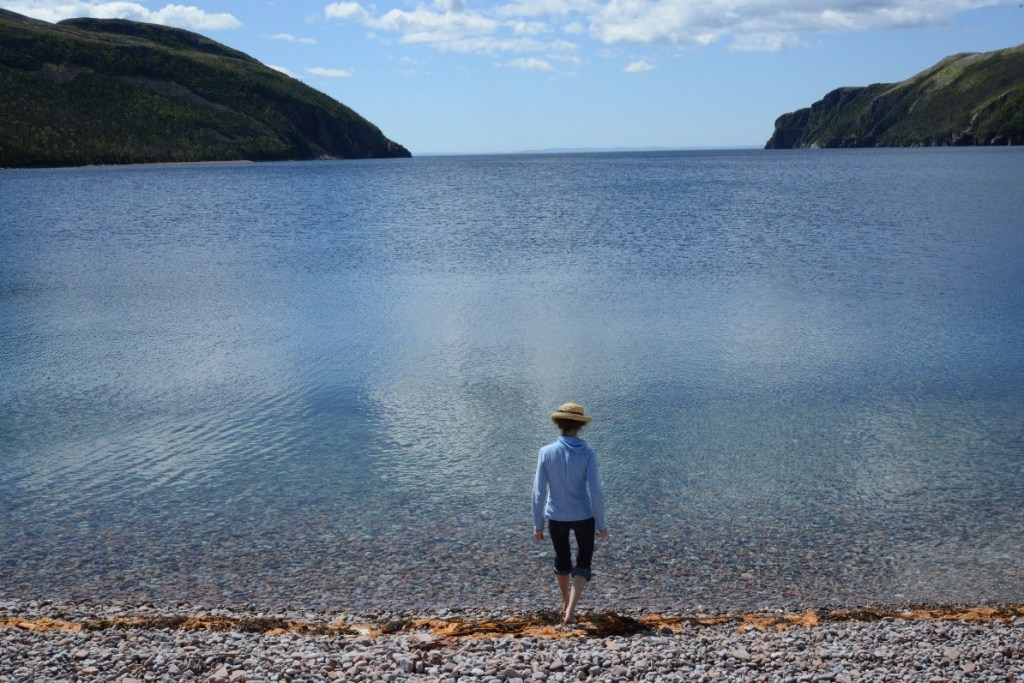
One of the people I took there last year was a dear friend, a spirited and intuitive artist, a teacher, one whose curiosity soars beyond the immediacy of the environment and encompasses meaning, feeling, and transcendence. Jessica Levman lives and works in Toronto most of the year where she combines studio production with a passion for teaching children. She, too, has a special place, both geographic and emotive where her city-based feet frequently sprout wings and fly. Overlooking the wild, tumultuous harbour of Flatrock, Newfoundland, Jessica can gaze over the top of her easel at an uninterrupted vista that stretches from Newfoundland to the Azores where swelling waves of the North Atlantic pulse like a Tantric heartbeat against a resistant granite shore.
Whales slap their formidable tails at her, the Grand Banks roll perpetual dense walls of fog up the hillside to envelop her shelter, fierce winds whip the sea into a frenzy and spew salt spray across her windows, while on other days the elasticity of the ocean relaxes and settles into a mirror of the sky. All the while her eyes record, her heart reflects and her hands create. Recently, she exhibited a body of such work at the Emma Butler Gallery in St. John’s. The show, organized in three views, Widening Circles, Surge, and Flatrock Tapestries, offered challenges to all senses
Joseph Addison wrote in Remarks on Several Parts of Italy (1718), “There is a very noble prospect from this place: on the one side lies a vast extent of seas, that run abroad further than the eye can reach: just opposite stands the green promontory of Surrentum, and on the other side the whole circuit of the bay of Naples” (p. 348). Whether Jessica is standing on a beach in Blue Pinion or leaning against a veranda post in Flatrock her intense gaze gathers, analyzes, and interprets. Visible in her mind are all those elements and forces which lie below the surface of the sea and beyond the blue of the sky. Days, weeks or months later they emerge back into the world and are given three dimensional presence on two dimensional surfaces. I sat for a full ten minutes on a bench at the Butler Gallery before a work titled, ‘Widening Circles VI, 2023.
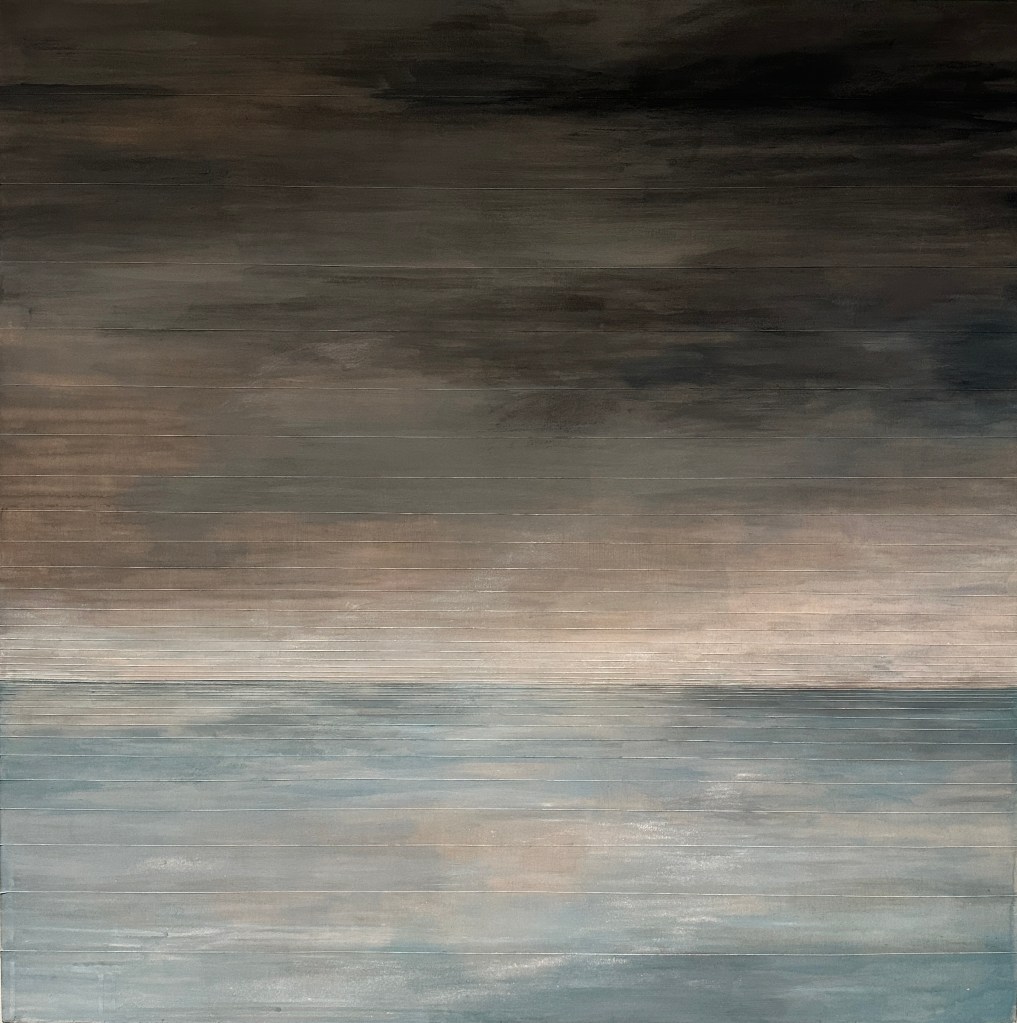
Gouache, acrylic, chalk pastel and string on wood panel
36 x 36
My view was blocked now and then by twenty-seven second intervals but not enough to break my concentration. After a while, sea and sky began to flip, stretch into one another and flow up and down the panel. Strings, visible upon close examination, vibrated at my distance, harp-like, resonating with sinew and bone inviting me to see, hear, smell and gingerly sway to the barely visible rhythms of the ocean. Their progression into the sky addled my thoughts of what constitutes a horizon line. For an instant, I felt like the artist was playing a game of cat’s cradle with me, shifting the lines each time they coalesced. Then I realized that she was asking me to see differently, to challenge my everyday assumptions of sight and explore with her how these lines blur and morph when you look below the surface or above the blue. They were an entrance, a ladder to either climb or descend. I walked around the gallery, lost in thought, then returned for my twenty-seven seconds and a smile.
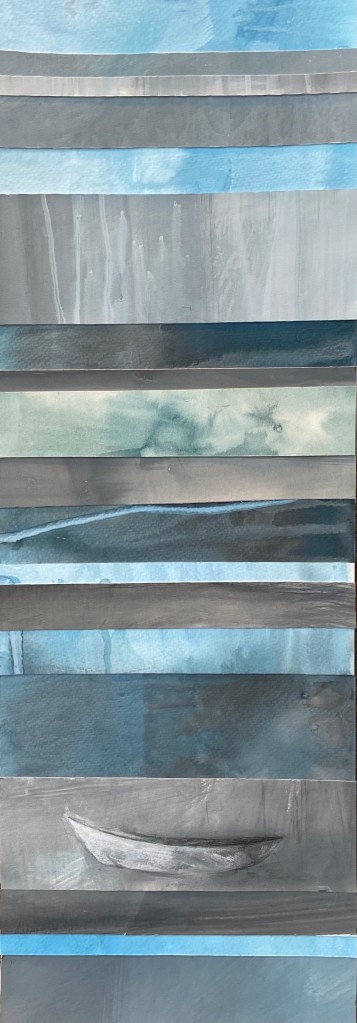
Chalk pastel, gouache, acrylic and collage on paper
28.5 x 9.5
The Flatrock Tapestries were well-titled – suggestive and inviting. In the same manner in which the Bayeux Tapestry chronicles 900 years of Norman occupation of England, these lead us through the artist’s occupation of her special place and provides us with a graphic glimpse into the collective body of work which has emerged during that occupation. The unique story-line of each piece, echo not only the artist’s journey but, places before us images which speak distinctly for the environment – the sea, its people, their boats, their habitat and that of the fish they seek, all steeped in elusive shades of blue. It’s much the same blue one sees at the horizon, between earth and space, and in the waves which wash Newfoundland’s shore. One can stare at it for days and believe it tangible yet every glass of water from the ocean is transparent and the horizon retains its distance with each step.
Acrylic, watercolour, conté, charcoal, gouache and chalk pastel are all enlisted to work together to capture the atmospheric and marine environment which dominates the view from her studio. Each piece is composed of even, horizontal strips of paper collaged into a unique story. Read them individually, forward, backward, up or down, or as a complete body of work; the ending is the same – you stand in awe of the visual capture of what it means to stand on this shoreline and absorb its wild beauty.
Then there’s the third element of this visual feast – The Surge Series, which the artist says, “was inspired by the Newfoundland spring, a world full of movement and force as nature wakes up, unfolds or unpacks itself, circling back to life … to reflect this vitality and vibrancy, the feeling of being alive.” There is little room to argue with this for all of the images are abstract, reconstructions of sight, thought, imagination and emotion. At Opening Night I listened to two viewers standing before a piece titled Requiem.
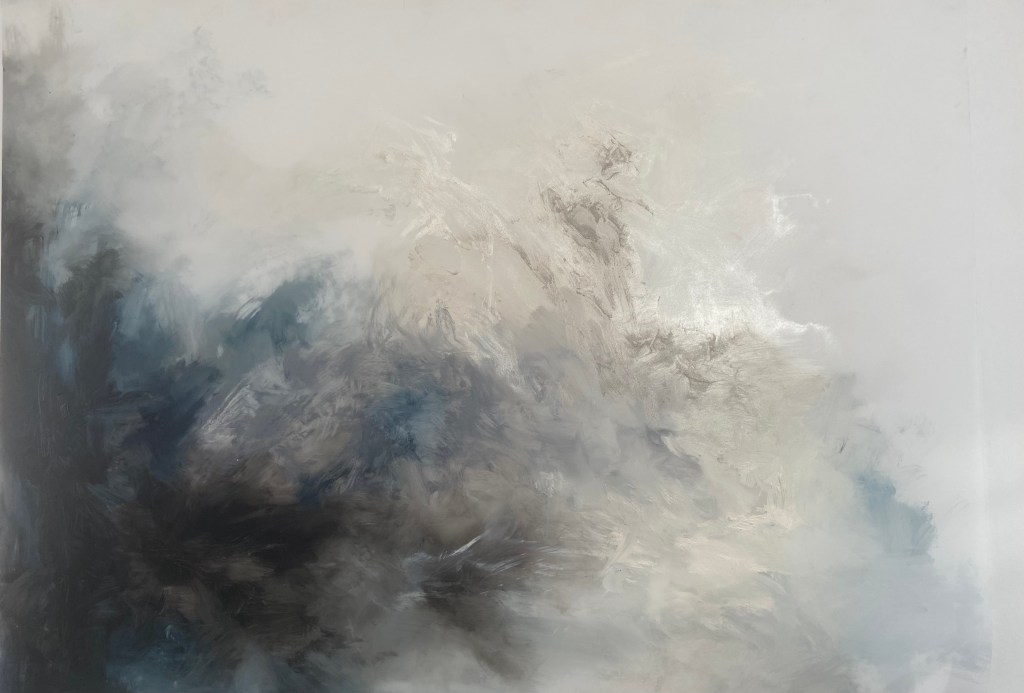
Oil and oil stick on mylar
19 x 25
Question: What do you think this one is all about? I admit I don’t know much about abstract art. This one is perplexing.
Answer: The title gives us a clue – Requiem. The questions is requiem for what? When I look at it I see the aftermath of a large ocean wave having hit bluntly and forcefully against a rocky shoreline and smashing itself into a mass of foam and droplets. We are seeing it from below the point of impact hence the darkened shades. It is no longer a wave, despite it having all of its constituent parts. It has been transformed by the shoreline and the impact. It looks nothing like its former self. The gradual, flowing, lifting shape of water that rose into a majestic wave has been decimated by its foe. On the one hand it is the end while on the other a new beginning. The water will retreat, reform and try again. This time it will look different. So, to go back to the question, a requiem for what? Is it a testimonial to the wave, what waves have done with erosion, what waves have done to coastal habitats, or what waves have done to human lives?
The artist is asking us to think about these things. She is not offering an answer and it’s in that space between question and answer that she places us, the viewers.
I smiled inwardly and waited for them to move to the next piece so I could think about what I’d just heard. It was while I examined the details of Requiem that I realized how successful Jessica Levman had been in penetrating our consciousness as viewers. All of us in that space, that day, were undergoing change, an awakening like springtime in Flatrock. Amid the primordial forces that shape those special places, we find sanctuary.
I was taken back to Blue Pinion where families lived, worked, cried and laughed during the 1800’s, to the quiet call to reflection that bounced off the water, the beach and the hillsides. I remembered the day Jessica Levman stood at the ocean’s edge, then waded ankle-deep into the edge of the harbour, the ripples from her feet widening across the flat calm surface. Her choice to stand in that water, in that place, at that time on that day made the place special to her. Seeing her work at the exhibit in the Emma Butler Gallery reminded me of the extraordinary beauty of the environment around us here on the south coast of Newfoundland and how all of us have special places to go in our bodies, our minds and in our hearts.
 All Things St. Jacques, NL
Lovely description, and tribute to this work. Makes me want to savour it and reflect upon such moments where the stillness is.
By: Deanne on September 14, 2024
at 7:23 pm