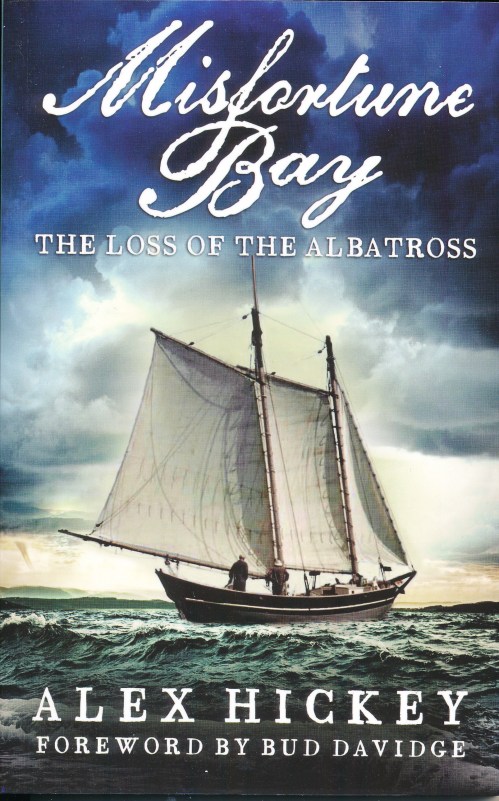
When we read, write, take photographs, explore the environment, and think about world events or family matters, we do so with a point of view, a way of viewing things. It’s the standpoint or position from which we look at things. If the thing before us is complex we may look at it from multiple points of view to achieve a better understanding. When I was writing Misfortune Bay: The Loss of the Albatross, I spent a lot of time thinking about the main characters and the people who loved them and who they loved in turn. Tragic events such as the one that befell the men in this story didn’t happen in isolation from their wives, mothers or children.
Keturah Fitz-Gerald, wife of Conrad, is away visiting her family in the hometown of her parents in Cape Breton at the time of the incident. Her presence is felt through her formal flower garden, Conrad’s reflections about where she sat at the table, and flashbacks and memories of the narrator and other events such as having one of her sons overseas fighting in WWI. We see her in earlier times and get to know her before the tragedy takes place. That way, as readers, we can infer her response, consider how she might have felt, and think about how she might have reacted when the news reached her. We place ourselves in her point of view.
The Tibbo brothers, Alec and George are married. We meet Elizabeth, Alec’s wife, through his recollection of her making his favourite meal of boiled salt-back pork and cabbage. That recollection serves to bring her alive. We see her as a woman of humour who enjoys the repartee between them. We also find out she is from Harbour Breton, where her experiences with food were different., Bridgette, married to George, is a more serious woman of Scottish ancestry, a midwife who has birthed many of the children of her community. When we meet her she is attending pregnant Monica Lynch, wife of Barry, engineer on the Hump, whose ship will come into conflict with the Albatross on which Bridgette’s husband is serving that night. She comes across as a bit austere, a hard worker, empathetic, intuitive and very competent.
Fanny Clinton is introduced to the reader at the point when she and her daughters find out that the vessel carrying her husband, Harry, has capsized. She finds confidence in putting on her husband’s cardigan and the warmth from her children’s bodies. We witness her biting down hard and retaining composure to give her daughters strength, and then turn to her religious beliefs to find solace and support.
Bess Burke was a Hearn who grew up in Harbour Breton. The events that unfold for her happen through her looking out the windows of her kitchen. She likes black tea, unlike other women in the community, sips it even when it gets cold and likes to think of where in the world the tea was grown. Most of what we learn about her is through her thoughts and actions. She has a large family, one of whom is Purser on the Hump. She is also revealed through her husband’s reflection of her presence with him, the light keeper on St. Jacques Island, who is a volunteer member of Fitz-Gerald’s crew searching for Clinton and Ryan.
Marcella Ryan is a mother of two girls, whom we meet through reference. Our knowledge of Marcella comes about indirectly through the story of her unfortunate death, its impact on her husband, Phillip and how that event affects the narrator and the guide, Stephen Bernard, who witnessed the incident. Although she comes to us through the point of view of these men, our true understanding of her as a mother and wife lies in the circumstances of where she lives. This pushed the reader to see her life from her point of view.
As we approach a day which for many celebrates the roles of mothers in our lives, it is important to remember the mothers of our past.
In Misfortune Bay I attempted to bring out the personalities and views of these women as wives, mothers and sisters. I didn’t invent them. They were real people who lived, loved and contributed to the lives of many, supported their community, worked for others and themselves, and saw the world through their own eyes. Based upon interviews, written recollections of them, and records of their lives and the lives of their peers, I re-imagined them. Are my characterizations completely accurate? Probably not! However, I have attempted to capture enough of them for you, the reader, to see them, to glimpse the lives they lived and to reflect on the story from their points of view.
 All Things St. Jacques, NL
Leave a comment