Posted by: alexhickey | September 26, 2015

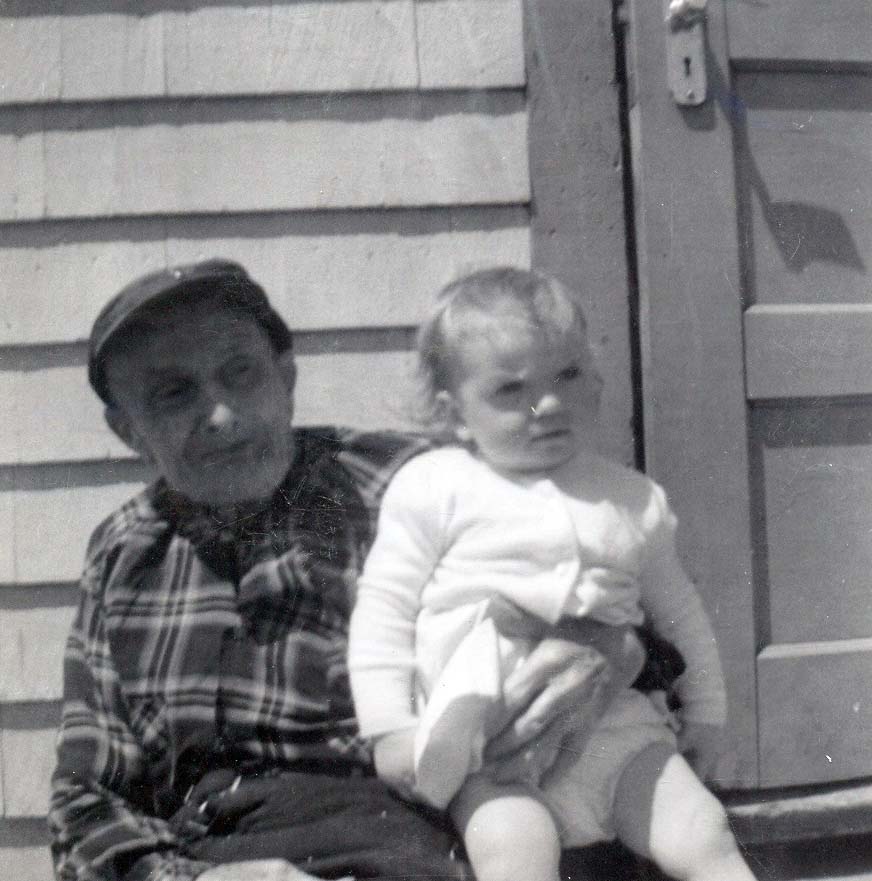
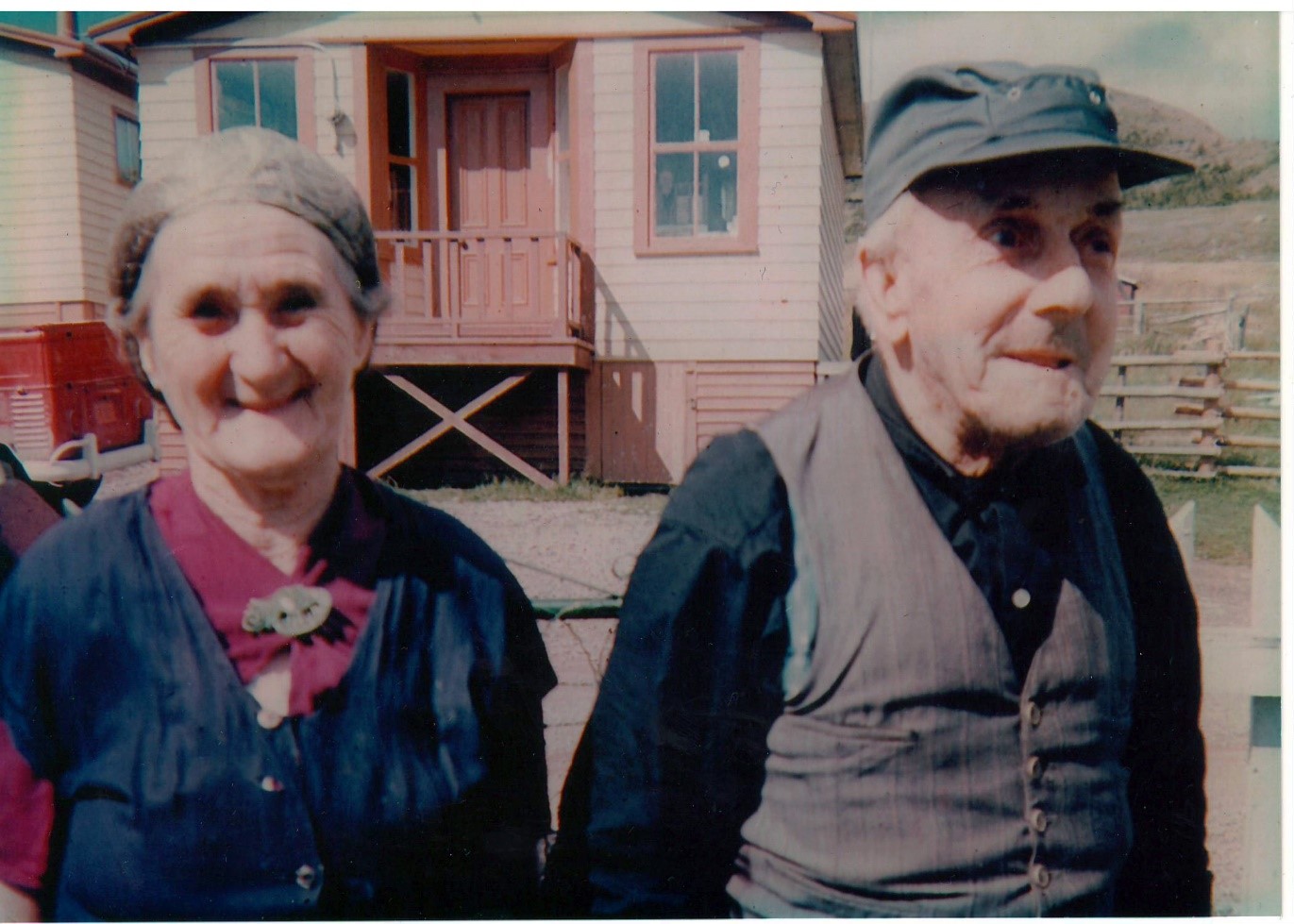
Uncle Joe Bullen ©

Uncle Joe Bullen at 94

Uncle Joe Bullen at 94

John J. Bullen, born Jan. 21, 1873, died May 9, 1974.

The high-back wicker chair creaked contentedly each time he shifted his weight despite there being very little weight to shift. The sound of Uncle Joe’s chair was familiar in the kitchen as was the impenetrable cloud of smoke which enveloped him from time to time. From his corner position he was able to survey all kitchen events, yet say little about the things he observed. Had it not been for the creaking chair or the distinctive odour of Sail pipe tobacco one could easily be oblivious to his daily presence. That was not the case regarding his presence in the family for Uncle Joe`s residency in St. Jacques coincided with the birth and raising of eight children under the roof of Tom and Burnsie Lawrence.

Despite arthritic hands whose knuckles twisted at odd angles, bent that way from years of immersion in winter waters off Bay de L`eau Island, his coordinated grasp of a tobacco pouch and a crooked stem pipe remained as agile as fifty years earlier. Holding the pouch in his left hand he would slowly position the pipe, use the forefinger of his right hand to rake tobacco towards the opening and stuff it into the bowl. Then, carefully he would fold the pouch, lay it aside and transfer the pipe to his left hand. Reaching into his pants pocket he’d rummage until he found a small pocket knife which would be improvised to tamp down the tobacco in preparation for lighting. Clutched in the palm of his hand was a box of Eddy Sure Strike wooden matches. In a single practiced twist of his wrist the match would strike the edge of the box and burst into flame. The same motion carried the match upward to hover above the pipe in his mouth, its flame then drawn downward with each intake of breath. He never used more than a single match to bring his pipe to full glow. After several puffs Uncle Joe was barely visible.

Soon his head, mottled with age spots and wisps of white hairs along the sides, would again be seen from across the room. The look of contentment on his face defied description as his aged frame, now as bent as his pipe stem, settled back into the wicker chair. Where he went when that pipe was under full steam I don`t know; however, I suspect he was at sea, again a young turk with sea legs braced, absorbing the ocean swell, watching the horizon for land, returning home to Bay de L’eau Island to the arms of Eliza and the memories of their two young children who never grew old.
John Joseph, is what his parents christened him. I suspect he was frequently called John Joseph by his mother and others living on Bay de L’eau Island as was the custom during the era in which he grew up. One can imagine listening and hearing boys being called for dinner: Randall Tom, George Sam, John Tom, Silas James and John Ben, with John Joseph standing among them, all preparing to scatter to various houses in the community just long enough to swallow a morsel of food and be off again to the exploits of young boys living on an island.

No one remembers Uncle Joe ever getting angry or upset. He quietly and politely engaged in conversation and offered his assistance to any outdoor activity taking place. He assisted with the sheep, the hens, mending fences and maintaining the property around him. Despite the gnarled knuckles, the bent back and the spindly legs, he remained active and mobile until he was one hundred. On civil weather days Uncle Joe could be seen making his way over Cellar Hill, Red Rail Hill and then to the bridge over Pittman`s Brook for a visit to Edgar Dyett`s General Store. His distinctive posture and walking cane was a fixture moving along that stretch of road for many years. Every time he received his Old Age Pension he would walk to the store and change it into cash where one of his first priorities was always to purchase some little item to give to the children. This token act was a way in which he could repay the kindness and generosity afforded him by the Lawrence family.

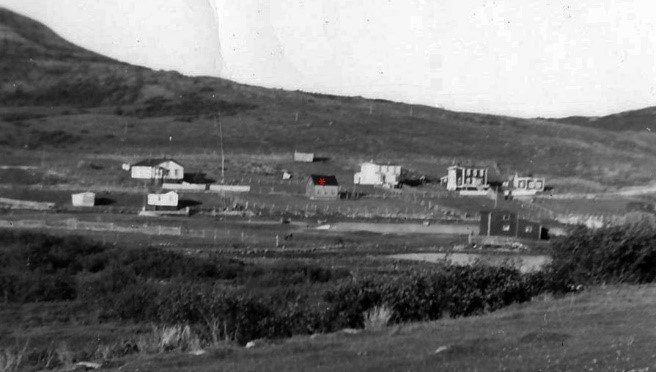
Uncle Joe came to St. Jacques in 1951 when Tom Lawrence moved there from Bay de L’eau Island. Bay de L’eau was being voluntarily resettled as were many of the other small communities throughout Fortune Bay. By then John Joseph Bullen was living alone, an elderly man of seventy-seven without any close relatives and no place to go. There was but one other household left on Bay de L’eau Island by that time and they too were preparing to relocate. The generosity, compassion and character that the people of St. Jacques came to know in Tom Lawrence explained his invitation to Uncle Joe to come live in his new house in his new community. Today, I marvel at the extremely human gesture that was extended that evening on Bay de`Leau Island. I try to imagine what it was like inside John Joseph Bullen`s mind when he realized the enormity of the offer. Knowing the principles and beliefs which guided Tom Lawrence throughout his life I`m certain that Matthew 25:40 wasn`t far from his mind , ‘Truly, I say to you, as you did it to one of the least of these my brothers, you did it to me.’

In addition to a love for tobacco, Uncle Joe had a penchant for Wrigley’s Spearmint chewing gum which then was marketed in packages of five sticks each. Between blissful episodes with his pipe he chewed gum. When he had chewed enough for an occasion he would stick it to his chair within easy reach for future chewing. A few short years before he died he took it upon himself to quit smoking which he was quite successful in doing; however, he probably chewed a little more gum.

He studiously rocked each child in the cradle there in the kitchen near where he usually sat until they fell fast asleep. He did this with the first child and each successive one as they came along. No doubt, this was a grateful act of an old man whose role as grandfather came not from his descendants but from the benevolent act of a neighbour who didn’t hesitate to make room for him to grow into that role.

His worldly possessions were minimal. When he left Bay de L’eau Island he took very little with him; when he left this world he left very little behind, memories, some old clothes, his beloved pipe and that now rickety wicker chair. He had saved enough money to cover his funeral expenses and bestow a small gift upon the family he had grown to love.

Joe Bullen was the first centenarian I ever knew. In fact, Uncle Joe had launched himself into his second century by the time he died. Despite having lost two children to illnesses before they reached the ages of twelve, he was never dogged by illness throughout his life. The first time he ever made a visit to a Doctor was when he fell and broke his arm at age ninety. He didn`t simply stumble and fall to the ground or across a piece of furniture as you might expect. Not Uncle Joe, he wandered in to the garage adjacent to the house where work was being carried out on a car. In order to work safely and comfortable underneath the vehicle an open Pit had been constructed into the floor of the garage approximately four feet deep. The Pit was usually covered by planks, however; on the day Uncle Joe visited, a car had just been removed from the garage leaving the pit temporarily exposed. Without noticing the opening he stepped directly into the abyss. Fortunately he broke only his arm and made a near-miraculous recovery with the arm healing in record time for someone his age.

When Uncle Joe celebrated his one hundredth birthday he was agile and alert. As the children assisted with placing one hundred candles on his birthday cake everyone gathered around had two thoughts in mind – will one hundred candles fit on the cake? And, will he be able to blow them out? As it turned out it took so long to light that many candles that the first to be lit were nearing the end of their fuel supply by the time the last were lit. The cake looked as though it had suddenly burst into flames and was being consumed right before everyone’s eyes. Uncle Joe who had smoked for most of his adult life took a deep breath, and with the gusto if a man determined to show his mettle, blew a breeze across that cake that rivaled any breeze which filled the mainsails of schooners heading out the Bay and left the cake sitting in a cloud of smoke! His was as delighted as every child in the kitchen that day.

He received a letter from the Prime Minister of Canada acknowledging his one hundredth birthday, but more impressive than that to him, was a similar letter from the Queen. In his lifetime the British Commonwealth had undergone tremendous change as had the circumstances of his own life, thus a letter from the Queen of England where, undoubtedly his grandfather had lived at one time, was as much mystifying as it was appreciated.

Resilience characterized the life of Uncle Joe Bullen. His life as a young man is not known to us in great detail anymore and the community in which he worked, married and sired children has dispersed and disappeared. However, the latter portion of his life was lived in the midst of a community where everyone knew and accepted him. For twenty-three years he looked out over St. Jacques Harbour, watched members of a new family grow into adults, enjoyed the comfort and care of an adoptive home, and witnessed phenomenal technological change – all at a stage of life that is well past the experience of many people.

1921 Census – Bay D`Leau
1935 Census – Bay D`Leau Island
World Events of 1873

Posted by: alexhickey | August 5, 2015

South Coast Arts Festival: The Early Years ©

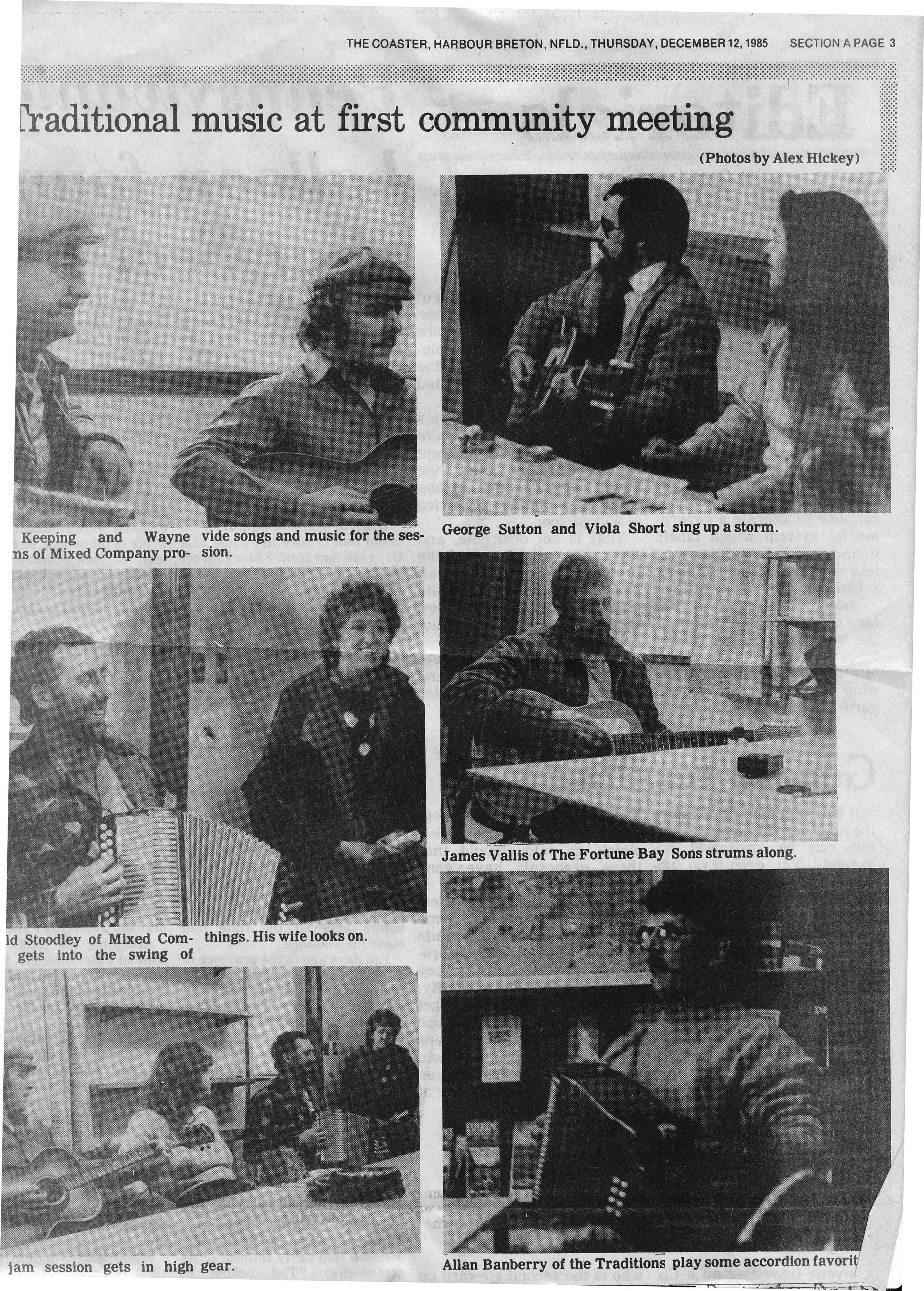
Thirty years ago a small group of volunteers gathered in the South Coast Regional Development Association Office on the Intersection of the cross-country road and the Harbour Breton highway. That evening, amidst, the ringing strings of guitars, the melodious accordions, and jovial storytelling a new daring organization was born. Never had there been anything like the South Coast Arts Community (SCAC) anywhere on the Connaigre Peninsula. That was December, 1985.

First Meeting of the SCAC, December 1985

First Meeting of the SCAC, December 1985

Those sitting around that table were bold enough to say they would represent the communities from Rencontre East to St. Alban’s to promote all forms of the arts along the coast. Membership ebbed and flowed as with all organizations with representatives from Milltown, St. Alban’s, Hermitage, Pool’s Cove, Belleoram and the communities within St. Jacques-Coomb’s Cove over time. There were those who cheered the group for their vision and there were those who predicted its demise.

That evening dreams of art exhibits, theatrical performances, dance, musical events and film making were placed on the table. Nothing was out of bounds to the group buoyed by hope and determination. There was animated discussion and a decision to organize and host a music festival that would take in performers from all along the coast. It would be a showcase of the rich musical heritage this coast has been known for. The Hangashore Folk Festival was in its heyday; Brimstone Head was just getting started and the Bannerman Park Folk Festival was well underway.

The Festival was originally envisaged to be a travelling event which would alternate between Milltown, Hermitage, Harbour Breton and St. Jacques. The first one was held in Milltown adjacent to the Lions Centre, our stage the back of a flatbed truck, set against a background painted by students at the community centre in St. Jacques and trucked to Milltown for installation. A single 10 x 10 platform before the stage served dancers well while the blustery gusts of wind blasted sand throughout the valley. There was excitement in the air as the first event got underway. From the stage it was easy to see the many folks from ‘down over the road’ who had made the trip to be in this first audience. It could be nothing but a success.

The second festival was hosted by Hermitage adjacent to the local Lions Club. Again there was excitement as our members from the Hermitage area worked hard to ensure everything went as planned. By now we were experienced and could see a long future of doing this along the coast. Attempts to bring the third event to harbour Breton failed to garner any interest so the Board decided to find a suitable location in St. Jacques. After scouting several sites the current site was selected.

At that time the St. Jacques site was covered with low bushes and shrubs even though it had been a grass ground many years earlier. The owner of the property, graciously donated it to the SCAC as a permanent location for what, by now was being called “The Festival”. A team of volunteers set to work with saws and lawn mowers and readied the field. That first festival on the site was a tremendous success despite erratic surfaces and occasional boulders. People from all surrounding communities turned out in great numbers. Support from other community organizations was overwhelmingly positive. Our flatbed stage served the performers well. The tarps draped over a skeletal frame kept off the drizzle and rain most of the time on one of the days. There was never a shortage of volunteers. In fact, sometimes it was challenging to keep everyone busy. In short, it set the pattern for all future festivals in St. Jacques.

In the meantime a photography exhibit was organized, a one act play written and performed, and several Arts nights held at the Red Rock Lounge near Beaver Pond with local performers thrilling audiences until the wee hours of the morning. All proceeds went to getting the SCAC off to a solid start. At one point a scholarship for any student at Fitz-Gerald High School who went to an Arts Program was offered. Monies were spent on fencing for the festival site, road and parking lot work, stage maintenance, etc. Before long the site began to take on the look of a permanent installation with running water, perimeter lighting, security fences, concession booths and emergency services.

Local recording artists such as Simani, Country Dream, Gordon Drake, Stan Fiander, George Sutton and the Fortune Bay Sons were making a name for themselves throughout the Province. Sim Savoury had started Sim’s Studio in Belleoram. Bud Davidge had established SWC productions in English Hr. West. Local bars hired live bands.

At festival time performers flocked to the St. Jacques site from Bay D’Espoir, Hermitage, and Hr. Breton. Joe Rideout and George Fiander from Hermitage were perennial favourites. Bill Snook and Terry Crant from Hr. Breton drew a crowd. Ron Bartlett and Carl Green from Milltown won over audiences whenever they played. On occasion performers from elsewhere in the province graced our stage such as Des Walsh and Paul Dean.

Now, thirty years later “The Festival” is a flagship event in the Coast of Bays drawing residents home around the second weekend of August each year. Families see it as a time to reunite each summer; friendships are strengthened and developed among the many residents who see the event as the best time of the year to connect with others. It has become more than a cultural event; it has become a social event integral to all of the surrounding communities.

At the core of “The Festival’s” success has been a contingent of dedicated volunteers who have worked extremely hard to keep it alive and growing. The engine which has taken the SCAC this far is volunteerism; without the hundreds of volunteers and the thousands of hours they have given to the cause the event which thousands of people have lovingly come to call “The Festival”, would not exist. All participants volunteer their time, expertise and talent. Local performers from all of the communities between St. Alban’s and Rencontre East are celebrated and provided time to perform. None accept remuneration. Other than the individuals who handle financial transactions during the event, all others who work to make The Festival a continuing success are strictly volunteers. This is a source of some pride within the local communities.

Other organizations such as the Lions Club, Fire Department, Church Groups, RCMP, the Medical Clinic, Public Health, Town Council, Recreation Groups, among others take part and provide services. The SCAC, which is a not-for-profit organization, does not sustain itself on external grants; rather, it thrives on local revenue, wisely reinvesting each year in its own infrastructure in order to be able to offer residents and visitors a quality experience.

An event like this festival takes months of planning and preparation; time spent outside of work commitments during evenings and weekends. That volunteerism is almost invisible. During the event volunteers are moving about making things happen seamlessly, such is their skill and dedication. Each year it is a struggle to accommodate all of the performers who wish to take part. The stage is filled for twenty hours of live music spread over three days. Find another festival like that.

This year, festival organizers salute the many volunteers who have made this annual regional reunion such a success as we once again celebrate the music and artistry of the south coast on Newfoundland.

The video below, put together for our 25th Anniversary will give you a glimpse into those early years.

Posted by: alexhickey | July 12, 2015

Santander to Ushuaia ©

Between Newfoundland and Spain lies the vast Atlantic Ocean, a two-way highway which has served the interests of both countries for centuries. Newfoundland sold salt fish to Spain, as well as to Portugal, Italy, Brazil, and the British West Indies throughout its history. Returning vessels brought back loads of salt, varieties of spices, spirits, dried fruits, furniture, and other valued goods to merchants in this country. Spanish sailors frequented Newfoundland waters long before many other Europeans. Red Bay, Labrador, a UNESCO Historic Site bears witness to that presence. The highway also claimed the lives of many Newfoundlanders and Spaniards, and their ships, as they sailed back and forth. Spanish explorer Giovanni da Verrazano used the term “Terra Nova” on his map of 1529.

Captain Lawrence on Bridge Of Capesante

Captain Lawrence on Bridge Of Capesante

St. Jacques contributed crews and captains to many of these ships and others over the years. We can look back to schooner captains such as Isaac Dinham, John Noseworthy, Ike Evans, Ralph Skinner, Randall and Samuel Young, James Dyett, and Thomas Evans among many. Then there are the captains of fishing trawlers, Thomas Lawrence, Lloyd Skinner, Earl Tibbo, and more. Add to that the captains of Navy ships such as Edgar Skinner and Lester Hickey during WW II, and today, men like Master Mariner Andy Brown of St. Jacques shepherds huge tankers through international waters.

Though the days of the salt fish trade are largely behind us, our seafaring men and women are still finding their way out into and across the Atlantic Ocean. Some spend a month at a time on fixed oil rigs while others fish for a month at a time. Still others spend most of their year moving from port to port on oil tankers, cargo ships and coast guard boats.

The Atlantic Leader

The Atlantic Leader

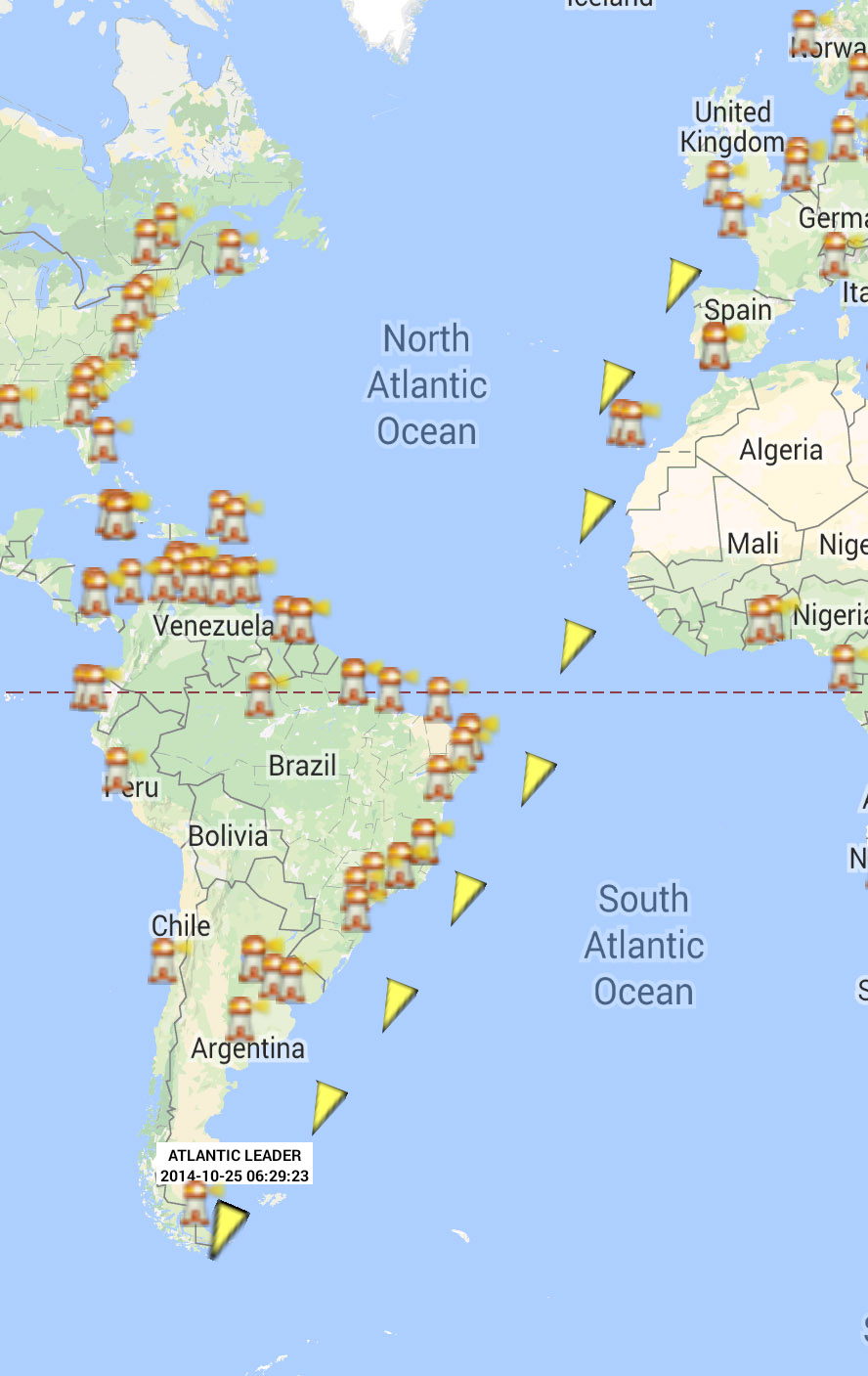
In the fall of 2014 four men from St. Jacques, along with several from Nova Scotia and Argentina, undertook a voyage that took them not only from Newfoundland to Spain but from Spain to Argentina; in fact to the southernmost city in the world, Ushuaia. The Newfoundland to Spain leg of their journey was by air to the city of Santander in northern Spain. Their task was to oversee the final readying of a deep sea factory freezer fishing vessel on behalf of Clearwater Sea Foods of Nova Scotia, then upon completion of sea trials take it southward down through the Atlantic Ocean almost to Antarctica.

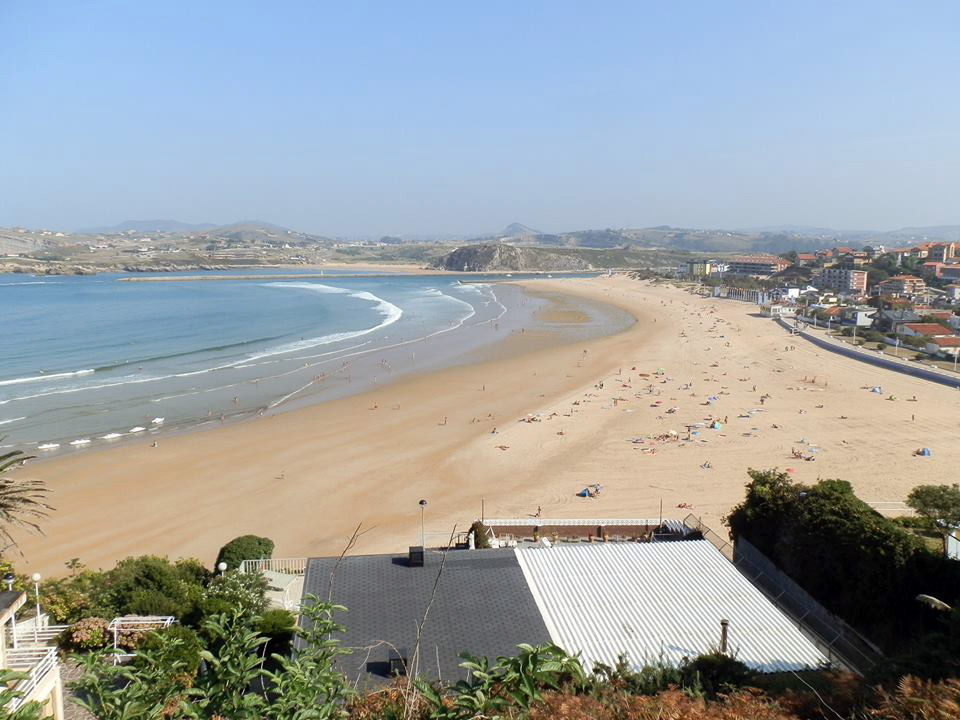
Santander, Spain

Santander, Spain

Captain Albert Lawrence, First Mate Roy Lawrence (both sons of the late fishing captain Thomas Lawrence), Brian Whalen and Tom Hickey, all of whom were born in and grew up in St. Jacques – eagerly undertook the challenge of sailing Clearwater’s newest vessel at the time from its shipyard in Spain to its new home port in Argentina.

Albert Lawrence had traversed long, ocean distances previously. In 1990 he took the Aquatic Pioneer from Japan and sailed it across the Pacific, down the west coast of North America and through the Panama Canal then up through the Atlantic Ocean to Canada. He fished in international waters throughout the southern Atlantic ranging from the coast of Argentina to South Africa. His brother Roy accompanied him on many of these voyages as did his brother Sam on several occasions when they fished tuna and shark in the North Atlantic.

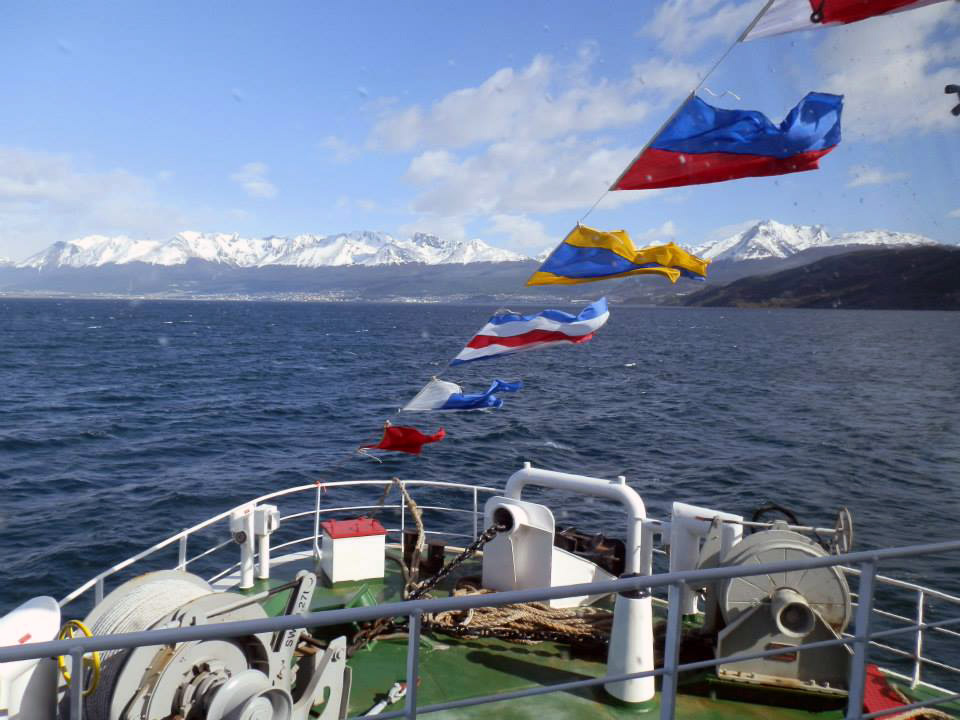
Entering Ushuisha, Argentina

Entering Ushuaia, Argentina

Captain Lawrence retired from active sea work several years ago and took up work in management with Clearwater’s Fleet office in Nova Scotia. Asked why he would embark on such an undertaking after twelve years ashore, he simply stated, “I wanted to see if I could do it again. After a decade working onshore in management, I wanted to check my skills, to make sure I still have what it takes to Captain a large fishing vessel; to get back to Argentina and see how things had changed or not, and to see some of the people I had made friends with during my time there nineteen year ago. ”
Of course his experience in working with Argentinian crews in the past were an asset as was his previous exposure to Spanish during those years. Albert hand-picked his crew, gathering around him men he knew were up for the challenge and who would give one hundred percent without hesitation. No one turned down his offer. Roy Lawrence, when asked how it felt to be working under his brother as Captain again, said, “This was Albert’s last big trip and I know how he feels about his life at sea coming to an end. I was thrilled to be be part of his last trip. I have spent many years at sea, and during many of them Albert and I were together. When he told me a couple years ago that he didn’t miss going to sea, it left me speechless, as a matter of fact, it left me feeling sad inside. So, this was in many ways, a trip of a lifetime for both of us.”

From the Captain’s perspective the task of choosing a crew was critical. Said Albert, “I choose the crew mostly from people I knew or worked with in the past and for the knowledge I knew I could possibly pull from if needed – young guys with training and knowledge and the need to learn, and older guys with experience willing to share, the perfect crew. Some of the crew had just recently completed bridge and engineering training in various training institutes in NL and NS. Other crew members were chosen because they were good men who had retired and I thought they would like to have the experience of an international voyage. We had two Argentinian engineers on the voyage with us and by the time we were five or six days into the trip we were all one big happy family.”

“When traveling internationally it’s a good feeling to have crew around that are or feel like family”, observed Captain Lawrence. “The St Jacques crew were all good men I had worked with and liked their work attitude as well as their family background. We worked well together because I knew they were dependable and hardworking – a necessary requirement when traveling international waters. I stated to the crew prior to leaving Spain ‘gentlemen please keep in mind when we are out there in the middle of the Atlantic Ocean we are on our own no one will be coming for you for a very long time if we get into trouble.’ This statement came true to us when twenty-two days into our voyage we were contacted by Brazilian Coast Guard Radio to keep an eye out for a sailing vessel that was missing with four crew on-board. We later learned the vessel had been missing for 34 days prior to the request from the Brazilian authorities to keep a lookout.”

R. Lawrence, B Whalen, T. Hickey of St. Jacques

R. Lawrence, B Whalen, T. Hickey of St. Jacques

Roy Lawrence is also employed by Clearwater as a ships officer on the Ocean Concord. Since that voyage, he too has acquired his Captain’s ticket. Both Tom Hickey and Brian Whalen had worked with Clearwater in the past. Tom is self-employed as an inshore fisherman in an enterprise he shares with his wife Rosalyn in St. Jacques where they focus on harvesting crab, lobster and cod throughout the year. Brian has worked with Clearwater as well as in the Aquaculture Industry raising salmon in the crisp waters of Fortune Bay. The trip to Santander Spain was the first time that three of them had been to Europe. All three reported on the contrast of beaches, temperatures, water colour and architecture in contrast to what they were familiar with back home in Newfoundland.

Their first weeks involved them working alongside Spanish workers as the ship went into its final stage of readiness. It also allowed time to do some sightseeing and exploration of the city of Santander, its cultural spaces, parks, restaurants and of course an occasional bar.
Santander has a population of 178,465. In comparison St. Jacques has a population of approximately 150. The climate of Santander is with an average monthly temperature around 10 °C. Humidity is high year round. Average temperatures range from 23 °C in summer to 13 °C in winter. Newfoundland has an average summer temperature of 16°C while the average winter temperature is around 0°C. The average summer temperature in Ushuaia is 9 °C while the average winter temperature is 2 °C.

Atlantic Leader on Dry-dock, Spain

Atlantic Leader on Dry-dock, Spain

The Atlantic Leader had undergone renovations, and an extension to its hull at the Astander shipyard. After determining the vessel was seaworthy Captain Albert Lawrence and his stalwart crew set sail for a destination halfway around the world. In order to get to their destination they had to leave Santander which is near southern France, sail down past the Mediterranean, past North Africa, and cross the Equator before entering the southern hemisphere. From there they took a diagonal course across the southern Atlantic to South America. Once across the ocean they remained in international waters until reaching Argentina where they had to sail past the Falkland Islands and travel into the straits of Tierra del Fuego enroute to Ushuaia.

Like all mariners the first time a sailor crosses the equator it is a time of recognition and ritual. Tom and Brian did this for the first time on the trip. In a time-honoured ceremony they were presented with a Certificate and Tee-shirt to mark the occasion.

Voyage of the Atlantic Leader

Voyage of the Atlantic Leader

When asked what there was to see, Tom Hickey, simply said, “Water, and lots of it! It was really interesting to experience the dramatic changes in water temperature over the course of the trip. We went from warm to almost hot, to warm, to cold, and I mean really cold when we arrived in southern Argentina.” Brian Whalen, who is now working towards another fishing ticket, spent as much time as he could with the Captain learning from one of St. Jacques master mariners. He has similar observations about the momentous journey.

When asked if he thought of the many sailors over the centuries who travelled similar routes, Roy observed, “I have said it over and over again. They were better sailors back then, than we are now. Today, we have equipment to show us exactly where we are. Back then, they had the compass and stars. It’s amazing how they sailed the world.” Captain Lawrence, well-schooled in celestial navigation and an ability to find his own way, commented that he had “never worked with most of the navigation equipment on the new vessel before. The onboard technology has changed so much since I came onshore. I tried to pick crew who had knowledge that I could learn from. I took with me the basic things needed for navigation if we had a failure – pencils, parallel rules, and a worldwide hand held GPS.”

A challenge which hearkens back to centuries ago and still presents a threat to mariners are pirates. Roy added, “The other thing, which I never dealt with before, were pirates. Pirate warnings were issued regularly in some areas. You had to monitor all vessels and make sure the other vessels you were seeing were not acting strangely or making weird course changes. It had all of our minds working overtime.” As a precaution the crew were told not to use the radio for casual conversation because the pirates are known to use radio signals to locate vessels in that area off Northwest Africa.

Once delivered to Argentina the Atlantic Leader was renamed to the Capesante. It will be operated by Clearwater’s partner in Argentina to fish in the South Atlantic.

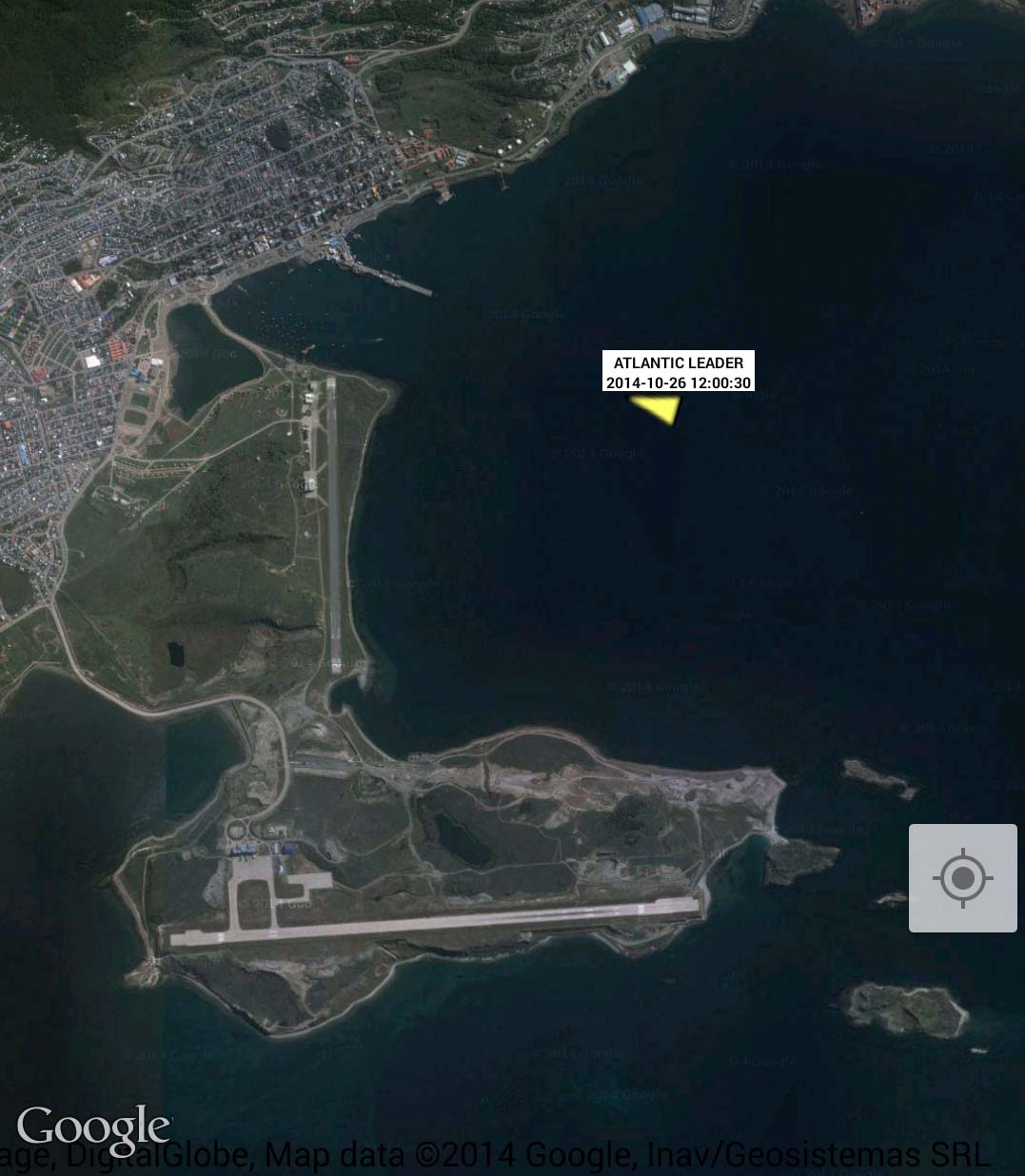
Atlantic Leader in Ushuisha, Argentina

Atlantic Leader in Ushuaia, Argentina

“The climate change was very apparent upon our first sighting of the land with its snow and ice capped hills and mountains”, said Captain Lawrence. “We had travelled from summer/fall in the north to winter/spring in the South, temperatures from 35 to 40C to -5 to 5C in 30 days. Some of the guys only had one pair of pants and long sleeve shirt and no jackets for the cold weather but they braved through it because I don’t believe they cared with the excitement of the voyage being successfully completed without incident.

Albert summed up the arrival in Ushuaia this way: “Arrival was a grand event with the ship flying all the international code flags escorted by a helicopter filming the event. We were met on landing by the normal authorities and the ship’s new owner and several company officials. For me it was a very emotional time to meet some of the people I had last seen nineteen years ago, and judging from the reception I received they were very excited to see me again. For the crew, a good steak dinner and a few drinks in a fine restaurant with heartfelt thank you from the owners, both Canadian and Argentinian, and I guess (to the crew) a grateful thank you from their Captain capped the voyage.”

Watch this video of the Atlantic leader arriving in Ushuaia as the Capesante. Video by Luke Hansen MacDonald; used with permission of Clearwater Seafoods of Nova Scotia.

If you enjoyed this post you might also be interested in reading the The Ocean Going Skinners of St. Jacques.

Links to Explore

Photo Show of Santander

Santander Spain

Ushuaia

Tierra del Fuego

Clearwater

Spain

Asander Shipyard

Document in Spain sheds light on Placentia Basque History

The International Fishery of the 16th Century

1500s: One Hundred Years of Activity in Europe and Newfoundland Fishery

Red Bay

Crossing the Equator

Posted by: alexhickey | June 28, 2015

Headin’ In the Harbour ©

Eastern Point-Friar Cove-StJacques

Eastern Point-Friar Cove-StJacques

As you approach the mouth of St. Jacques Harbour from the northeast you pass between “the island and the land”. On your left is the imposing basalt profile of St. Jacques Island less than a kilometre offshore rising dramatically from the waves, a beacon to sailors since 1908. On your right is the multi-coloured pebbled beach of the Back Cove divided into two unequal sections by a promontory called Jimmy’s Rock. If you listen carefully you can hear the undertow moving the egg and potato size pebbles in and out as it ebbs and flows, a magical sound from beneath the edge of the sea.

The beachhead ends abruptly as it encounters a dense treeline of fir and spruce, a backdrop, a curtain of green seemingly positioned to accentuate the pastel pinks, blues, greens and violet variations in the beach rocks. Here and there a discerning eye can locate vague openings between the trees, remnants of ancient paths once worn clear by the many feet that made the trek from the harbour to harvest wood, to picnic on Sunday afternoons, to catch rolling capelin in season, and to tend woodland gardens hidden in spaces carved from the forest undergrowth.

Seagulls perch comfortably on exposed bedrock cautiously watching the bay; behind them rich burnt brown peat lies exposed to the air, a perfect disguise for red foxes to burrow winter lairs. A metre or two away crisp clear water lazily oozes from an underground stream, the depressions dug by thirsty hands of yesterday no longer visible.

The expansive beach abruptly gives way to a sheer rock face topped by scraggly low growing spruce trees and patches of crowberry bushes. The obliquely sloped cliff suddenly shatters into jagged extrusions of beige coloured, layered rock and tapers to the water’s edge. Here the waterway quickly ‘shoals up’, made shallow by centuries of boulders which have tumbled end over end to rest beneath the salty ocean. At low tide one steers well clear of Eastern Rock else its looming shape abruptly caresses and scrapes the bottom of the vessel and delivers a menacing blow to propellers.
Rounding the point reminds boaters that the water below is the ocean and not a calm inland pond for currents create tumult and stresses requiring diligence regardless of the size of the vessel. Waves seem to fight against themselves, vying for a firm compass direction as unseen forces beneath the surface push and battle each other as they’ve done since the beginning of Fortune Bay.

Around Eastern Point lies a dramatic surprise for the first timers. Here, in the little cove is a sea stack rising like an obelisk from the mid-tide mark; a layered stack of stones intricately interlocked, a veritable Rubik’s Cube. Atop the near forty foot column is a collection of twigs and sticks woven into a birthing place for stately birds. Left behind by centuries of erosion, this, harder than its surroundings, column of stone has served as the nesting place for Eagles and Osprey year after year. The Friar, as sea stacks are known locally, stands stately and diligent, lording over the coming and going of fishers and other residents just as it witnessed schooners and Jack Boats slicing through the waves a hundred years ago.

At the western end of Friar Cove, the beach, shaped by the perpetual action of waves into layers resembling the undulations of gentle ocean swells, rests against darkened granite whose worn edges resemble the beach itself. Carved into its base, a sea cave large enough to accommodate most of a small dory, invites exploration and demands one to marvel at the forces of nature. High above in silhouette against the sky, wary Osprey fly in circles keeping an eye on all life forms below.

Beyond this near pristine piece of the coastline lie a series of small beaches in crevices too small to be called coves. Towering above them the brow, still covered by spruce trees tenaciously clinging to the edge, gently slopes as the harbour opens to full view. The shore abruptly changes to a beach of boulders whose edges, though worn, bear none of the witness to the power of moving water as the rocks of Friar Cove. Haphazard in their arbitrary placement these irregular chunks of granite bridge the waterline to the grass covered banks above. Only flat-bottomed dories venture close. Anyone gazing over the side can readily see the ocean bottom, barnacles, starfish, and perhaps, a fish or two swimming along. Large ships remain further out into the centre of the harbour as they enter. Behind the mussel-encrusted boulders of this rugged beach, created by the scattered remnants of a once sturdy breakwater that extended almost two hundred feet into the harbour, lies the protected waters of Burke’s Cove.

On the southwest side of the entrance, Louis’s Cove, sheltered from prevailing winds, beckons as an oasis, a near idyllic expanse of pebbled beach, flanked by rocky headlands and set against an expanse of evergreens that reach to the sky. The beach transforms into ever increasing rocks and boulders until it becomes a cliff once more with pebbles at its base. From there the rounded rocks that roll beneath ones feet continue all the way past the swimming hole to Hatchet Cliff and a grassy landing which leads to the local road.

Whether you are rowing a flat-bottomed dory, guiding a luxury yacht home or returning home from the fishing grounds, the arrival to that point in the harbour where the entire community opens to a panoramic view is breathtaking. The skyline is defined by Bottle Hill, Big Hill, Bungay’s Hill and a protective arm which separate the harbour from the bay. One’s eyes can travel unobstructed, following the contours carved by time. Beyond Hatchet Cliff the “Barrisway” nestles in a sheltered valley flanked by Bottle Hill and the Barrisway Point. The roadway ribbons past St. Michael and All Angels Anglican Church, skirts the base of Big Hill, dips as it crosses Pitman’s Brook then curls eastward to wend along to Sacred Heart Church and branches onto the community wharf. Up over Clinton’s hill, the roadway, shaped by hand-built rock walls, carries on to the end at Burkes Cove.

It’s time to cut the motor and drift into the expanse of this protected harbour, once an insured haven from storms, backed by Lloyds of London. Drift among the waves made by thousands of schooners, steamers, dories and longliners that have come this way before. When the breeze is right you can hear the voices of men loading herring on the decks of Gloucester schooners at Gorton and Pew’s wharf; feel the wake of vessels laden with barrels of fish hoisting sail for Spain or the West Indies, and sometimes, hear the cautious voices of women and children as they watch sails coming around Louis’s point, giving thanks because their men have made it safely home once more.

Heading in the harbour is as much a spiritual experience as it is physical one; shared moments across historic waters feeling the buoyancy which brought people here centuries ago and which sustains today. Inspiration for poetry and song rattles off the hillsides, forming half-spoken thoughts which drift carelessly away on the breeze. Mind, body and soul seek no differentiation here; no separation, just oneness with sky, land, sea and time.

Cradled by undulating swells, caught in motion that supersedes human life, a boat floating languidly in through the harbour carries within it all that is embodied in the life of a coastal community. While the moment registers on the calendar, it flows through time and people, through life and death, and courses through the emotion of what it means to say, “ I am from St. Jacques.”

Posted by: alexhickey | May 24, 2015

Aunt Maggie and Uncle Tim©

Let me live in my house by the side of the road,
Where the race of men go by-
They are good, they are bad, they are weak, they are strong,
Wise, foolish – so am I.
Then why should I sit in the scorner’s seat,
Or hurl the cynic’s ban?
Let me live in my house by the side of the road
And be a friend to man.
– Sam Walter Foss, The House by the Side of the Road

Saltbox style house where Maggie and Tim resided. Photo courtesy of their granddaughter Margaret Whalen.

Saltbox style house where Maggie and Tim resided.
Photo courtesy of their granddaughter Margaret Whalen.

The architectural style of the house in which Aunt Maggie and Uncle Tim lived beside the road in St. Jacques is known as first generation salt box; a single story with a loft formed by a steep-sloped, shingled, peaked roof. When it was built no one really knows; however the style was common after 1835 and went through several adaptations over time. In its latter years it stood out among all of the other houses because of this style. By the mid-to-late twentieth century it was the only one left in the community; though they had been quite common throughout the nineteenth century.

Aunt Maggie raised her first family there with her husband John Power. Some say John came from St. Pierre and Miquelon; others say he came from somewhere in Placentia Bay. Both scenarios may be right. Born in 1860, he probably moved around a bit before settling in St. Jacques. His young wife Margaret Barnes was born in Big St. Joseph’s, Placentia Bay in 1890. They had six children: Lawrence (1909), Mary Ann (1911), John (1916), Ignatius (1917), Bridget (1919) and Lillian (1924). John died around 1925. Maggie remarried in 1927 to Timothy Whalen, a man born in St. Jacques in 1891 to James and Sarah Whalen. They had one child, a son Joseph (1928).

In true affection and respect, voluntarily offered, they were given the title of aunt and uncle to all who lived in the community and by many from surrounding towns such as English Hr. West, Mose Ambrose, and Belleoram. Rarely does a couple achieve the recognition as to be mentioned in the same breath as that achieved by Aunt Maggie and Uncle Tim. Throughout their lifetime the door to their house was open to all who wished to enter and during their forty-two years together few, if any of the generations who shared that time, missed the opportunity to sit and talk with the couple in their compact kitchen.

Maggie, according to all who remember her, was a delightfully gregarious woman who enjoyed the rhythm of music which she expressed through her love for dancing. She was frequently the first person to choose a partner and move onto the dance floor at a ‘time’ in the Parish Hall, or in a neighbour’s kitchen. She especially enjoyed teaching young people the moves and progressions of square dances and could be seen with her choice of dancers on her arm throughout an evening. While the music played Aunt Maggie danced. When there was no musician to play the fiddle she improvised by playing the ‘comb’.

This is an old world method of making music by placing a fold of water resistant paper over an ordinary hair comb and humming a tune thereby causing vibration against it with ones lips to create a sound similar to that created by a kazoo, which is readily recognizable today. It is affectionately told that when Robert and Mary Oakey married in the early 1940’s Aunt Maggie could be heard in the kitchen creating dance music well into the evening on her comb for which there was no shortage of dancers.

Tim was known for many things, all complimentary. Among them was his incredible strength and another his spatial knowledge, both of which has left him legendary in memories and stories. Though his stature was not out of the ordinary he possessed strength in his arms, legs and back that placed him above his peers in the physical feats he could accomplish.

Stories are told of seeing him lift a forty-five gallon drum of gasoline and moving boulders other men had failed to budge. One story which has been told with variations had him carrying a ten stone sack of flour from English Hr. West to St. Jacques on his shoulders without once stopping for a break – a distance of ten kilometers! This came about when Harry Petite, at whose store the flour was purchased, asked him how he was planning to get the sack of flour home. Tim replied, “I’ll carry on my back and do it without taking a spell, sir.” Petite, doubting it could be done, paid a young fellow $2.00 to follow Tim to St. Jacques to see if indeed he could do it without taking a break. The young man reportedly informed Mr. Petite that Tim did as he claimed he would!

Uncle Tim had a reputation for his ability to look at a pile of rocks, envisage a stone wall and without hesitation set about building the wall. He would sort the stones by size and shape then craft a stone structure which would last beyond his lifetime. This skill he used to the satisfaction of many customers who hired him to build retaining walls in the community. Today one can still see some of his handiwork in old stone drains which pass under local almost forgotten roads as well as rock walls which protected houses from foundering hillsides.

In his later years Uncle Tim gradually lost his vision and for his last years was completely blind. Though he was blind, his devoutness took him to Mass at every opportunity. He held Maggie’s arm as she guided him a distance of almost two kilometers to the Roman Catholic Church on the eastern side of the harbour. He had a sense of humour about his blindness. On one of those Sunday’s on his way to Mass, Joe McCarthy, whose house he had to pass by on his way to the church, asked him how his eyes were on that day. Tim replied, ‘Not too bad Joe, I can see that small horse up there by the school but I can’t see the big one!”

Blindness did not prevent Uncle Tim sawing from his own wood. Using his well-developed spatial sense he was able to measure with his hands the distance to move the stick of wood along at just the right interval to saw off a junk the perfect size for his stove. Across the road, Uncle Tim’s sawhorse was a permanent fixture, always in the same place. Aunt Maggie would lead him across the road, assist with placing a stick of wood on the sawhorse. She’d return to her house and when another was needed he’d call her name.

The low ceiling of their cozy house meant there was little room for heat to escape thus every visitor that was met with a warm heart was also met with a warm room within to sit. Aunt Maggie and Uncle Tim lived simple and frugal lives yet they were exuberant in attempting to share with you whatever food they had available at any meal. Many residents recall not only the delectable, mouth-watering aroma of home-made bread emanating from her kitchen but also the texture and taste of it fresh from the oven, still hot on the inside with a crunchy crust on the outside. Biting into a slice of her bread with melted butter or molasses was an experience comparable to dining at the hands of the world’s greatest chefs. Little did most of us know it at the time!

Uncle Tim never lost interest in knowing who had entered the house. He could be frequently found lying back on his daybed beside the window which looked over the Barachoix. As soon as he sensed you were seated he would ask Aunt Maggie who was visiting and once he knew your name and the names of your parents all was well with his world and yours. After Tim died in 1969 Maggie moved away from St. Jacques into a senior’s home in Holyrood where she spent the rest of her days regaling and entertaining her fellow housemates with wondrous stories of her life in St. Jacques. She died in 1990 in her one hundredth year.

Though their first generation salt box house is gone from its foundation and the space it occupied now incorporated into the road which for decades detoured around it, those of us who sat in the kitchen of Aunt Maggie and Uncle Tim can still imagine them standing in their yard, smiling at passerby’s or walking arm-in-arm over the Barachoix Point. Sometimes when the wind catches in a twig on a tree and vibrates, I hear Maggie’s comb and see her lined face looking back at me. When I walk by any of the rock walls found throughout St. Jacques the strong hands of Uncle Tim carefully placing each stone are still at work, selecting, positioning and testing its stability. It takes little effort to pause in awe and stand for a moment in his shoes as he assessed his own handiwork.

Maggie and Tim Whalen Photo courtesy of their granddaughter Margaret Whalen.

Maggie and Tim Whalen
Photo by John Burke – early 1970’s. Provided by their granddaughter Margaret Whalen.


A few links to explore:

Salt Box Architectural Style

How to Play Paper and Comb


Posted by: alexhickey | May 11, 2015

Born Together ©

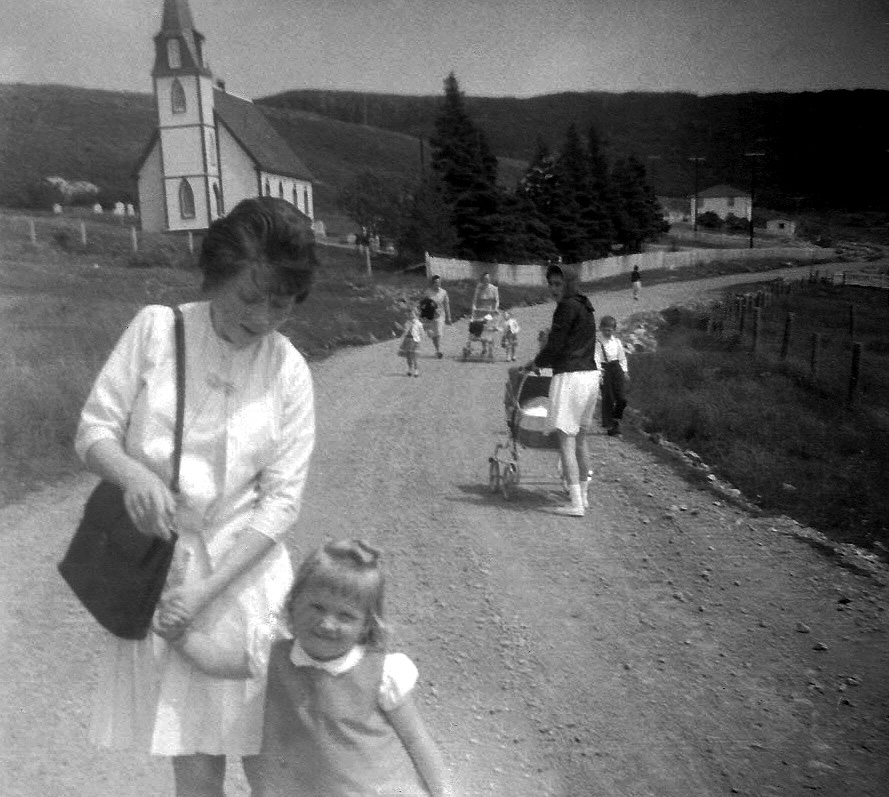
Women and children walking along a gravel road.

Young Women with Children on a Sunday Stroll .
Photo courtesy of Louisa (Fudge) Healey.

Pregnancies in St. Jacques and probably other similar communities during the 1950’s and 60’s seemed to be a communal occurrence among the younger families. One can chart the children of any number of families of that era on a time grid and see considerable overlap from year to year. The marriages didn’t all have to begin at the same point in time. For instance, I am but a couple of months older than our neighbour’s second child and a few weeks younger than another neighbour’s fourth child.

This pattern of the children in larger families correlating by birth year is in many ways a product of the employment history of such communities where the men worked away from home for great stretches of time and returned home at predictable times of the year. One can examine birth records and see the relationship between month of birth and work histories in families.

In any given year there were numerous mothers whose pregnancies overlapped resulting in a cluster of births and a group of children who are able to identify with being born in the same year, some within weeks of one another. This is handy and valuable occurrence later in life when one is reminiscing or attempting to reconstruct family relationships and birth orders. One can imagine a conversation which goes something like this:

Clara: Now, how old do you suppose John is?

Julia: I allow he’s close to Bob’s age.

Clara: Yes, I allow he is. Come to think of it, they were both born the same year. John was born in the middle of June and Bob in the first part of July, that summer. I know that because that’s the year I was between my second and third one. Now, my second one is thirty-eight and the third is thirty-six. So John must be thirty-seven. Her other child Bernice was born the next year. She’s the same age as my third one, Trudy. And that was the same year Jane had her twin of girls. I remembers that as clear as day because old Mr. Browne was being waked in the church that night when we got the news that she’d had twins.

Julia: That’s right, he was born the same year Bessie had Blanche. She and John started school together. My goodness, how the time flies.

Clara: Yes my dear, they were all born together and they all left home together.

Not only were lateral age relationships noticeable among us, so too were the number of children in each family. The anomalies were families with merely two or three offspring. The norm in our neighbourhood was larger with some of us enjoying five siblings, others several more and a few families with thirteen children. Those are full term, surviving children, with unsuccessful pregnancies not being factored in. An old friend of mine observed to us during an afternoon visit several years ago that at one point in his lifetime as a parent, between the Barachoix Point and Cellar Hill there were 30 children. Today there are but two in the same area.

Larger families viewed from a distance seems a bit overwhelming to some for it is difficult using today’s measures to fathom how eight or more children could be raised in the one household in addition to the presence of one or more elderly grandparents under the same roof. It does seem daunting at first, however, as many people who survived such large numbers under a single roll will attest, we raised each other up. By the time the youngest was born some of the earlier born children were old enough to have left home in pursuit of post-secondary education or employment, thus removing some of the pressure. In fact, may large family members speak of ‘two families’ within one. The older siblings tend to be seen as a single cluster and the younger as another.

Often, the two describe upbringings which are distinctly different from one another. That difference of experience can be attributed to changing economic circumstances as one or more of the parents get better established in their careers/employment and are able to enjoy better income levels. A second factor is related to the maturation of parents who learn quite a bit of ‘how to’ and ‘how not to’ raise children from their early experiences with child rearing. It’s a testament to the old adage that you learn to be a parent by being a parent. Over a twenty to twenty-five year period of raising children many changes occur, including the departure of older siblings, leaving the younger ones to bond with a much smaller family group.

The fortunate families are those whose children are able to reach across age differences and coalesce a unit beyond the efforts of their parents. They are able to experience the highs and lows of aging as a group of adults, sometimes with an enormous degree of empathetic support. I have met people who’ve told me they have older brothers and sisters whom they’ve only seen once or twice in their lifetime. That is saddening yet reality for many.

Having friends, extended family members and acquaintances of the same age as you in your hometown makes for interesting get-together’s when quite divergent versions of the same events are shared from different perspectives. We grow to appreciate the complexities of our lives otherwise never known. It also heightens the sense of loss when one of that group passes on. It becomes, a ‘there but for the grace of god, go I’ type of scenario.

Community history is told and retold during gatherings when someone inquires about another person’s age. As relationships are unfolded and more names are tossed into the conversation an organic oral history lesson emerges complete with storytelling, reminiscences, and sometimes facts. Conversations like that ground us in our family histories, community histories and reinforce for us a sense of place and belonging. That is as true of urban neighbourhoods as in rural remote towns. Yet, being able to think through a roster of people who were born in or around the same year as you, whom you can not only call by name, but can call upon throughout your life as friends, speaks volumes about being born into close-knit communities of people.

We know each other by who we are, who our parents are and the order of our birth within those families. We identify people we know to others by establishing who else that person may know from the family across generations. Each time it happens the thread across time and space gets stronger, forging deeper respect and affection. That strength of knowing builds nations and if we as Newfoundlanders are not a nation, then who are we?
Strollers replaced baby carriages as our family grew. By the time the youngest of my siblings had arrived the brushed aluminum frame of the post-war’ ‘pram’ (short for perambulator) with its plastic waterproof lining, white rubber tires and its own suspension system of stretchy springs, had given way to a much simpler folding vehicle, the stroller. I can only assume that as space became a premium in the house the larger ‘pram’ was viewed with an eye to how much space it occupied. Another contributing factor to its demise was the extended use it received by friends and extended family members when not in use with one of my siblings. That old carriage must have been quite durable and built to last for I find it hard to imagine how many miles it travelled on the roads in St. Jacques until it finally shuddered and collapsed!

During its service it was often used to push one child while another was in gestation, waiting for its turn to enjoy the bumpy ride along those dusty gravel roads. Baby carriages were more plentiful than cars in those days and in some houses doubled as a bed during the night for one whose legs weren’t too long to fit inside.

There are two views of the world from a baby carriage; from the perspective of the person doing the pushing and from the inside looking out. From the latter, it seems now that most of the mothers in St. Jacques during the fifties and sixties were perpetually pregnant for as soon as a carriage occupant got old enough to appreciate being ‘ambulated’ it was time to relinquish the carriage to the next in line. As toddlers we found our friends of the same age and forged life-long relationships which today are still as vibrant and interesting as they were back then. Along the way a few have fallen out of the carriage and are missed by us all.

Mothers who are able to look back on those formative family years and filter life’s events through the lens of who else was born each year must share a collective ownership of the community, a shared knowing and means of documenting and measuring the passage of time deeply rooted in the spiritual and physical experiences of childbirth and parenting. I know that being able to see oneself as a lateral slice of time in the long heritage of a single community and its people is a comfort of belonging beyond mere words to capture and communicate.


A few related links for exploration:

The Baby Stroller: A Visual History

The Evolution of Baby Strollers Will Make You Appreciate Every Mom In History

The Pram

Million-dollar babies: The cost of raising a child

Two-child families becoming the norm in Canada

Parenthood, child-rearing and fertility in England, 1850 – 1914 by Siân Pooley, Pembroke College , Cambridge , UK. Published online: 29 May 2013

The Cost of Raising Children

The Changing Face of Motherhood

Family

Posted by: alexhickey | March 31, 2015

Rounding up the Sheep©

This is a guest post from my friend George Pauls, a former resident of St. Jacques. George now resides in Halifax where his heart and mind frequently takes him back to the place where he grew up. I am pleased to be able to share George’s story of rounding up the sheep and ask anyone who has a story of St. Jacques to share, to send it to me at stjacquesblog@gmail.com I’ll make every effort to share them here.

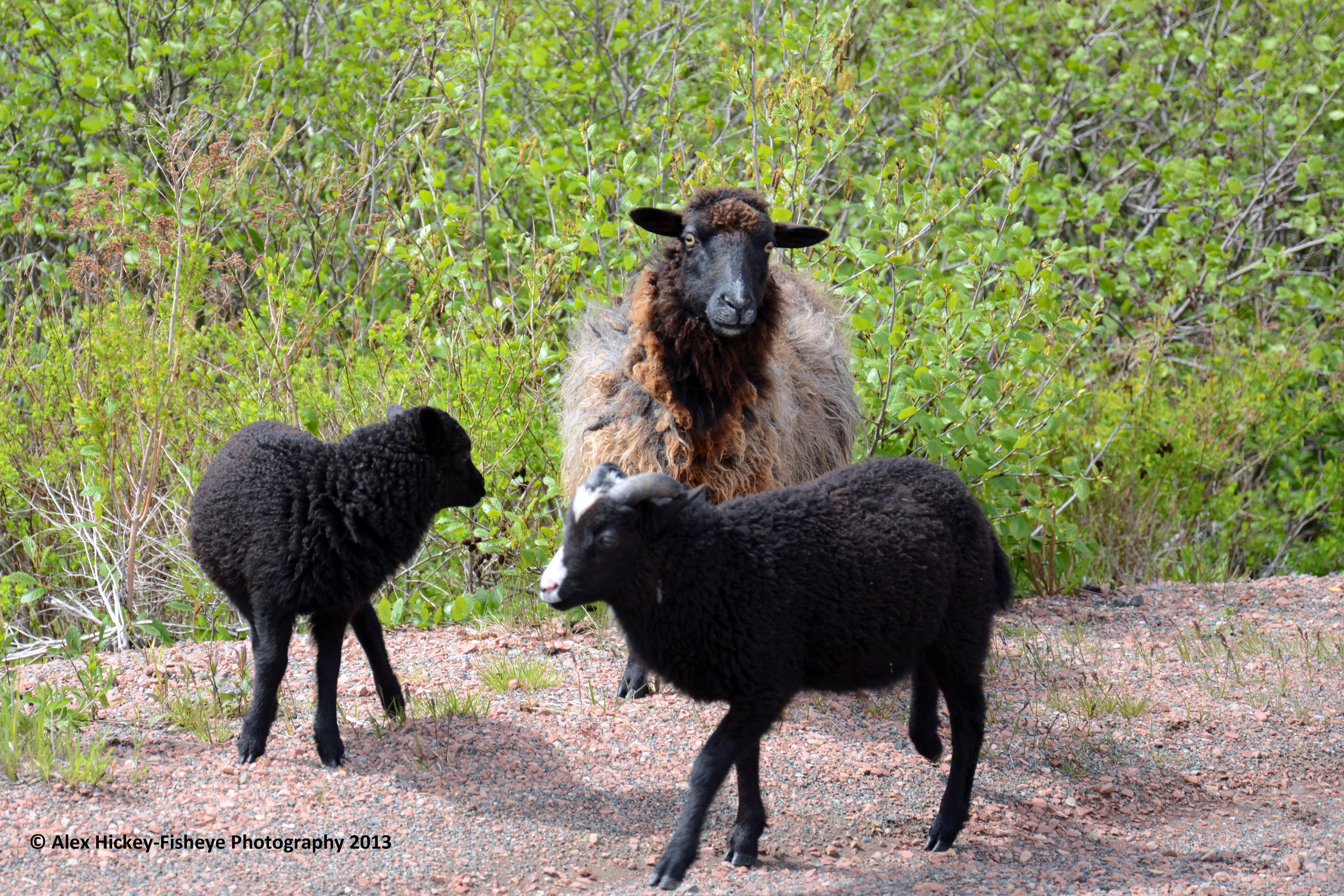
one adult black sheep and two black lambs standing on the side of the road

Walter Whalen’s Sheep, St. Jacques

Rounding up the sheep that had been absent from the community since their last shearing earlier in the summer became an annual task for ten or twelve of us; or sometimes, perhaps one or two more, and possibly less, by the same margin. We would meet at some predetermined location as the fall of the year was approaching, and there, with ropes strapped over our windbreakers prepared to head for the hills in search of sheep “at large” or “on the loose”. That would be before the Bankers got back from their Greenland voyages, after which they would tie up for the winter.

To look back on the excitement of corralling the animals into smaller and smaller enclosures before yanking them off on their homeward trot, recalls fond and gratifying memories that cannot be contained or even counted fully within a few or several lines of just a little script; even by someone such as myself who took part in the activity on one or two occasions, once I became adaptable to the roping and the sheepshank!

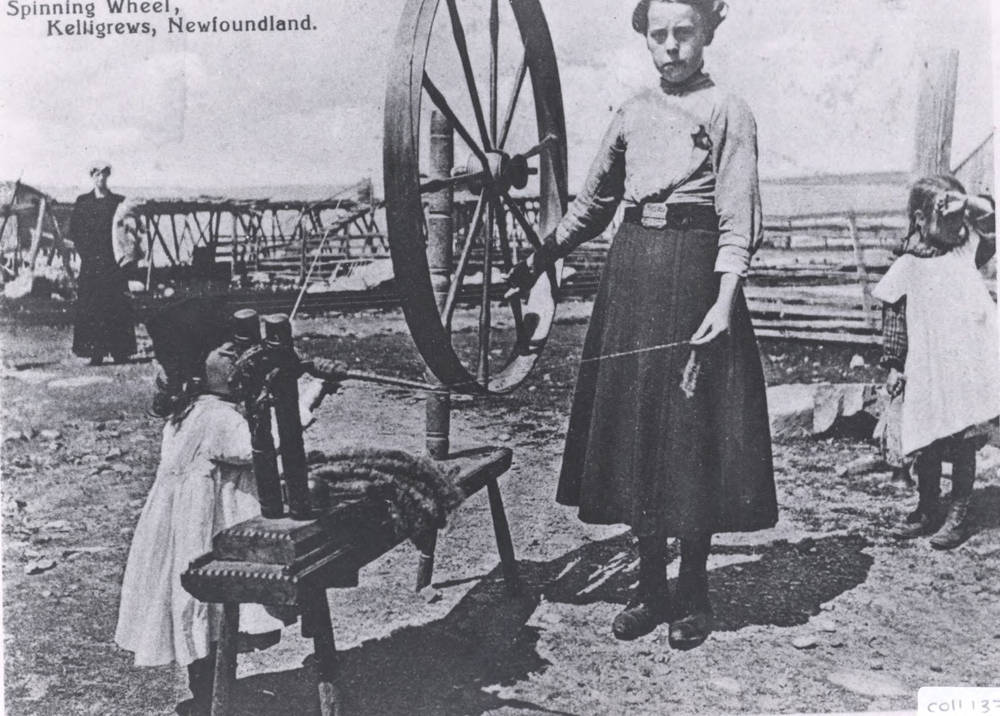
Spinning Wheel, Conception Bay c1900 Memorial University Digital Collections

Spinning Wheel, Conception Bay c1900 Memorial University Digital Collections

Our family did not own any sheep, but nevertheless, like other families, obtained wool mostly through the barter system. In every house it seemed there was a spinning wheel and the accompanying carders, etc. Hanks and hanks galore came off the backs of some of those beautiful chairs that adorned the scrumptiously clean little homes of those engaged in the home-spinning of such important fabrication.

These woolen garments were so necessary to the success of the fishery. Once there was any sign of fall in the air the knitting needles and the skivers got busy under the most capable hands of the womenfolk, with young girls in full attention and assistance. Socks and mittens for the fishing fleet were the most produced items but then again, many heavy sweaters and even underwear came off their racks. All did not go to sea, but what did take to the water, especially the mittens, through the trashing and soaking in the salt water became waterproof, which with the shrinkage ended up being prized gauntlets when handed own to us for use in our snowball fights.

The people who went after the sheep were mostly owners in part, of the different folds who had their sheep well-marked, mostly on the ears. There was never any dispute of ownership when we got the animals back to St. Jacques and impounded them in their proper pens where they were cared and provided for as winter set in. Of course, not all owners took part in the roundup because most had only a couple or so sheep to contend with in this regard and they quickly followed the main or larger part of those on the move without hesitation.

The highlight of the move to capture lurking strays was the closing in on them. All hands joined hands in a semi-circle arrangement which would gradually interlock into a complete bond when applied as such and which always had the desired effect.

The group carrying out the roundup and the getting home of the sheep being accounted for to an extent here, consisted mostly of older men (old to some of young gaffers) but they could run rings around us. Uncle Johnnie Young assumed, and was always regarded as being in charge. Jack Drakes and the Piercey’s were good runners; even though Jack tainted some areas with tobacco juice! The Noseworthy’s and the Dinham’s, as well as Tom Evans, all played their parts with gusto. The families of Tibbo’s, Skinners, Fiander’s, McCarthy’s and Whalen’s (Jerome and Patrick of the last mentioned name were particularly taken up with the breeding and care of a certain stock).

There were others, and of course George Hickey and his father Alex Hickey, were both much committed (besides attending to their regular duties with the fisheries which entailed a commercial lobster processing operation) in the rearing, etc. of a small flock of sheep between them. Getting them home safe and sound with all the others before the snow fell was one of their priorities.

In the meantime Mrs. Mary Madeline Hickey, Georges mother, who endorsed whatever was going on in her loyal and supportive fashion, began ‘fishing out’ the long needles, the skivers, as we called them, to once again take up the task, a pastime to her, of producing (knitting) besides other things, excellent sweaters and cardigans from her own home-spun wool; garments that stood out so magnificently in the classrooms of the St. Jacques Convent School Complex where they were much admired. In the end they’ve become just a memory – but what a memory; priceless!

Links to Explore

Wool Whisperers – A Land and Sea show about Newfoundland Knitters
Harling Stalker, L. Lynda (2000) Wool and Needles in my Casket : Knitting as Habit Among Rural Newfoundland Women. Masters thesis, Memorial University of Newfoundland.
The Household Economy in Newfoundland and Labrador Outports
NONIA Rafts of Character Newfoundland and Labrador
Archival Moment -The ladies knit, for our soldiers
Traditional Sheep Shearing in Newfoundland
Video – The Shepard: Howard Morry
The Legacy of Aunt Martha’s Sheep
Why is Rural Newfoundland & Labrador Not a Haven for a Thriving Sheep Industry?
Newfoundland Sheep
For Ship-Shape Sheep, Island ‘Vacation’ Promises Tasty Last Licks Before Slaughter
Not Just Any Old Sheep . . .
Boon, Sonja. Just the kind of girl who would want a chap to be a man”: Constructions of Gender in the war stories of Tryphena Duley , Newfoundland and Labrador Studies, Volume 25, Number 1, Memorial University, 2010.
Dale, Linda. A Woman’s Touch: Domestic Arrangements in the Rural Newfoundland Home, Material Culture Review, Volume 15, Summer 1982.
Carding
Spinning Wheel
Spinning Wheel Conception Bay, Newfoundland- Memorial University Digital Collections
Scott, Shirley. Canada Knits: Craft and Comfort in a Northern Land
Miriam using a “Newfoundland Spinning Wheel” at Grand Bruit, c1930

Posted by: alexhickey | February 18, 2015

In Belleoram Road©

Road Leading from St. Jacques to Belleoram

Road Leading from St. Jacques to Belleoram

“Let’s go for a walk.
Where?
Let’s go in Belleoram road.”

That conversation may be attributed to any generation of people who have lived in St. Jacques since there has been a road between it and Belleoram. What is presumed by “in” isn’t quite clear to me since the road roughly parallels the shoreline, then up one side of Bungay’s Hill and down the other. Yet, all will speak of going “in” the road. Curious, isn’t it?

What does it mean to take a walk in Belleoram road? Today, it’s a paved secondary highway without traumatic twists and turns which climbs steadily from the level section adjacent to St. Jacques Pond. It cuts along the south side of Bungay’s Hill with an incredible vista of Fortune Bay on one’s right then an exquisite view of Iron Skull and The Reach as one descends to Belleoram. The old road, upgraded and replaced in the mid 1960’s, used to follow the contour of the pond and wend its way around a number of bends and turns until it reached the crest then did the same as it found its way down the other side. It was narrow, barely wide enough for a single vehicle, but with plenty of room for a horse and cart.

After a heavy rain the water level of the pond would be near the tire ruts in the old road. During spring run-off when an increased water flow found its way down from Barred Pond and Belleoram Big Pond, it frequently flooded one or two sections making it a challenge to traverse. On a positive note, this proximity to the water made it a great location to stand on its shoulder and cast a line out into the pond in hopes of getting a bite from one of the numerous mud trout which prosper beneath its surface. Through the generations many a resident could be seen standing there patiently watching the bobber drift until it was quickly pulled under. A knee-jerk reaction, cultivated from experience and seeing the same response from others, resulted in a bamboo pole being flicked and a six inch trout going airborne, sometimes falling off the hook as gravity took hold and landing to flap desperately in the middle of the road.

The old road is still visible though more the worse for neglect and the effects of water. Though it’s called the old road it truly isn’t the real “old road” to Belleoram. That one is almost completely grown over now by Spruce, Fir, Birch and Alder trees. However, if you know where to look, there is a perceptible difference in the age of the forest at the first major curve of the new old road as it climbs upward. The road curves to the right towards where the new road passes by now. On the outside bend of the curve is where the first road between St. Jacques and Belleoram is located. It used to be an attraction for young boys and girls in the middle decades of the last century because just a short distance in that road stood an apple tree which fascinated all. It was an attraction to visit and observe the apples as they grew each season. Then, with any luck, there would be an opportunity to pick some of them when they ripened. Life doesn’t always work out the way you anticipate or imagine it should for as often as not, someone would decide to raid the tree before the apples ripened and either throw the apples away of take them home to ripen.

The road at that time was more of a wood-path, partly grassed over and being encroached upon by saplings. I cannot say for certain but I have been told by elders that the road continued up and around the back of Bungay’s Hill then approached Belleoram from the west. Today it isn’t discernible, even from a distance.

We can assume the first overland link between the two communities was a walking path, one which most likely grew out of wood harvesting patterns in the area. That would have been sometime in the 1700’s or before. It would have grown in width to accommodate horseback riding and then a horse and cart and a horse and sled during winter months. There were no motorized vehicles until around 1900 and their arrival in the Belleoram-St. Jacques area was probably sometime later. Therefore a pathway smooth enough to allow a horse and cart to move safely around would have been the ideal.

It was probably the first overland link between St. Jacques and any of the other surrounding communities which speaks of the level of communication, interaction and commerce which was taking place with Belleoram. When the Church of England established the Deanery of Fortune Bay in 1841 the three communities of Belleoram, St. Jacques and Point Rosie made up Belleoram parish which places the two communities in a common history for quite a long time.

When Church of England Bishop, Edward Feild visited St. Jacques in 1848 he walked from Belleoram to St. Jacques and took a boat from there to English Harbour West. This is how he described in his journal the condition of the road between the two communities on September 21, 1848, St. Matthew’s Day:

“Full service in the morning at the church (Belleoram). Directly after the service we started to walk to St. Jacques, en route for English Harbour, where I was expected to consecrate the grave-yard. The road for the greater part of the way is only laid out, not made: the stumps of the trees are still standing, and it is very wet and boggy. I was several times in over my shoes.”

Improvement were made and a century and a half later we see the results. Traffic flows back and forth between the two communities all day and night.

So that’s the road. What significance does it have? The road itself has a function namely to provide an avenue of transport for people, animals, and goods. That has been true over the years despite the condition of the road. What makes it most interesting is what the road enables, where it takes people and how people make use of it.

A Sand Pit located a short distance in the road at the back of the pond served not only as a source of naturally crushed stone to repair gravel roads and walkways but also as a rendezvous place for lovers under the cover of night, a place for friends to gather and light evening fires, toast marshmallows and cook wieners on sticks. On summer evenings, young people, couples and groups could be seen making their way in the road. Drinking underage is not something parents encouraged but suspect some of their children might experiment with from time-to-time. That sand pit served as a private haven for such experimentation, especially on weekend evenings.

On sunny summer Sundays, families could be found, with table cloths spread on the grass in the area along the side of the old road where the brook from Barred Pond skirted along the road’s edge, setting up an afternoon picnic. While children jumped stepping stones to cross the stream, parents gathered wood and built a fire pit to boil the kettle or picked early blueberries, raspberries and marsh berries. Across the brook a wide open space owned by the Evan’s family was a meadow which offered older children a place to explore. Small pools of water in the stream were attractions for small children as they sought out the young trout moving up and down the brook. Smoke from blasted boughs burning filled the air in a frequently futile attempt to ward off black flies.

For generations that reach back to the first settlers in St. Jacques men harvested wood throughout the valley between Big Hill and Winterhouse Hill to heat their homes. In one season they would cut down the wood and leave it to dry before trimming it out and hauling it home during the fall and winter. Horses and sleighs could be seen coming out the old road laden with neatly trimmed sticks of spruce and fir in winter. Where the going was good and the horse pulling with minimal effort the owner often stood on the runners or sat atop the load. When the going was tough it wasn’t unusual to see the wood cutter helping the load along by pushing from behind the sleigh. The frozen surface of the pond was a welcome stretch for both horse and man for it meant little effort to keep the load moving.

In the fall of the year young boys, youth and men explored the forested valley along the road for signs that rabbits were moving about. Once a good run was identified a snare was set with the expectation that by tomorrow it would yield fresh food for dinner.

December was the month when, as Christmas neared, people could be seen walking in the road seeking the perfect tree to bring home for their living room. Back in the days before Forestry required people to go back three hundred metres from the road to cut a Christmas tree, a good one could be found usually within sight of the road or on the point of land that extended from the road out into the pond which was owned by Denis McCarthy.

Then there was the need to walk to Belleoram for services which were not available in St. Jacques. The Canadian Imperial Bank of Commerce had its branch in Belleoram which required periodic visits. Following the closure of Dr. Conrad Fitz-Gerald’s clinic in St. Jacques residents had to visit the medical doctor in Belleoram. The coastal boats called to St. Jacques and Belleoram on alternate schedules. On those occasions when she didn’t call into St. Jacques it was necessary to travel to Belleoram to catch the Portia, the Kyle, the Prospero, the Home, the Bar Haven, the Baccalieu, the Tavernor and others who serviced the coast during the last century.

Retail stores in Belleoram had freezers to carry frozen foods before those in St. Jacques. It was not uncommon during those years for one to walk to Otto Bond’s shop in Belleoram to purchase a chicken for Sunday dinner. Mr. Knott, whose general store was located near the middle of the town was a place to purchase hardware after the larger general stores closed in St. Jacques in the 1950’s. Most families did not have access to cars or trucks thus the necessity of walking to Belleoram.

Halfway up Bungay’s Hill there was a grassy area off to the side of the road which invited curiosity. What was it doing there? Everyone called it Mary Allan’s. As a young child that name was abstract to me; however, later I learned that the Allan family lived there for quite some time. Travellers from a generation before me used to stop in for a visit and a break as they climbed the hill. All I ever saw there were the remains of the foundation of the house.

Social bonds kept the residents of both towns in close contact. If there was a dance in the Lodge, the Legion or another hall in Belleoram a contingent of youthful dancers from St. Jacques would converge and walk back up over Bungay’s Hill following a night of dancing! Friends visited friends and families visited relatives by walking to Belleoram generation after generation. Yet, there was at least one dark reason for young boys to walk in Belleoram road. That was to ambush other young boys from Belleoram as they walked into St. Jacques. They hid in the trees and when their prey from Belleoram passed before them they unleashed a barrage of rocks towards them which inevitable ended up in a reciprocal effort. The same was practiced upon groups of young boys from St. Jacques entering Belleoram. It wasn’t terrorism, it wasn’t war; it was simply rivalry without any serious intent to injure or maim. Though I don’t remember the specific instance I am certain I probably threw rocks at some of my best friends from Belleoram as well.

Crowning all of the reasons to walk in Belleoram road and the reason which enabled both towns to sustain their populations to some degree over the years was the rituals of courtship. For generations young men and women from St. Jacques found partners in Belleoram and vice versa. Today there are numerous descendants of “St. Jacquesers” living in Belleoram and the descendants of “Belleoramers” living in St. Jacques!

The road between the two communities has had profound impact on both of them. When a Belleoram resident speaks of it their reference is to the road to St. Jacques as though there exits nothing else beyond. For St. Jacques residents a walk in Belleoram road could have a thousand motivations, a thousand memories and a journey in the footsteps of many generations before them.

Check out a few of these sites which may provide you with some background to this post.

Belleoram
Memoir of the Life and Episcopate of Edward Feild, D.D., Bishop of Newfoundland, 1844-1876, by the Rev. H.W. Tucker, M.A., London: W. Wells Gardner, 1877
Fitz-Gerald’s Visit Their Roots

Posted by: alexhickey | January 25, 2015

Disaster Strikes Early Morning 1885 in St. Jacques©

Winter Garden

Sunday, April 12th, 1885, a week after Easter, was a day that brought about changes in the lives of Patrick Farrell and his family that they would never forget. On the evening of the 11th Patrick’s sister had come for a visit. We can imagine that, like most families, such a visit brought joy and celebration. Next door, though some distance away, lived a brother and his family who undoubtedly joined the gathering at Patrick’s house.

Early April on the south coast of Newfoundland is not the springtime of more temperate climates; it is still winter by all standards. The ground is frozen, snow covers the hillsides and can be seen throughout the community. Patrick’s family members who came to visit would have dressed warmly as they walked along the lane-way that evening, their feet slipping on occasional patches of ice and hardened snow. Valleys and crevices in the landscape without southern exposure were still filled with remnants of winter’s last storms.

The calendar might show that spring had arrived but anyone who lived in Fortune Bay knew differently. Sure, the late morning sun might offer greater warmth through kitchen windows but by evening it had beaten a hasty retreat allowing the cold of night to envelop the visitors who walked to Patrick’s house that evening. They would have seen and smelled the smoke of burning wood and coal spewing forth from chimneys around the harbour as households kept their stoves stoked to ward off the chill. With visitors coming Patrick would have put extra effort into warming the house.

The door to the spare bedroom at the top of the stairs would have been left open all day to allow heat to penetrate the painted sheeting paper on cold walls in a room rarely used. A test of whether the room was warming up would have been how much frost had melted from the single pane window glass. By the time Patrick’s sister pulled down the blind when she went to bed later that night the window would be clear.

Throughout the evening food and stories were shared; laughter echoed up and down the staircase and at the end of the evening a group of people would part company feeling good about each other. Patrick’s wife would tuck the new baby in its crib, his mother would bid her good night to all with a special smile and hug for the visiting daughter. Once all was secured the last things Patrick would do before climbing the stairs was to fill the stove to keep the house warm throughout the night and blow out the kerosene lamp in the kitchen.

That Saturday night the family slept peacefully; the world probably didn’t weigh heavy on any of their shoulders. However, before daylight arrived the next morning their lives were shaken. The rest of this story is best told through a letter to the editor of the St. John’s Evening Telegram newspaper which was published on Tuesday, May 5th, 1885.

Mr. Editor,
A melancholy accident that occurred in St. Jacques, Fortune Bay, urges me to request space in your valuable paper for the following brief description: On Sunday morning of the twelfth instant, the house of Patrick Farrell, a respectable planter of this place, was burnt to the ground in the course of a few hours. As the fire took place at a time when all the neighbours were fast asleep, no alarm was given till it made its way to the upper story of the house, where the family slept.

It appears that the fire originated in the hall, near the stairs that led through the centre of the house towards the back, and that it must have been burning for a long while before it was discovered; and had it not been that Mr. Farrell’s sister, who had come on a visit the previous evening, happened to be awakened at the time by the crackling noise of the fire that had already reached the doors of the sleeping apartments, not one of the whole household could have escaped.

The moment she opened the door the blaze rushed into her face. With a coolness and self-possession not common on such occasions, (especially to females unaccustomed to such a scene of terror), she rushed through the midst of the flames to awaken her brother who, alarmed and confused at the perplexity of his situation, jumped immediately through the window to spread the alarm, that assistance might be rendered in time; but before any help arrived, the flames were burning through every aperture. None were very seriously injured except Mr. Farrell’s wife, mother and sister.

Miss Farrell made several attempts to reach her mother’s room to apprise her of her danger, but with the flames raging round her on all sides, she narrowly escaped by leaping through a window. Mr. Farrell’s wife, holding her infant in one hand, held onto the window sill by the other; but being forced at last to let go her hold, she dropped to the ground and miraculously escaped being injured.

When at last the roaring of the flames and the cries of distress from outside had awoke old Mrs. Farrell, and she became conscious of her situation, she first endeavored to get to her daughter’s room, thinking that the cries came from that quarter, but the moment she opened the door the fire burst in upon her; and scarcely had she time to raise her window before the flames were rushing round on all sides.

Being an old woman, and helpless in such a predicament, on trying to get through the window, it fell and jammed her, and as no help had yet arrived, she remained in that wretched condition for some minutes, the fire blazing round, all the while, burning her in the most horrible manner; but freeing herself at last she fell to the ground, unconscious at the feet of her daughter, who was the sole witness of that heartrending spectacle.

All this was but the work of a few moments. Consider what must have been the anguish of that poor girl’s feelings while seeing her mother in this deplorable condition! Who, having a heart capable of feeling, could not sympathize with her in the soul-rending agony of that moment?

No assistance had yet come; so that she was obliged, almost naked as she was, to drag her mother to a heap of snow at some distance to extinguish her blazing garments. In this wretched condition she lay for some moments, suffering the most excruciating agony, before any help had arrived. This must have been a spectacle to call forth the pity and commiseration of the most hard-hearted and unfeeling. Such a scene of misery and suffering can be more easily imagined than described. Her flesh was burnt in such a manner that she could not even bear to be touched, or even to have clothes put on her.
In this deplorable state she was obliged to walk barefooted and almost naked to the house of another son, at a distance of about 200 yards. For a few days it was expected that her injuries would prove fatal, but, as medical attention was immediately procured, it is thought that she may soon recover.

From the time the fire was first discovered, it was not more than two hours till the house was reduced to ashes; so suddenly did it spread through every part that there was not time to save a single item except a small quantity of provisions. Thus, in a few moments, the results of years of labour and saving were reduced to a heap of smouldering ruins.

The house, being a well-furnished, comfortable dwelling, could not be valued at less than £400. Besides provisions for six months, there were trunks full of clothes, and near two hundred and fifty pounds in money, and also some articles belonging to his craft. All this burnt, one thousand pounds could scarcely compensate the loss.

Thus it may seem that in a few hours these people were rendered destitute, without means of providing for their present wants, not having saved even clothes enough to cover them. I cannot omit to state that the people of St. Jacques showed genuine sympathy, by their ready and liberal contributions, both of money and clothing that is not always found under similar circumstances. The people of Belleoram and English Harbour also gave liberal assistance.

Hoping that I have not trespassed too much upon your space, I remain, Mr. Editor, yours gratefully.

A Sympathizer.
St. Jacques, April, 1885.

If anyone reading this has any information about Patrick Farrell or any other Farrell family who lived in St. Jacques please share that information here through comments or contact me at stjacquesblog@gmail.com

Posted by: alexhickey | December 30, 2014

St. Jacques, December 29, 2014 ©

Morning, St. Jacques Harbour, 2014-12-29

Morning, St. Jacques Harbour, 2014-12-29

“Nothing can bring you peace but yourself.”
Ralph Waldo Emerson

Beyond the black snow-capped spruce which blanket the hills surrounding the placid harbour this morning the sky seems undecided. In a typical December manner, it vacillates between allowing the mellow light of a low sun to fall on my shoulders and piling high the mountainous steel blue clouds which dwarf Bottle Hill. Off to the West’rd the crest of Buttercup guarding the entrance to Blue Pinion peeks above the treeline and glows in a shaft of sunlight. So too does the back side of English Hr. Mountain which appear to have risen above its stature to reach the heavens and its gift of light.

Above them all, intricate layers of tufted clouds stack themselves in an ever-changing display of shape and form as though an omnipresent hand were stirring the pot. In one moment there are deep blue’s evocative of the arrival of night, then, thin wisps of ethereal whites appear which fade to nothing as I watch. Then, if I look beyond the harbour entrance, the thin strip of black underlining the horizon which I know to be the Burin Peninsula, is dwarfed by curtains of clouds ascending as far as my eye can see.

At the high-water mark last night’s dusting of snow has yet to melt. It clings tentatively to blades of grass and branches of ambitious spruce stunted by years of salt spray. Clusters of dead straw, yellowed and rigid, stand aloof, unmoved and unaffected. Where layers of grass form miniature canopies for hardy insects and winter mice, dark green shadows remain protected from the thin white covering.

In the land-wash dark clusters of seaweed cling to the rocks and slipways, their rich brown and green tones adding depth and texture to a shoreline still wet from the falling tide. Occasionally, when the sun peers through an opportune opening, fine jewels of salt water wink back at me, reflecting the mirrored harbour surface.

From the Barachoix Point to the Government wharf, from Edgar Dyett’s store to Burkes Cove, from the mouth of Pittman’s Brook to the headland at Louis’s Cove there is not a ripple, not a single wave, just water unbroken by even a gentle breeze or the breach of an errant fish. It extends beyond Eastern Point, the Island and on out through Fortune Bay, perhaps all the way south to Jamaica and across the Atlantic Ocean to the shores of Spain.

I imagine a boat making its way out the harbour splitting the surface like a knife sending symmetrical waves to the east and the west which gradually lose form and eventually reach shore with a gentle lick against the waiting rocks. But there is no boat this morning. Fishermen are taking a break from harvesting; enjoying the company of family and friends. Yet they do not remain idle. Along the side of the cove where the Young’s family business operated during the last century, chimneys in smaller fishing stages announce that work is progressing on preparation of gear for the next fishing season. Tendrils of white smoke lazily creep forth from chimneys around the harbour and by the time they’ve reached the height of church steeples they are no more.

Patches of blue sky behind Bottle Hill accentuate its gracious undulating shape which sweeps upward to a delicately rounded apex. The scree, dressed in a cape of white, draws attention to the dark evergreen branches now transformed into a salt and pepper forest. A moment ago I heard a chickadee call it’s courageous, small voice, announcing its presence to all who care to listen.

For just a few seconds a sliver of sunlight penetrated the cloud and made a pass across the cliff face of Winterhouse Hill as if to shout, hey look what I’ve found! I stand still and marvel at the stoic rocks which have watched down over this community from its beginning. I imagine it as the great glaciers flowed seaward, taking with them soil, tress and boulders to be left miles away. I then picture it as it emerged from retreating rivers of ice transformed into an expansive wall of sheer granite standing guard, watching our backs as we look to the sea.

Pittman’s Brook falls has been serenading us for the entire season; it’s readily recognized timbre serenading the entire harbour; its resonant tones of cascading water enhanced and accented by the texture of splashing and spraying as it flows down a staircase of layered rock.  Seagulls have been bathing and socializing in its effluent for several days, quietly splashing water beneath their wings and dipping their beaks and heads. Earlier this morning, a great black-backed gull stood at the water’s edge for almost an hour, listening, watching and moving inch-by-inch down the beach as the tide fell, maintaining its contact with the retreating ocean. Its black eyes observed every movement and its head turned to investigate the smallest sounds, even that of a camera shutter clicking.

Friar Rock, ever-present and elegant, stands solitary as the waters escaping from a string of ponds that reach for miles into the woods behind St. Jacques and Belleoram swirl past on their way seaward. With equal strength it awaits the rising tide and stands firm against every force of nature. Today it is wrapped in the quiet tingling sounds of water returning home to the sea.

One would be challenged to not pass reflection on the peacefulness, the solitude and the overpowering sense of belonging that accompanies an early morning walk anywhere in this community of St. Jacques. There is harmony between the fleeting human soul and the eternal spirit of nature in places like this; a harmony which makes each step soft and light, each glance at one’s surroundings fulfilling and accepting. Every fibre of being feels the oneness of body and soul; of water and land, of sea and sky, of yesterday, today and tomorrow.

As Thoreau observed in writing about Walden Pond in 1845, “I have, as it were, my own sun and moon and stars, and a little world all to myself.”

« Newer Posts - Older Posts »

Categories