Doctor Conrad Fitz-Gerald lived and worked in St. Jacques from 1902 until his death in 1939. Prior to moving to St. Jacques he had been employed for twenty-seven years by Newman and Company in Harbour Breton as the company doctor. In that capacity he ministered to the medical needs of residents throughout Fortune Bay. The only mode of transportation was either walking overland or by water. At first he used company vessels but soon realized the need for his own.
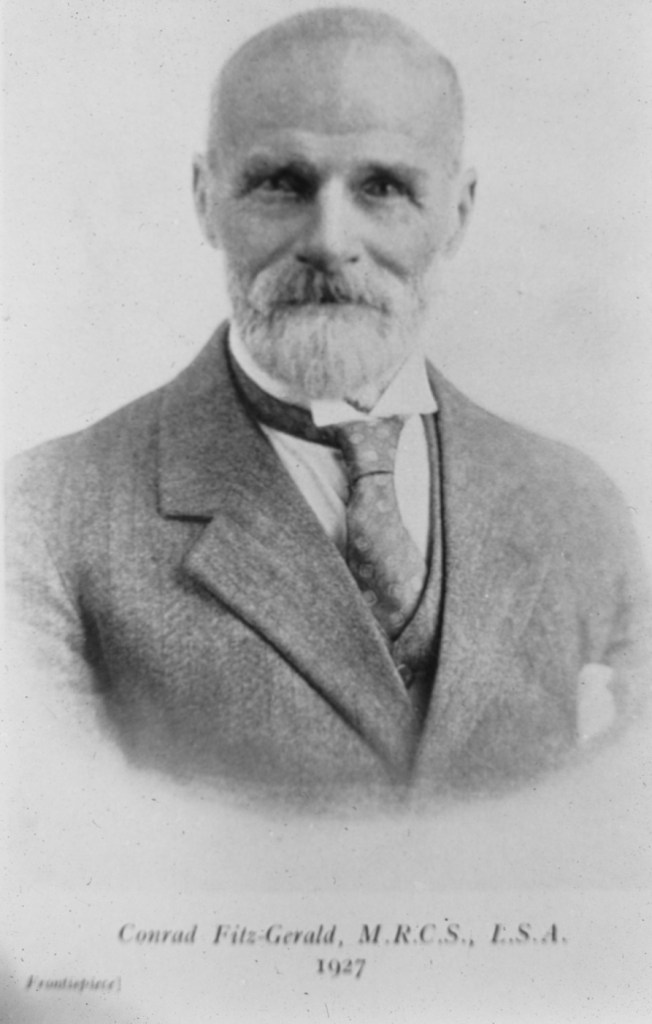
A book titled The Albatross, written in 1935 by his grandson, also named Conrad Fitz-Gerald, provides us with a description of getting a small schooner built and outfitted. It gives quite a detailed account of the vessel which was so familiar to the communities around Fortune Bay until its unfortunate loss in 1916.
Dr. Fitz-Gerald approached several people, in Harbour Breton without success, concerning the building of his boat. He was advised to visit Skipper John Cluett of Belleoram which is located about twenty miles further into Fortune Bay. Cluett was well known for his skill in building boats of all types and sizes. A trip to Belleoram ensued and after a lengthy discussion the two reached a contractual agreement. John Cluett agreed that, for a sum of fifty pounds, he would build a yacht of about seven tons. Fifty pounds would be approximately five thousand of today’s Canadian dollars.
Throughout the winter of 1875 Dr. Fitz-Gerald carried out his medical practice visiting all parts of Fortune Bay in Newman and Company sail boats and, as often as not, in row boats or on snowshoes through the wilderness between settlements. By the arrival of spring he had decided that an appropriate name for his new yacht would The Albatross. The albatross is a bird he had seen many times during his years at sea while serving on a British Naval Ship in the southern hemisphere, notably near Australia and India. He had served as ship’s doctor on the seventeen hundred ton sailing ship Anglesey. The author states that Dr. Fitz-Gerald had witnessed those large birds “swooping majestically over breaking seas, and he had thought that if he ever owned a ship he would like it to weather wind and wave as bravely as they did.”
During the winter he acquired a piece of hard wood from which he carved a figure-head for his yacht. After many hours of carving and painting he produced “a beautiful gilded and accurate model of an albatross head,” which he would install on the prow of his ship.
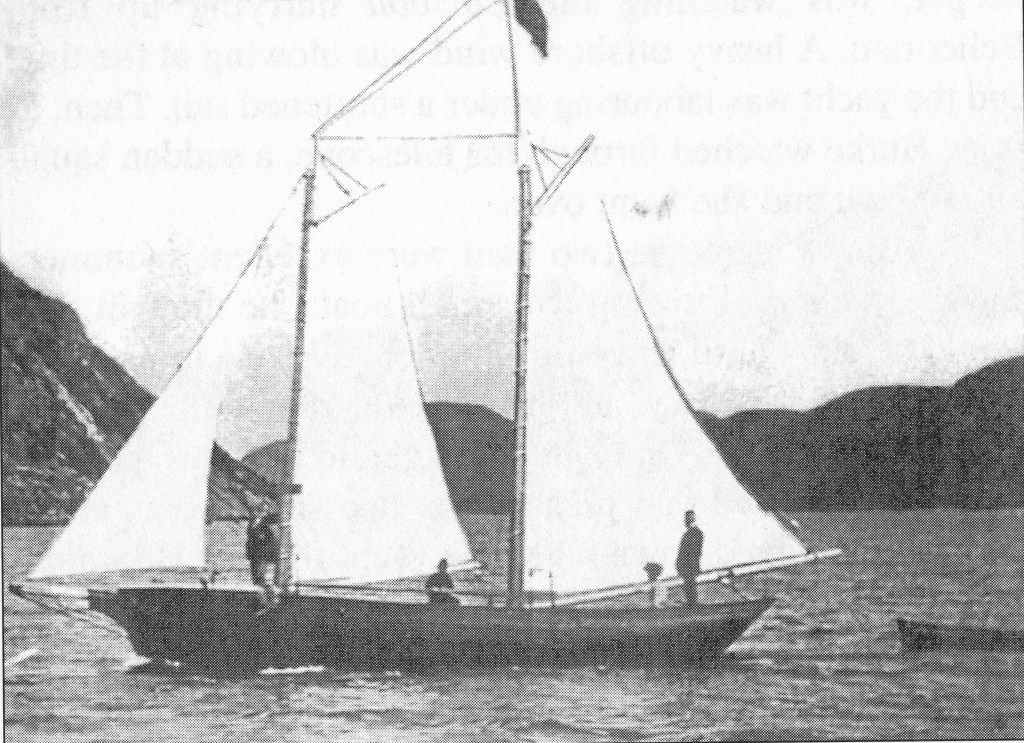
On June 15th 1876 the doctor received a message from Skipper John Cluett informing him that his boat had been launched and was waiting for him in Belleoram harbour. With great excitement and anticipation, he arranged for a crew to convey him to Belleoram to take possession of her. His grandson wrote, “As he stepped on the deck of his little schooner he little thought that for forty years she was to be his close companion, conveying him through storms, tempests, and calms on errands of mercy in the service of several hundred rugged fishermen and their families.”
In the logbook of the Albatross, which contained an account of every voyage he made during his many years in Fortune Bay, he recorded the following:
Schooner Albatross, built at Belleoram by John Cluett during the winter of 1875-76.
Length of keel 25 ft.
Length overall 30 ft.
Length of mainmast 30 ft.
Length of foremast 28 ft.
Length of topmast 12 ft.
Beam of 9 ft.
Draught aft. 4 ft. 9 in.
Draught forward 2 ft. 9 in.
The boat was rigged in much the same way as a regular schooner. The Albatross carried “a jib which was attached to a jib boom about twelve feet long, a foresail and mainsail. Just forward of the foremast a ‘gipsy’ windlass was erected.” The masts were about seven inches in diameter at the base and installed to slope slightly backwards towards the stern. The rigging was of rope typically used on most schooners of that day. The builder had placed three rows of reef-points in the mainsail, two in the foresail and one in the jib. Years later he replaced the rope with wire.
The Albatross had a rail eight inches high around the deck. At various points were wooden pins used for the purpose of securing the sail ropes. The cabin, located amidships taking up almost all the space between the masts, was ten feet long and about four and half feet high. Its roof protruded about eighteen inches above the deck. There was enough room inside for two sleeping berths and two seats. Space beneath the seats was used for the storage of food.
There was a space about six feet by five feet by three feet for standing room aft of the mast. This was cut into the deck to allow the helmsman some degree of protection from the weather. Under the deck, between the cabin and the standing room, was the main storage locker which, in addition to food storage, was also used for storing extra canvas, rope and other boating essentials. The author states that “a four-foot iron tiller was attached to the rudder-head, and the steersman from the standing room could control the tiller, main-sheet, fore-sheet and jib-sheet.” Ballast, a critical addition used to keep the boat balanced and steady, was stowed under the beams. Cluett used two tons of iron chain which was probably salvaged from retired vessels.
On June 15th Dr. Fitz-Gerald left Belleoram in charge of his first ship, and the life of the Albatross in Fortune Bay had begun. The following extract is taken from his logbook:
June 15th, 1876.-Left Belleoram at 9 a.m. Wind very light from S.W. to N. Fog dense with very heavy showers. Arrived at English Harbour West (nine miles N.W. from Belleoram) at 3 p.m.
June 16th. – Left English Harbour at daybreak and arrived at Coomb’s Cove (nine miles N.W. from English Harbour) at 4 p.m.
June 17th. – Left Coomb’s Cove a dawning. Wind westerly, foggy, passed many Turrs. About 9:30 a.m. anchored at Harbour Breton. Occupied in painting and fitting out until the 30th.
This was but the beginning of work for Doctor Fitz-Gerald as he laboured to make the Albatross ‘seaworthy and presentable’. Painting was the first order of business – red below the water-line and black above it. A yellow streak about an inch wide was also added which ran the length of the vessel on both sides. He fitted her with two heavy anchors of one of one hundred and twenty pounds and another of eighty pounds to replace the light anchor which came with her. Thirty fathoms of half-inch iron chain was attached to each anchor.
The vessel was examined thoroughly for leaks, including the seams of the deck, and all necessary work done to stop any water seepage. A small window facing the bow was added to the cabin to permitting a view of the deck and allow natural light to enter. It was covered on the outside with an iron grating. A small stove was set up in the starboard for’ard corner suitable for burning wood or coal. Berths were prepared by fitting wooden frames with netting upon which mattresses stuffed with shavings were laid. Eventually, blankets and pillows completed the sleeping quarters.
An emergency rope of two-and-a-half-inch warp, thirty-two fathoms long was coiled and stored on the stern for emergency use. Cabin lockers were filled with such things as a compass, lanterns, a sheath-knife, a lamp, flag, an axe, and various other things he anticipated he would need at sea.
A local cooper in Harbour Breton made a small oak water-keg which was kept aft tucked into the coil of emergency rope. Several of the carpenters employed by Newman and Company a very efficient bilge pump. To complete the deck side additions, iron mooring chocks were installed on each side of the bow and the stern.
In the cabin, according to his grandson, he placed “an important piece of furniture, a medicine chest given to Dr. Fitz-Gerald by his predecessor, Dr. Brunton. This chest was kept filled with useful drugs, and also a supply of surgical instruments. In the after hold a quantity of coal and wood was stored and a zinc-lined bread box. Another box contained cups, plates and cutlery, also some molasses and hard biscuit. Other eatables, such as butter and canned foods, were kept in the lockers. On the walls of the cabin hung a clock, mirror, and several shelves, which as time went on were heaped with many odds and ends.”
When the Albatross was ready for her maiden voyage all that was missing was a lifeboat. A small boat was borrowed and on June 30th1876 with the red ensign flying, and all sails drawing, the Albatross sailed out Harbour Breton harbour into the waters of Fortune Bay for the first time. At the helm was Doctor Conrad Fitz-Gerald accompanied by a two close colleagues for the inaugural voyage. He repeated this journey many times from his home base of Harbour Breton until he left Newman and Company in 1902 after which he moved to St. Jacques and established a private practice. From his clinic he carried on ministering to the medical needs of Fortune Bay residents until old age prevented him from doing so.
In 1916, the Albatross, while on a search and rescue mission, was struck amidships by the S.S. Hump which had joined the search efforts late into the evening. Wrongly assuming the Albatross was the distressed vessel, the captain set a direct course for her mast lights. By the time Doctor Fitz-Gerald realized what the captain of the Hump was probably thinking it was too late to successfully carry out an evasive maneuver. He desperately tried to get out of the way of the Hump but the Hump followed suit thinking the wreck was drifting. The Albatross was a total loss. He commissioned a second, similar vessel, named it the Albatross, which served him until his retirement.
Source
Fitz-Gerald, Conrad Trelawney. The Albatross: Being the Biography of Conrad Fitz-Gerald, M.R.C.S., L.C.A., 1847-1933. Bristol, Great Britain: J. W. Arrowsmith Ltd. Quay Street, 1935.
Flanker Press will be publishing my account of the tragedy of the night the Albatross was sunk in 1916, in Spring 2024. Watch for Misfortune Bay, by Alex Hickey.
 All Things St. Jacques, NL
Very interesting I remember my mother talking about Dr Fitzgerald
By: Georgina Cluett MacKinnon on October 16, 2023
at 2:16 pm
Great work Ales in keeping Fortune Bay history alive.
Calvin Hackett
Sent from Outlookhttp://aka.ms/weboutlook
By: Calvin M Hackett on October 16, 2023
at 3:09 pm
The builder, John Cluett, was my Great Grandfather.
John (Jack) Cluett, Picton, Ontario
By: John Cluett on October 16, 2023
at 4:07 pm
Great story,
Wonderful to hear these historical tidbits.
My father Joseph T Miles ( 1915 – 1998) and his siblings grew up in Mose Ambrose. My Grandparents lived there, my grandmother Mary Ann Miles (Bullen) 1880 -1985 (105ys) moved to Halifax in 1945. My grandparents are in the Mose Ambrose cemetery.
All things St. Jacques, NL ⭐️
Thank you Terry Miles
terryandgailmiles@gmail.com
By: Terry Miles on October 16, 2023
at 7:19 pm
Thanks for your new post. I knew of the Albatross disaster but little else. Now I know the full story Ted
Sent from my iPhone
>
By: Ted L on October 20, 2023
at 11:43 am
[…] More information about Dr. Conrad Fitz-Gerald and his medical schooner, The Albatross may be seen on my Blog page The Albatross. […]
By: Misfortune Bay: The Loss of the Albatross | All Things St. Jacques, NL on May 2, 2024
at 1:47 pm
The late Ella Manuel was fascinated by the story of Dr. Fitz and read on the CBC years ago a story about him and his work in Fortune Bay. (see “No Place for a Woman . . ” Breakwater; and the podcast series “Down to Sally’s Cove”). It puzzles me that in his grandson’s book about Dr. Fitz, and in the memoirs of Hugh McDermott there is little cross-reference from one to the other, though their work in Fortune Bay overlapped in time.
By: Antony Berger on July 22, 2024
at 5:24 pm
Thank you Antony Berger. I thoroughly enjoyed listening to your reading of Ella’s piece about Doctor Fitz. I will seek out a copy of “No Place for a Woman.” Your observation about the lack of cross-reference of these men in “The Albatross” and “MacDermott of Fortune Bay” has also intrigued me. It does cause one to wonder about their relationship and their perceptions of each other’s work. I have not encountered records of any significant interaction between them.
By: alexhickey on July 26, 2024
at 12:01 pm
Hello Alex
Yes I had the feeling that they did not much care for each other. Of course Fitz was a doctor, not a cleric: Mc Dermott the converse. Still I would have thought they might mention each other more than in passing.
Tony
By: Antony Berger on July 28, 2024
at 10:01 pm