Alex Hickey June 2026
How often do we look at a photograph and hastily conclude that we know what it’s about? More often than not, I suggest. A short while ago I received a message from an acquaintance telling me of how a friend of his had been looking at a photograph on my Blog and had a few questions for me. He put us in touch. What followed was a delightful exchange of information and conversations, one of many I’ve had with readers since starting the Blog, All Things St. Jacques, in 2013.
The photo this gentlemen was inquiring about was in a post I had written in 2023, titled, The Iron Buoy. It was about a buoy that generations of St. Jacques mariners used for anchorage and maneuvering sailing schooners far enough from shore to capture the wind in their sails. The image showed a small seaplane secured to the buoy sometime in the 1940’s. Very little was remembered about the event beyond that it happened. One elderly lady recalled for me that it was somehow connected to a local airman, Harry Young who once lived in the community. I was curious about that and attempted further research but wasn’t able to find any more information. For three years the photograph was looked at, commented on and marveled at by viewers. During that time, no new information emerged. My curiosity around the plane didn’t abate. I wanted to know where it came from, why it was there, who owned it, where it flew when it left, how long was it there, who was on the plane, and who the pilot was, yet, the questions all remained unanswered.
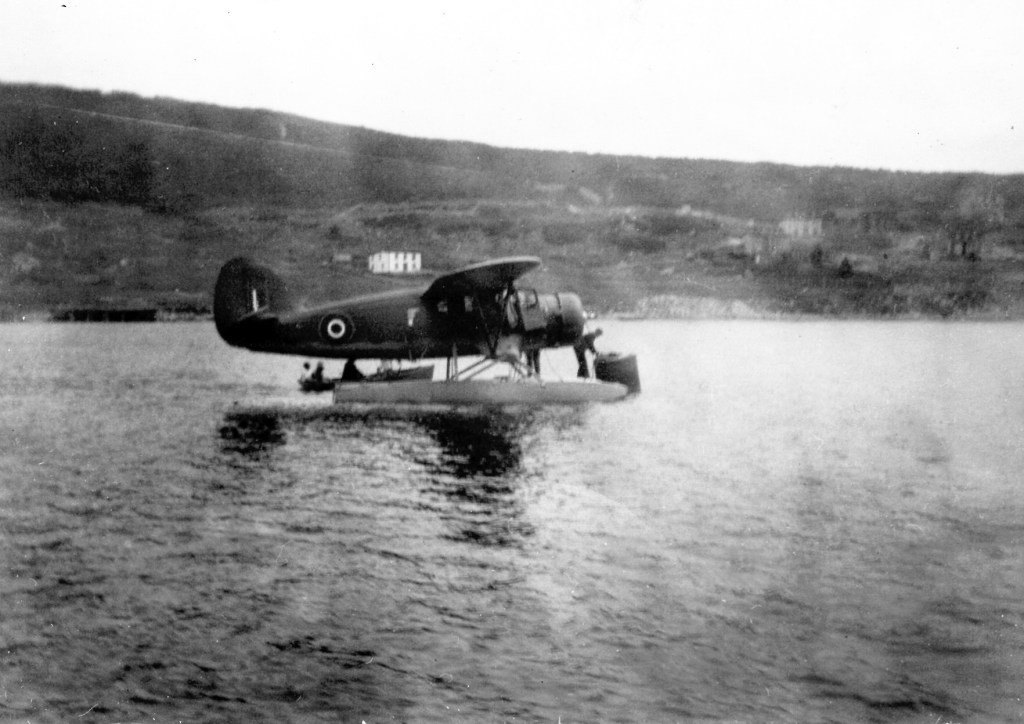
Keep in mind that the primary reason for posting the image was to show the buoy. All other questions were secondary at that time. However, all that changed when I contacted the gentleman who had inquired about the photograph. Sean Gilmore, born in 1934, suggested to me that the man who flew that plane, was his father, Joe Gilmore, who was stationed in Gander with the Royal Air Force. The plane was a Norseman, manufactured in Montreal. Sean thinks this one had been nicknamed the Flying Caribou to honour the S. S. Caribou and the many lives that were lost when it was torpedoed and sunk while crossing the strait between Nova Scotia and Newfoundland on October 14th 1942, by a German submarine.
It got even more interesting rather quickly for Sean then told me that this photo was taken either upon arrival or departure in the summer of 1943 or 1944 and he was one of the passengers on that plane. His supposition was that it was most likely a departure image given the small boat which was likely delivering him to the plane. It turned out that Sean’s father was a good friend of an aircraft mechanic from St. Jacques, by the name of Harry Young. They worked together at the airbase in Gander. Sean, who was about 10 years old at the time, had just spent the summer in St. Jacques with Harry’s parents, John and Isabelle Young. In Sean’s words, “My dad had flown me to St Jacques in ‘43 or ‘44, when I was 9 or 10 years old. Harry Young was an aircraft mechanic with the Royal Airforce Transportation Command (RAFTC), my dad was chief engineer RAFTC. I really have no idea or the details of the arrangements or how it came to be that I was to spend my summer in St Jacques, and to be fortunate enough to spend that time with the Young family. I recall the buoy and tying up to it, being rowed to the wharf, and feeling very much at home the whole time while there. St Jacques in many ways reminded me of our home, a coastal town named Ardglass in County Down, Northern Ireland.”
My initial contact, which led me to finding this information, was with author Darrell Hillier of Gander, whose book, North Atlantic Crossroads: The Royal Air Force Ferry Command Gander Unit, 1940–1946 was published in 2021. I had met Darrel previously and his book was in my library, however, I had not gotten around to reading it. You can surmise what happened then. I soon found a comprehensive accounting of the role Sean’s father played in Gander during WW II.
Darrell is an avid historian as well and this story was new to him. He set about finding out more. He messaged me with the following:
“The RAF Ferry Command at Gander kept two flight logs, one external for overseas flights, and the other internal for local flights and those incoming (mostly bombers) from Dorval in Montreal. Fortunately, these logs survived the war. I checked the internal logs and found one relevant entry: On 23 July 1944, Captain Joe Gilmore flew to St. Jacques and return in Norseman FR405. This was the only entry I could find referencing St. Jacques. Perhaps Sean was on this flight!”
Indeed he was. I sent Sean 1945 Census information for St. Jacques and asked him about his recollections of that summer.
“One of the first things I did after reading your posting was to look up the census data exactly for that reason. Making friends was easy, unfortunately I do not recall names and only some of the many adventures we shared. My memory is just not that good, and frankly last names were really not that important when you’re 9 or 10 years old There was one of my friends who was very proud of his family name. Time has played its tricks. I thought it was Freeman or something similar but I could not find anything close to that in any census I read. What I do remember was that his home was on what I think would be the Western curve of the harbour. If my memory is even close I would say, for reference sake, the Young home was on the Northern side. That’s about as close as I can get to names of those I met. One other thing that comes to mind was having to go by boat to Belleoram for a haircut. There was no barber in St. Jacques.”
I asked Sean to share more of his recollections of that summer visit. This is what he wrote.
“I recall my first taste of dried caplin. We, I mean my friends and I, would carry pockets full and snack on them during our adventures around and outside of the bay. The Young family had bins of caplin in their attic. I’m guessing that everyone in St Jacques had similar arrangements.
On one occasion, Mr. Young showed me his sidearm. It was a Luger in an unusual wood holster. The holster served a dual purpose, via a rail-like system, the firearm could be mounted to the holster and used as a rifle. He told me he carried it, particularly when sailing to the Labrador coast, and once was obliged to shoot a sled dog that had attacked him. It’s not unusual for a kid to remember a story like that. I also have a recollection that he had owned and operated 11 schooners, and lost them to storms. The number comes from memory and may not be exact. I remember too, the wharf resident Sculpin. I watched it many times herd smaller fish, what I think folks called Connors, into a sunken 45 gallon drum, then follow them in, and the only thing to exit would be a Sculpin with tails sticking out of its mouth.”
The Young Brothers, John, Sam and Randall, were members of a merchant family who operated a fishing business in St. Jacques for nearly a century. During that time they owned and lost many vessels.
During our conversations Sean mentioned something quite similar to a story my grandmother told me about when she lived on St. Jacques island during WW II where my grandfather was the lightkeeper. She recounted of living in fear of Germans coming ashore on the island and attacking them. At night, she said, they could hear the submarines surface and run their generators to charge their batteries under the cover of darkness. At times they could hear their voices on the wind. Sean recalled, stories he had been told while in St. Jacques that summer of “German submarines, on occasion, tying up to the buoy during the night, running their diesels to charge batteries and hearing crew member walking and talking while on the deck. Those that told the story had absolutely no doubt that the subs were indeed German and could point to sub identification silhouette posters hung on the wall in what served as the post office. I have no idea if the stories are in fact true. I was certainly convinced.”
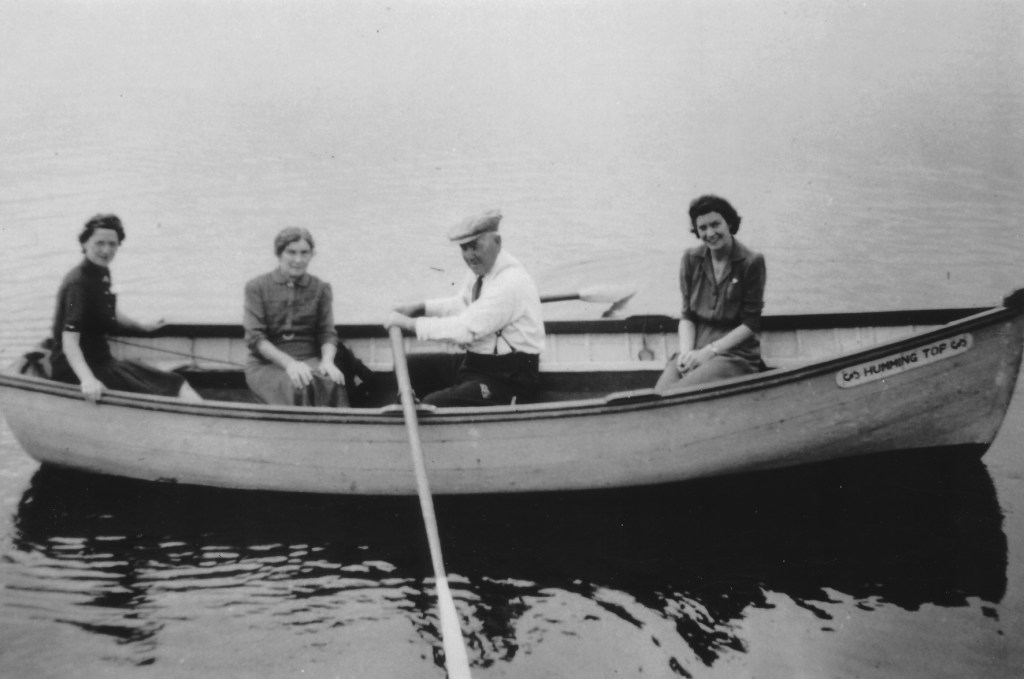
If you look closely at the photograph of the Norseman plane, you’ll notice a rowboat on its Port side. It looks quite similar to the ‘Humming Top,’ which was was owned by John Young, Sean’s hosts for that summer visit. The image below shows John, his wife Isabelle and two other women in the boat.
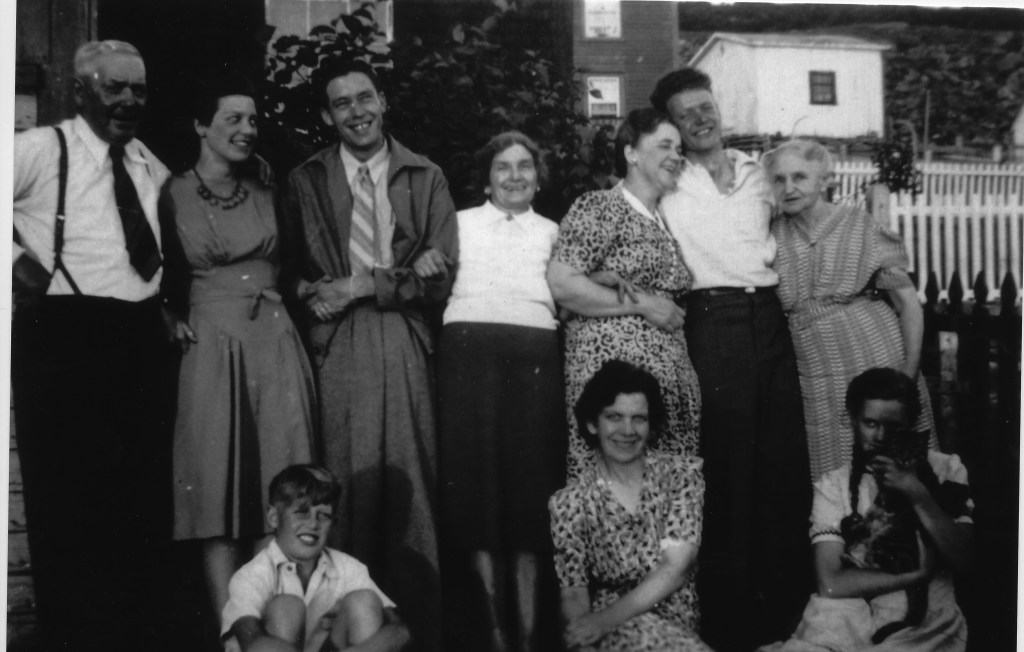
I sent Sean several photographs from that time period to assist with memories, including one of John Young’s family taken on the roadway outside their home during WW II. All of his children were adults by that time. Seated on the ground at the bottom of the image was a little boy whose identity always befuddled me. Through the years I’d asked various descendants who the child might be. None knew for certain. I was hopeful that Sean might recall the child. He sent me a message soon after receiving the images. He said of the group picture in particular, “I think, so far, the only one I recognize is Harry Young. I feel that I remember the younger women. It’s been a long time, and I am 92 – that’s an acquired excuse! For a while I thought the boy pictured sitting in the group photo might even be me. I have no idea how that would be possible without a date for the photograph.”
In a follow-up message he said, “Alex, is there a date on this photo? I am reasonably certain that I am the guy sitting, knees up, near Mr. Young. If I am correct it would have been taken shortly before I left. I remember we had a special meal, I think it was goat, and it was delicious, a special meal for a special occasion, though I have no idea now just what the occasion may have been.”
The occasion seems to have been a family gathering with their son Harry and their daughters having returned home for a visit. Of note, John and Belle’s daughter Mollie had married a British airman, Harry Rymer, who is also in the picture. That may have been the reason to celebrate.
Sean added, “You know, I may have seen this picture before, many years ago. I’m really grateful to you for resurrecting it, not sure that’s the right word, but you know what I mean.”
At the end of that message he added: “PS. I checked with my wife. It’s official. She thinks it’s me!”
Now that you’ve met Sean Gilmore through his memories as a child visiting St. Jacques let’s explore who he grew up to become as an adult.
Sean Gilmore’s father’s life ended in tragedy. On May 15, 1945, while en route to Montreal, the Norseman crashed near Charlottetown, Prince Edward Island. Both Joe and his passenger were killed. His body was brought back to Gander for interment at the Gander Commonwealth Graves Cemetery, Row 14, Grave 11.
After his father’s death Sean and the rest of his family moved to Canada aboard a B24 Bomber. In the workforce he worked as tool and die maker with Northern Electric for eleven years while studying at McGill and Concordia in Montreal. In 1966 he promoted to Human Resources (HR) Manager, then in 1968 became head of Selection and Placement. In 1971 he was appointed Director of the Transmission Division. In 1975 he moved on from that company to join Union Carbide as their Human Resource Director of their Metals Division. Within a few years he was HR for all of Union Carbide in Quebec responsible for all employee relations including negotiating collective agreements. Come 1979 he assumed HR responsibilities for the company Canada-wide. He left Union Carbide in 1984 to join another company, Twinpak, in a similar role, from which he retired in 1991.
In 1982 Sean acquired his pilot’s license. After retirement he bought and refurbished an older Piper Cherokee 140 plane. During those years of flying he met his present wife and in 1990 they established a Flight Training School which they ran for eleven years. Before selling that enterprise they bought the design and manufacturing rights to an aircraft building kit called the Bush Caddy. They designed and built new and larger aircraft ranging from two to four seaters and sold them world-wide. In 2010 they sold the business and retired. He and Marlene married in 2011.
Sean Gilmore, as you’ve seen, has had a busy career, but there’s more. He’s been a SCUBA diver since 1953 and in his early days designed and produced SCUBA related products. In 1964, along with another diver, he convinced Parks Canada of the importance of underwater archaeology. They did trial projects in the Richelieu River and later in Lake Huron. There, they recovered a fur trade bateau. This led Parks Canada to conduct further underwater archaeology which has included recovery of much of the French ship Michaud, the Red Bay Basque Whaling ship in Labrador and explorer Franklin’s ship the HMS Erebus, which Sean points out, ironically occurred fifty years almost to the day after they found the first fur trade bateau which convinced Parks Canada that underwater archaeology was worthwhile.
It is often in the ordinary moments of life that we find the most extraordinary things. In the many times I looked at that photograph of the Norseman plane tethered to the Iron Buoy in St. Jacques harbour I never wondered who was sitting in that rowboat on the plane’s port side. Yet, in the many time I looked at the photograph of the Young family I did wonder who the child was in the foreground. The photographs were taken by different people for different purposes. A seaplane was a novelty, and during wartime, a significant curiosity for everyone. The family portrait held significance to those in the picture, who would soon disperse, as a record of their gathering. Over the years I’ve met many of the descendants of that family including the grandson of Mollie and Harry Rymer, the daughters of their son John Jr. who wasn’t in the picture. Never did I imagine I would make a connection between the two photographs, not until Darrel Hillier put me in touch with Sean Gilmore.
There is always so much more to be seen in a photograph than we first surmise, so much more than the image is intended to capture. In a world saturated with visual imagery and technological innovations that can fuel a false sense of knowing we could do well to treasure those images from our past. They offer more than nostalgia, more than they intended at the time. For eighty-two years those photographs of the mooring Buoy and the Young Family have existed and carried forward, seen by many eyes, reflected upon by many minds, then along comes a key to unlock their connection, to tell the world a story.
I’ll leave the last word of this posting to Sean. “Thanks again, Alex, for bringing back through your posting, memories of some of the best years of my life, in particular my time in St. Jacques.”
*The word buoy is frequently pronounced with a silent ‘u’ in traditional Newfoundland English. That pronunciations may plausibly derive from Middle or Old European languages which were brought to the island by early settlers and have survived intact for centuries.
Links to Explore
Canadian Heritage War Museum – Norseman


Thanks Alex for a wonderful and interesting read! Thoroughly enjoyed from beginning to end, like you said, so much to see and learn from a photo from the past! Camilla Farrell
By: happysoftly3c25426202 on June 3, 2026
at 8:19 am
Hi Alex Wonderful informative story. My father was from Mose Ambrose – born and raised his parents were George and Maryann Miles ( nee Bullen) buried in Mose Ambrose cemetery. My Grandmother was born in 1880 and died in Halifax 1984/85 age 105. ( she now resides in the Mose Ambrose cemetery – in the Miles plot) Her husband George has predeceased her at an early age. Dad ( born 1915) and his siblings left Mose Ambrose for Canada and the US. Dad as a young man did some work with maintaining the telegraph line along the south coast communities and also the post office. In the early 40s he left home to join the Royal Navy and went overseas (WW2) after the war he came back to settle in Gander (YQX) because of his previous experiences and war time ship duties etc. He worked for Gander Aer Radio until his retirement. I was born 1947 and raised in Gander ( American Side) and then the new town site, so I grew up with the Aviation History attached to Gander. In you story you mention a few Gander connections. The reason I mention this is because of my connection to the St. Jacques NL district. I am wondering if it would be ok if I were to send this history/information to Gander a few information based historians and Gander Facebook.
I currently live in the Halifax NS area. I am on your mailing list and I really do appreciate the information and stories you send out. I have a few cousins living in the US and I forward some. We are all getting a little long in the tooth so it’s good to keep informed and pass on because I fear soon the history could be lost. LEST WE FORGET. CHEERS Alex
Terry Miles terryandgailmiles@gmail.com tell: 902-864-8532,
PS please let me know if you receive this note.
By: Terry and Gail Miles on June 10, 2026
at 8:16 pm
Hi Alex,
Thank you very much for the article Buoy and a Boy. I really enjoyed reading it and learning some stuff about my grandparents John and Isabella Young. Dad had told me some stories about grandfather. I don’t think he ever mentioned that grandfather had a Luger but I do know he was an excellent shot. Dad told a story about how grandfather was tied up in Charlottetown harbour, and there was a schooner tied up on the other side of the harbour that belonged to somebody he knew. For a practical joke he put a silencer on his gun and shot out the rope that held up the flag on the other schooner. I wonder if he used the Luger to do that.
Dad also said that grandfather was also an excellent sailor. On one occasion he was coming up to St. Peter’s Canal in Cape Breton and there was another schooner he wanted to get ahead of. So he kept the sails winged out, passed the other schooner, and kept the sails winged out as he went through the canal. That was before they widened the canal and he claimed he never even touched the sides of the canal as he went through winged out.
In the family photo from left to right is grandfather, Aunt Mollie, Harry Rymer, grandmother, not sure but probably a daughter of Samuel or Randall (Janice thinks that might be Aunt Hazel), Uncle Harry, that might be Martha Pike Reeves on the far right she was married to grandfather’s brother Samuel. In front in the middle is Aunt Sadie (Sarah Adelaide). I don’t know who the girl with the cat is, I’m guessing a granddaughter of either Samuel or Randall. I always wondered who the boy is front was, now I know! In the boat with grandfather is Aunt Sadie and Aunt Mollie. Mollie met Harry Rymer when he was stationed with the British Navy in St. John’s. After the war they moved to England. I didn’t know Uncle Harry was with the RAFTC, he later went to work for Air Canada as an airplane mechanic in Toronto.
I do have a family story that was passed down by my mother and I’m wondering if you have heard the same. Mom said that the family name isn’t supposed to be Young, that it should be Garrett (or possibly Gallop). The story is that a Garrett had deserted from the British Navy and was in hiding somewhere in Fortune Bay, but I don’t know where. The local people were keeping him hidden because the British Navy was searching for him. In order to help hide his identity he married one of the Young girls and took her surname.
Best Regards – Andy Young
By: fuzzy60117004c6 on June 28, 2026
at 3:40 pm