This site is dedicated to bringing you interesting information about the community of St. Jacques which is located on the north side of Fortune Bay in the province of Newfoundland and Labrador, Canada.
“Nothing can bring you peace but yourself.”
Ralph Waldo Emerson
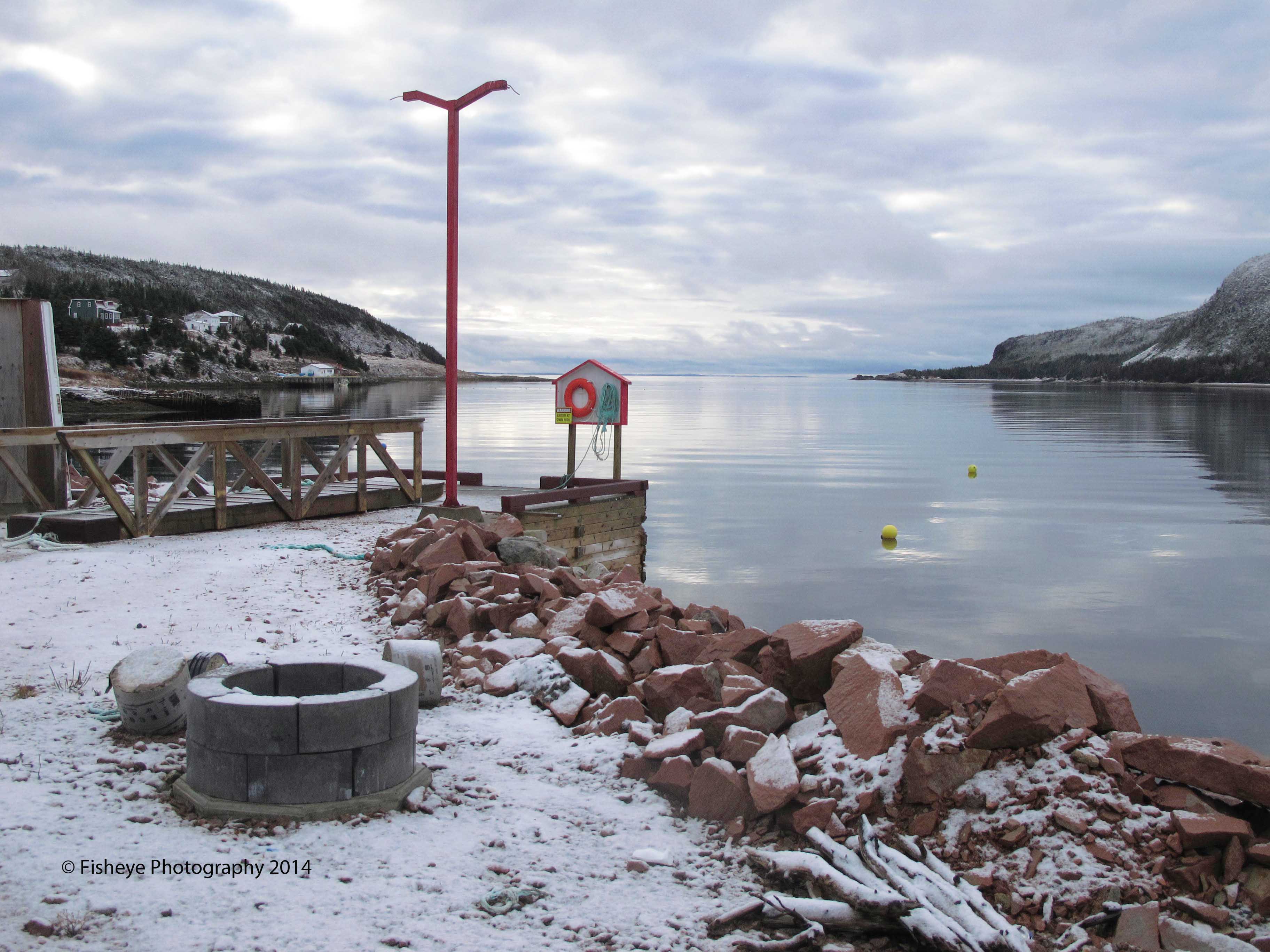
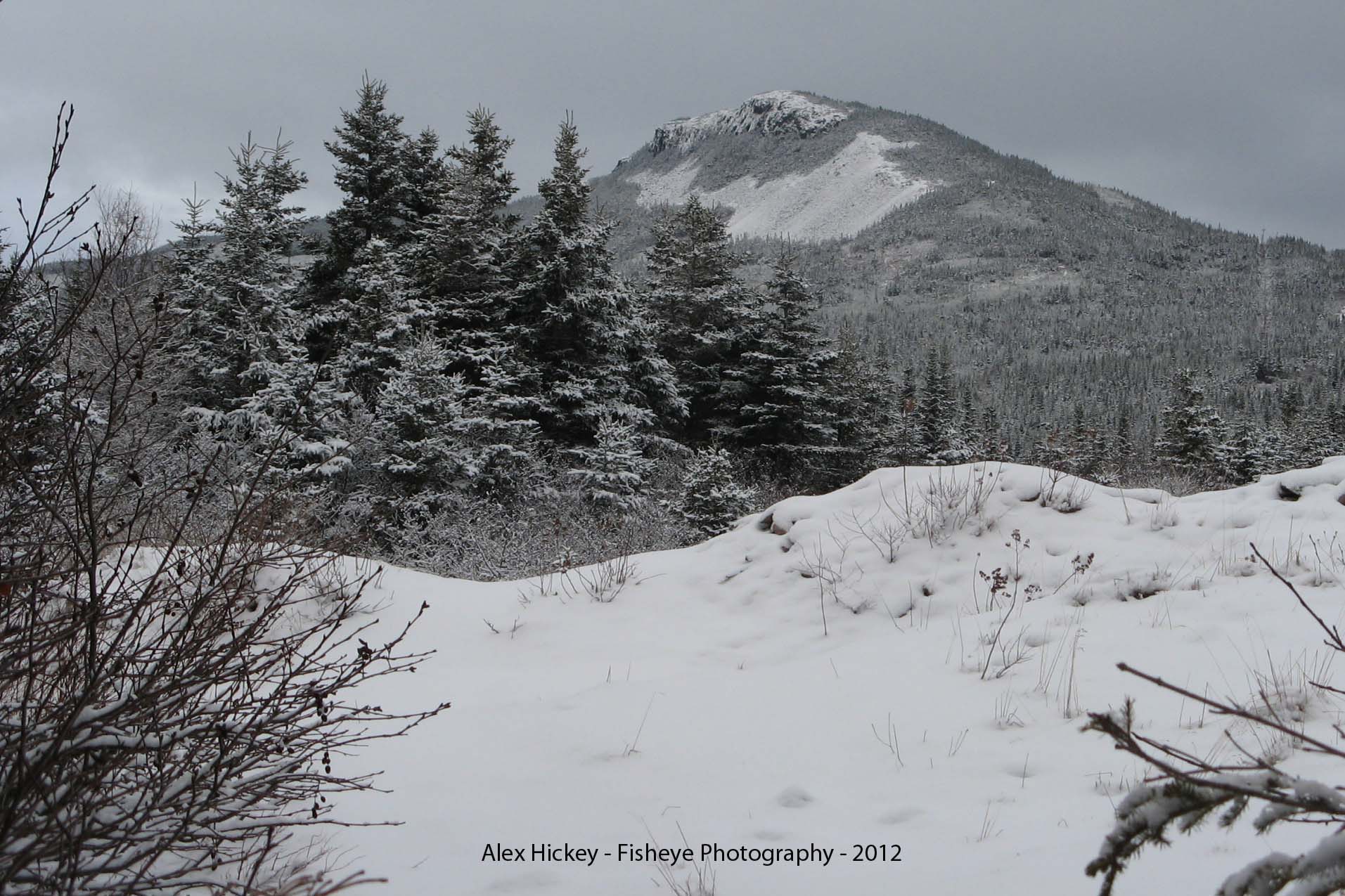
Beyond the black snow-capped spruce which blanket the hills surrounding the placid harbour this morning the sky seems undecided. In a typical December manner, it vacillates between allowing the mellow light of a low sun to fall on my shoulders and piling high the mountainous steel blue clouds which dwarf Bottle Hill. Off to the West’rd the crest of Buttercup guarding the entrance to Blue Pinion peeks above the treeline and glows in a shaft of sunlight. So too does the back side of English Hr. Mountain which appear to have risen above its stature to reach the heavens and its gift of light.
Above them all, intricate layers of tufted clouds stack themselves in an ever-changing display of shape and form as though an omnipresent hand were stirring the pot. In one moment there are deep blue’s evocative of the arrival of night, then, thin wisps of ethereal whites appear which fade to nothing as I watch. Then, if I look beyond the harbour entrance, the thin strip of black underlining the horizon which I know to be the Burin Peninsula, is dwarfed by curtains of clouds ascending as far as my eye can see.
At the high-water mark last night’s dusting of snow has yet to melt. It clings tentatively to blades of grass and branches of ambitious spruce stunted by years of salt spray. Clusters of dead straw, yellowed and rigid, stand aloof, unmoved and unaffected. Where layers of grass form miniature canopies for hardy insects and winter mice, dark green shadows remain protected from the thin white covering.
In the land-wash dark clusters of seaweed cling to the rocks and slipways, their rich brown and green tones adding depth and texture to a shoreline still wet from the falling tide. Occasionally, when the sun peers through an opportune opening, fine jewels of salt water wink back at me, reflecting the mirrored harbour surface.
From the Barachoix Point to the Government wharf, from Edgar Dyett’s store to Burkes Cove, from the mouth of Pittman’s Brook to the headland at Louis’s Cove there is not a ripple, not a single wave, just water unbroken by even a gentle breeze or the breach of an errant fish. It extends beyond Eastern Point, the Island and on out through Fortune Bay, perhaps all the way south to Jamaica and across the Atlantic Ocean to the shores of Spain.
I imagine a boat making its way out the harbour splitting the surface like a knife sending symmetrical waves to the east and the west which gradually lose form and eventually reach shore with a gentle lick against the waiting rocks. But there is no boat this morning. Fishermen are taking a break from harvesting; enjoying the company of family and friends. Yet they do not remain idle. Along the side of the cove where the Young’s family business operated during the last century, chimneys in smaller fishing stages announce that work is progressing on preparation of gear for the next fishing season. Tendrils of white smoke lazily creep forth from chimneys around the harbour and by the time they’ve reached the height of church steeples they are no more.
Patches of blue sky behind Bottle Hill accentuate its gracious undulating shape which sweeps upward to a delicately rounded apex. The scree, dressed in a cape of white, draws attention to the dark evergreen branches now transformed into a salt and pepper forest. A moment ago I heard a chickadee call it’s courageous, small voice, announcing its presence to all who care to listen.
For just a few seconds a sliver of sunlight penetrated the cloud and made a pass across the cliff face of Winterhouse Hill as if to shout, hey look what I’ve found! I stand still and marvel at the stoic rocks which have watched down over this community from its beginning. I imagine it as the great glaciers flowed seaward, taking with them soil, tress and boulders to be left miles away. I then picture it as it emerged from retreating rivers of ice transformed into an expansive wall of sheer granite standing guard, watching our backs as we look to the sea.
Pittman’s Brook falls has been serenading us for the entire season; it’s readily recognized timbre serenading the entire harbour; its resonant tones of cascading water enhanced and accented by the texture of splashing and spraying as it flows down a staircase of layered rock. Seagulls have been bathing and socializing in its effluent for several days, quietly splashing water beneath their wings and dipping their beaks and heads. Earlier this morning, a great black-backed gull stood at the water’s edge for almost an hour, listening, watching and moving inch-by-inch down the beach as the tide fell, maintaining its contact with the retreating ocean. Its black eyes observed every movement and its head turned to investigate the smallest sounds, even that of a camera shutter clicking.
Friar Rock, ever-present and elegant, stands solitary as the waters escaping from a string of ponds that reach for miles into the woods behind St. Jacques and Belleoram swirl past on their way seaward. With equal strength it awaits the rising tide and stands firm against every force of nature. Today it is wrapped in the quiet tingling sounds of water returning home to the sea.
One would be challenged to not pass reflection on the peacefulness, the solitude and the overpowering sense of belonging that accompanies an early morning walk anywhere in this community of St. Jacques. There is harmony between the fleeting human soul and the eternal spirit of nature in places like this; a harmony which makes each step soft and light, each glance at one’s surroundings fulfilling and accepting. Every fibre of being feels the oneness of body and soul; of water and land, of sea and sky, of yesterday, today and tomorrow.
As Thoreau observed in writing about Walden Pond in 1845, “I have, as it were, my own sun and moon and stars, and a little world all to myself.”
That was usually the last remark from my mother as I traipsed out the door on the first day of Christmas Holidays. Off I would go, up over the hill behind our house to seek out the perfect tree that would become the centre of attention in our living room for the full twelve days of the season.
For some strange reason it invariably turned out that the first tree was the best one though it would take a couple of hours wandering across the hillside to realize it. Depending on the amount of snow on the ground those two hours were either pleasurable or hard work getting around. The experience intoxicated me with the spirit of what it meant to cut a Christmas tree. The sharp echo of every broken twig carried through Billy Cluett’s valley and seemed to bounce back once it reached Winterhouse Hill. The smells of resins seeping from evergreens and the decay of leaves combined with the clean crisp air spoke of a forest going to sleep. And here I was, choosing a tree to mark both hibernation and birth; a shutting down and a new beginning; taking a tree home to be transformed from the ordinary to the treasured.
A December without snow meant bringing home the tree, storing it in the shed until it was brought into the house for decorating. During those years with snow it meant making even more of a judgement for every tree was already decorated with cream puff snow balls and glistening icicles. Once home the ice and snow had to be melted before bringing it into the house on Christmas Eve. The timing of the entry of the tree was never negotiable and there were Christmas Eves when the tree dripped tears of joy between the decorations.
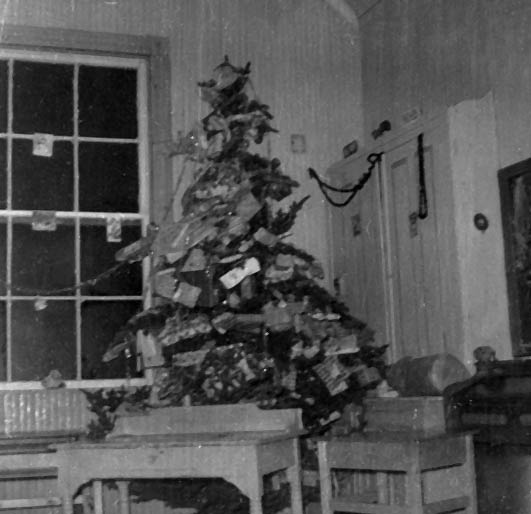
Christmas Tree, St. Michael’s School, St. Jacques
Of course this wasn’t the first Christmas tree of the season. In fact it was the second, for both Sacred Heart and St. Michael’s one-room schools boasted a tree precariously perched on a corner table or desk at the front of the room, usually to the left of the teacher’s desk for some inexplicable reason. Decorated with the imaginative creations of young children and an occasional old bell or bauble brought from someone’s home in the distant past, the tree captured our collective imagination days before school closed for Christmas. I don’t recall who cut the school trees; however, looking back at their pathetic, misshapen forms, I’ve concluded that the person didn’t spend two hours seeking them out. It also tells me my theory of the first being the best doesn’t work for all Christmas tree sleuths.
The classroom tree would never have made it in a competition for best shaped Christmas tree on any of today’s reality TV shows. Nor would it inspire a Victorian Christmas card. Yet, we thought it magical! That frequently barrel-shaped collection of uneven branches decked out with its motley collection of decorations with a bruised and tilting star atop inspired us all and invoked varying Christmas morning dreams among us. Surprisingly, its presence didn’t raise questions of Santa Claus nor did it diminish the expectations of our own Christmas tree at home. It simply added fuel to burning expectations and heightened the anticipation of time out of school. Some years it would be still standing when school reopened in January, most of its boughs bare and branches drooping from a lack of water; stripped of its majesty and magic, a mere reminder of the hopes, dreams and greed it embodied just a few weeks earlier.
The decoration of our tree at home rested with our mother for years; that is, until the older children had crossed over to the adult view of Christmas and could be trusted to keep the mystique alive for the younger siblings. That’s when the primary responsibility was passed on and the tree became a more communal responsibility.
Throughout the twelve days of Christmas I saw the trees of all my friends and those of my parent’s friends. Upon visiting a house for the first time the invitation was offered to come and see the tree. That meant, at the very least, standing just inside the living room door and offering an obligatory compliment regardless of whether the tree fitted into the good, bad, or ugly category. At its worst you were invited to stand beside the tree while someone told the story behind each gaudy but special ornament. As the season wore on, if you encountered someone whose house you hadn’t visited, the observation would be made that, “you haven’t been over to see our tree yet!”
Prior to the advent of electricity in St. Jacques in the mid-sixties, lights were not a decorating phenomenon. Whereas today lights are the common element of most decorations, back then the common element was silver tinsel! How it was applied varied from house to house. My grandmother used it sparingly, my aunt draped her tree as if dressing it for cold weather with waves of silver cascading down its branches hiding most of the other decorations. Neighbours used it to disguise imperfections, to help give shape to shapeless saplings. When the tree came down every effort was made to rescue as much tinsel as possible prior to discarding the tree to the woodpile. However, by the following year the saved tinsel had worked itself into an entangled mass defying anyone to extradite anything but a few shortened strands. After several years usage the tinsel lost it sparkling reflective qualities as it got bent and twisted, adding little to the tree but texture and something for the cat to make swipes at each time she walked by. And, of course, something to stick to your wool socks and travel with you until someone noticed your unwittingly decorated feet.
I still cut a “real” Christmas Tree. One of the enduring rituals when I first arrive in St. Jacques for Christmas each year is to scout out several choices. If there is no impending snow storm the pressure isn’t significant in waiting for my daughter to arrive to accompany me on those excursions; however, there have been occasions when she arrived late in the afternoon with snow on her heels. I recall once when we arrived back at the house barely before dark, two trees in tow and snow blanketing the ground dense enough to cover our footprints within minutes. Whatever the weather and whatever the shape of the tree, once decorated it took on a character and glow which endeared itself to all of us immediately.
The smell of a freshly cut fir tree standing in the living room defines Christmas for me more intensely than any other sensory quality. It takes me back to those hours of wandering through the forest behind my father’s house, pausing to assess and admire as I went about my crusade to find the perfect tree. It reminds me of those classroom days when the heat from the stove circulated the smell of the drying boughs throughout the room. Most of all, it reminds me of the simplicity of Christmas then when one could embody all that Christmas meant in a single tree cut just outside the fence of one’s backyard.
If you are wondering if I cut a second one for my grandmother, the answer is yes. I always cut two. Grandmother received the tree my mother rejected!
Merry Christmas!
Links
Below is a list of links related to this topic which you might enjoy:
All but three of the fourteen who volunteered came back. The St. Jacques men who enlisted in what was to become known as The Great War were not familiar with the sounds of artillery exploding or the whiz of bullets passing inches from their heads. Nor were they familiar with death on an unimaginable scale. Had they known, their zest to volunteer might have been tempered. However, they did volunteer and they brought home with them the sounds of explosions in their heads, the smells of death and the horror of what trench warfare did to human beings, along with the physical injuries they suffered. The stories of these men from St. Jacques haven’t been well documented and now are scarcely remembered.
Much has been written about the large numbers of volunteers who came forward and served with the Newfoundland Regiment. Much has also been written about the actions and loss of lives suffered by that fighting force. It is widely believed that the Regiment was Newfoundland’s first group of soldiers to be dispatched to fight for the Commonwealth; however, that was not the case. It was the 106 seamen of the Royal Newfoundland Reserve who sailed on the H.M.S Niobe from St. John’s on September 6, 1914 that were the first Newfoundlanders to take up active service. Newfoundlanders served on all classes of British warships. The Reservists were present at the Dardanelles during the Gallipoli campaign in 1915. They were also on war ships at the Battle of the Falkland Islands which took place on December 8, 1914. Some of the Newfoundland Navy volunteers participated in the Battle of Jutland on May 31 and June 1, 1916. Most of these ocean going men were involved in patrol work trying to prevent German ships from bringing supplies to Germany and in convoy support for Allied ships crossing the Atlantic where they were engaged in mine-sweeping operations. Others served as gun crews on merchant ships which carried defensive equipment.
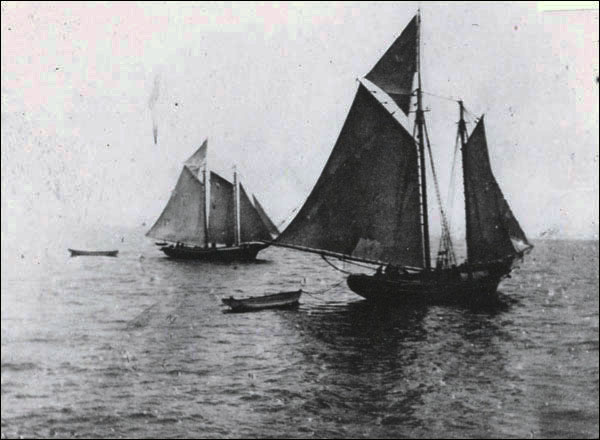
Typical Newfoundland Jack Boat
The St. John’s Daily News of August 15, 1914 reported that a vessel had visited St. Jacques on August 11th, 1914, picking up Naval Reservists. A motorized schooner known as a jack boat, The Caramel, owned by the Roman Catholic priest of the Sacred Heart Parish in St. Jacques, Father Patrick W. Brown, was employed by Harry R. Clinton to travel throughout Fortune Bay picking up members of the Naval Reserve. Clinton reported that “every man is enthusiastic and wants to go to the front, to take a hand fighting for the Empire.” Clinton was the ‘government man’ in St. Jacques which we can see by the positions he held. He was chairman of the local road board in St. Jacques, Customs Officer, and member of the local school board as well as Relieving Officer.
It is interesting to note that the news story spoke of picking up only Naval Reservists. Up to this point in Newfoundland there had not been a call for volunteers to fight the war. The big recruitment efforts throughout the island were yet to come. The date of this event, August 11, 1914 is but seven days after Britain had declared war on Germany. There was heightened awareness throughout Newfoundland that summer that a European war was a distinct possibility. Signs of that inevitable event were emerging as the summer passed its mid-point.
The St. John’s newspaper, The Evening Telegram reported on July 30, 2014, “We understand that the commanding officers of the H.M.S. Calypso have been instructed by the Admiralty to have all the Reservists in readiness and within calling distance, if their services are required. The total strength of the Reserves is about 600.”
In anticipation of war, on August 02, 2014, the Naval Reservists were called to active duty. War was becoming a reality for Newfoundlanders. There was concern that some of the Reservists might be reluctant to come forward since it was at the height of the summer fishing season; however, that was not the case.
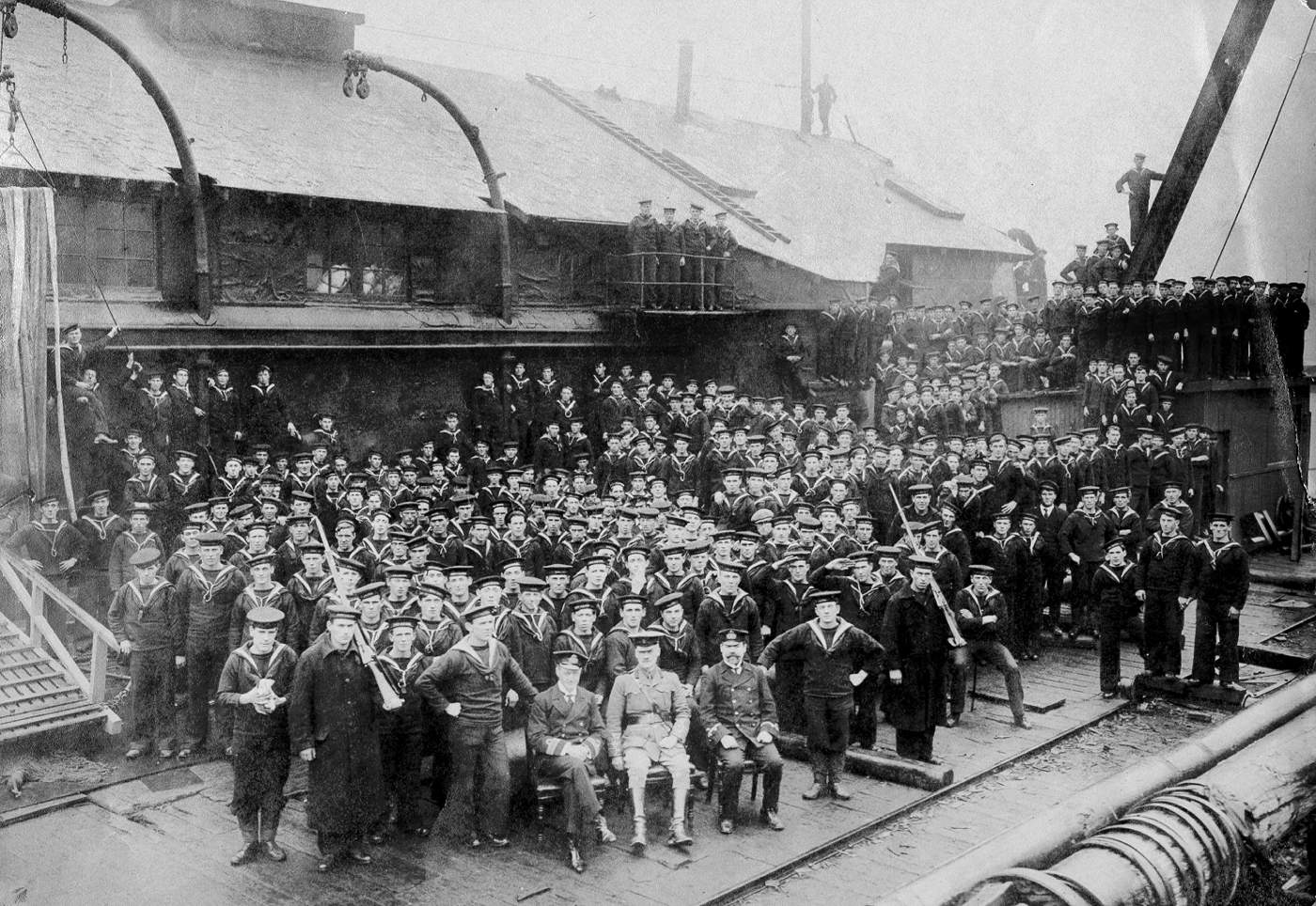
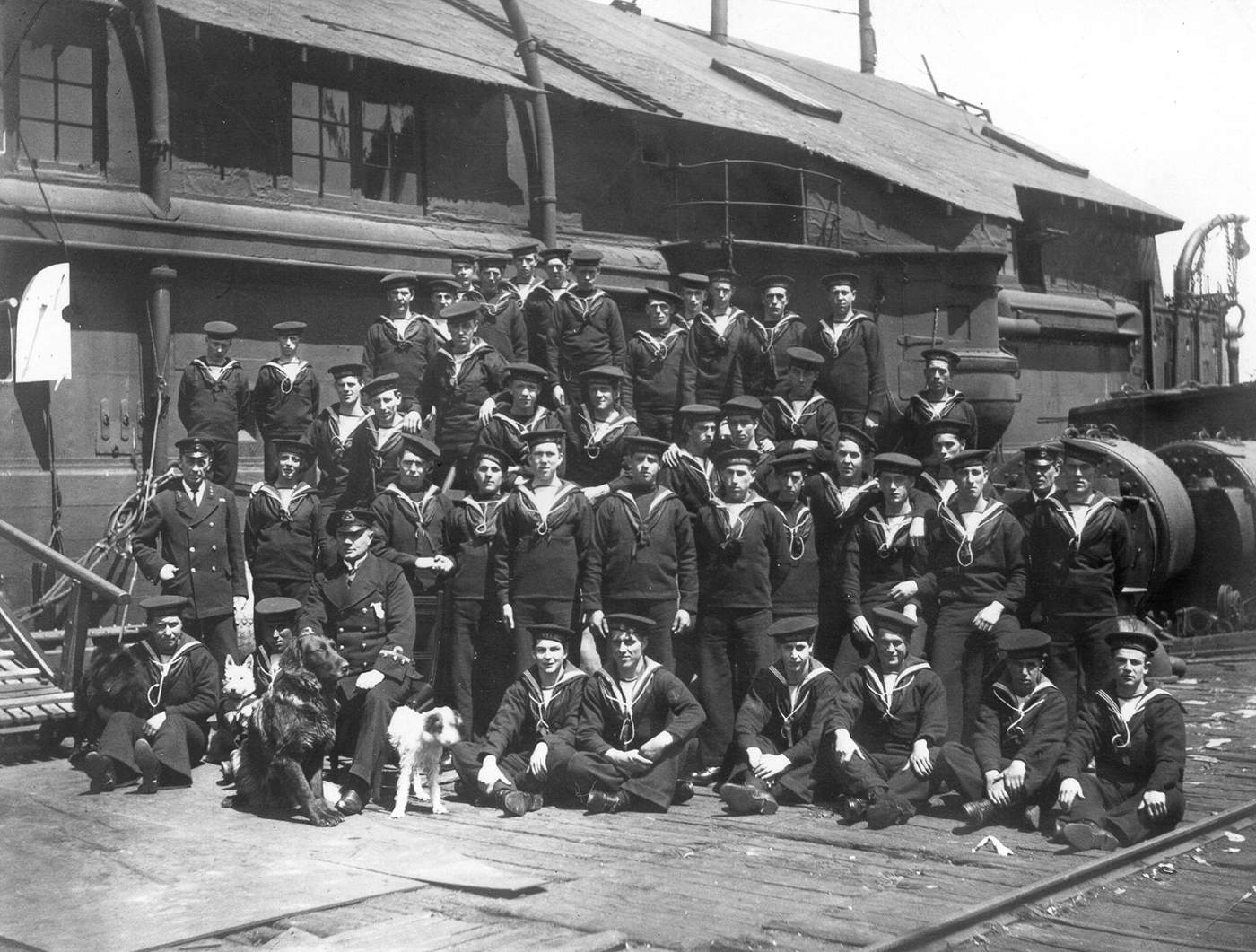
Royal Newfoundland Reservists Aboard HMCS Calypso
Royal Newfoundland Reservists Aboard HMCS Calypso
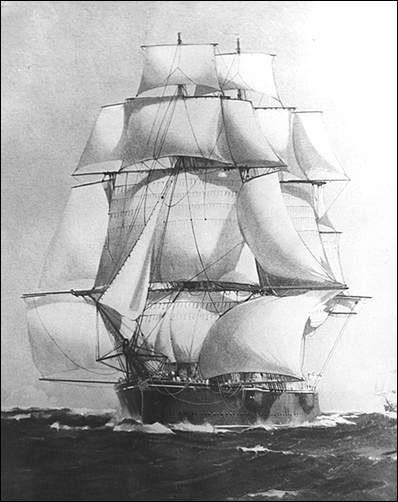
HMCS Calypso, NL Reserve Training Ship
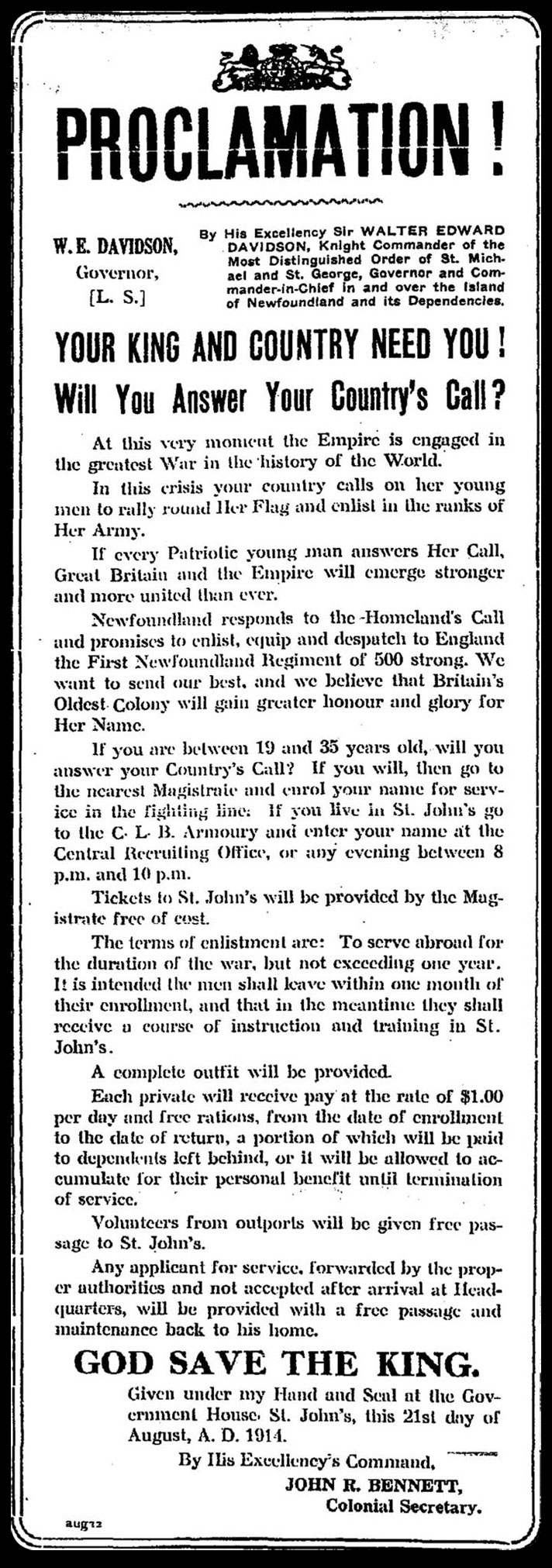
Proclamation Calling for Volunteers
Posters were placed throughout St. John’s and other communities notifying Newfoundland reservists to report to the HMCS Calypso as quickly as possible. Another vessel, the S.S. Kyle was dispatched to pick up reservists in coastal communities. Magistrates throughout the country were notified that reservists were to report immediately to St. John’s.
The Newfoundland Royal Naval Reserve was established in 1902 with about fifty members who were trained with the British Royal Navy. Later that year Britain made available a steam and sail powered training ship, HMS Calypso to be used for training of Reservists. Volunteers from around the island travelled to St. John’s for a month of training after which they agreed to be available for active service for a period of five years.
In 1903 the Reserves had 375 members. By the start of the war there were almost six hundred which grew to almost two thousand by 1918. The Reserve suffered 179 casualties and 125 were discharged as wounded during the war. It was disbanded in 1921. Members of the Royal Newfoundland Reserves did not fight as a single unit. They were disbursed throughout the British Naval Force where they served to great acclaim.
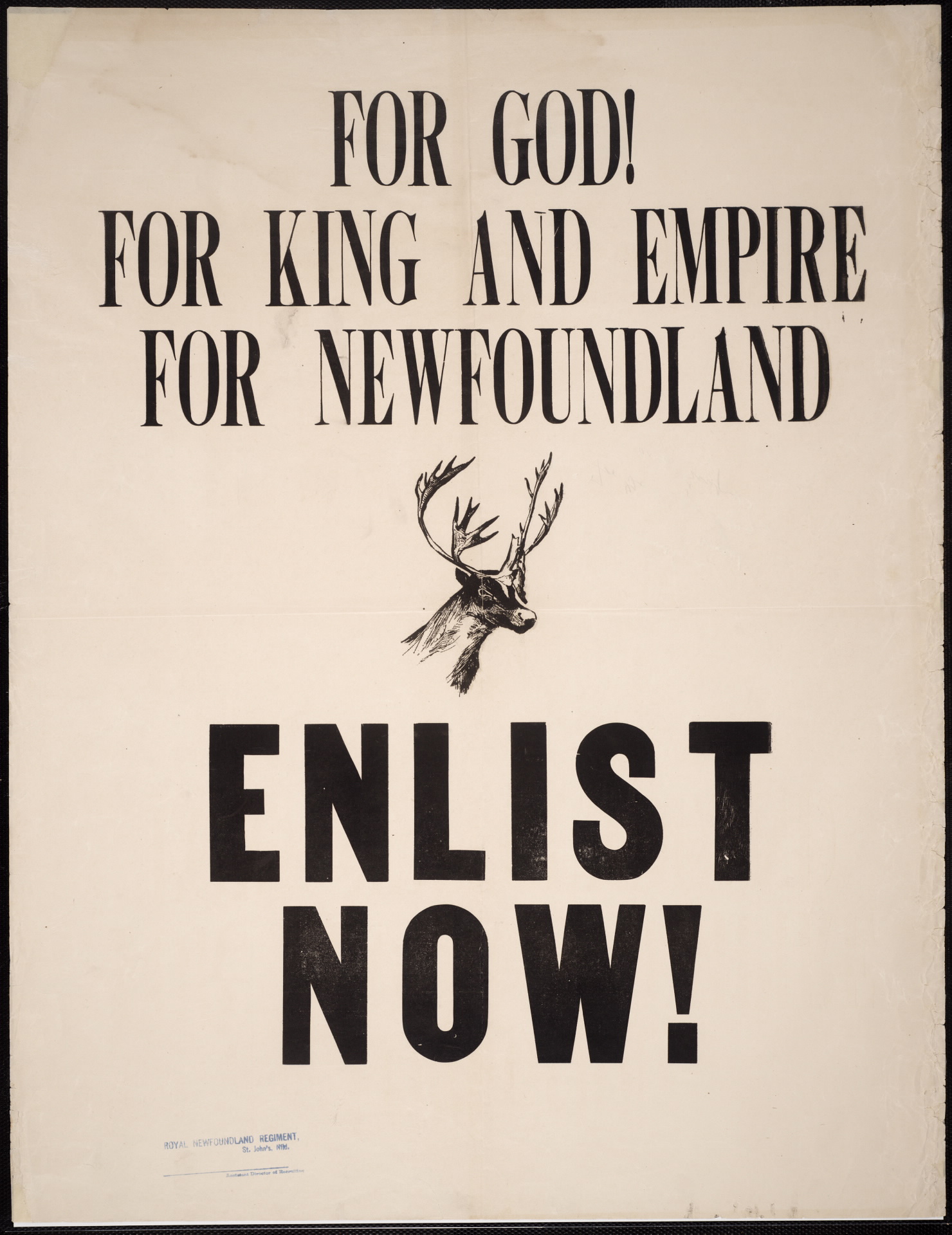
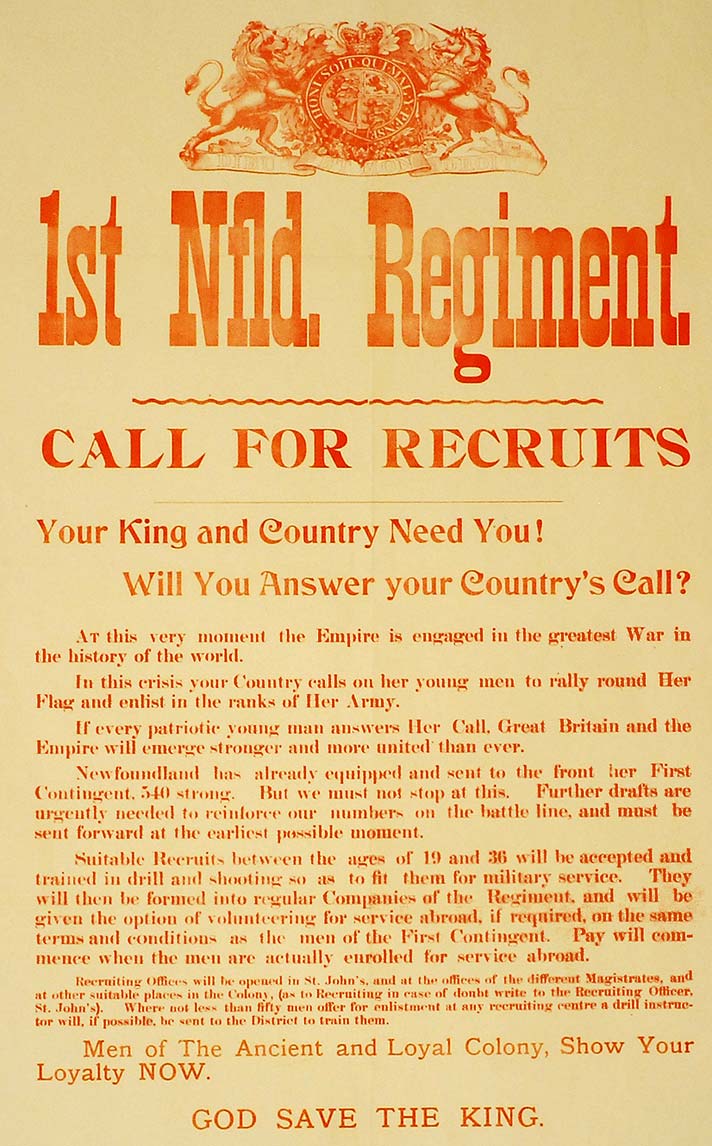
Recruitment Poster 1914
Recruitment in St. Jacques in 1914 was carried out from the church pulpits, public meetings and at any opportunity where people gathered. The message was the same there as it was throughout the Colony; a call to every young Newfoundlander to rally around the flag of Great Britain and to volunteer to fight for King and Country. They were told that Great Britain now needed the men of its colonies to come to its defense. Recruitment teams travelled to coastal communities giving presentations and encouraging people to volunteer.
On August 13, 1914 a local St. John’s newspaper reported that a very well attended public meeting had been held at the at the C.L.B Armoury on August 12, 1914, “ to consider the question of enlisting volunteers for land service abroad and home defense during the war. All classes were represented and the greatest enthusiasm prevailed.” The meeting was called by His Excellency Sir Water E. Davidson, the Governor of Newfoundland, and the official representative of the British crown. He told the crowd, “Newfoundland must do her part laying claim as we do to being the oldest and the most loyal colony.” On August 22nd a call for volunteers was issued across the Dominion of Newfoundland. Initial recruitment efforts in St. John’s were quite successful largely due to already existing cadet groups and the presence of strong social organizations which threw their support behind the efforts of the Newfoundland Patriotic Association which was set up to oversee recruitment.
As far as I have been able to determine there was only one of the men from St. Jacques who served as a Naval Reservist; that was William G. Skinner. Six others volunteered with the Newfoundland Regiment, five served with various Battalions of the Canadian Army, one served with the Nova Scotia Regiment and another served in the Mercantile Marine. Of these men who served three died during the war, one was taken as a prisoner of war and eventually repatriated. The other ten returned with their scars and memories.
When I first became interested in who served in WW1 from St. Jacques I knew of only one – Frank Burke, whose name appears on a plaque on the wall of Sacred Heart Church in the community. The plaque commemorates the fact that Lt. Francis M. Burke gave his life on October 14, 1918, less than a month before the end of the war. Frank, as he was known, was the son of Patrick and Alice (Mullowney) Burke. Later I discovered that the Baptismal Font in St. Michael’s and All Angel’s Church in the community is dedicated to the memory of John Evans who was lost on the schooner Elsie Burdette. He was lost at sea when the schooner he was sailing on was torpedoed on March 18, 1918 somewhere west of Portugal. John was the son of William and Mary Evans. The third man to give his life was Francis R. Burke who served with the Canadian Overseas Expeditionary Unit. He was killed on March 23, 1916. Francis was the son of Denis and Alice (Marshall) Burke.
William G. Skinner was the first man from St. Jacques to leave home to fight for “king and country” that summer. One can only imagine the thoughts that went through his head and those of his family as he boarded The Carmel down at the government wharf. How many of the people who lived in St. Jacques at that time gathered at the wharf to see him off? How many of them wondered if their son or daughter would be next? And they were next, thirteen more of them, three of whom never returned.
“Sometimes I relieve on the Surgical Lines: It is there the horrible sights are; you would not believe me mother if I tell you about what I have seen and gone through.” Frances Cluett in a letter to her mother, 1916.
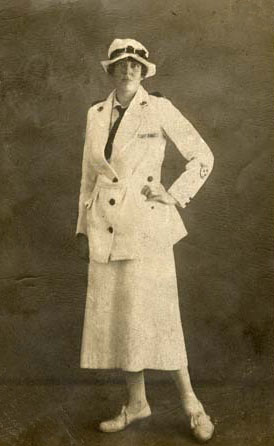
Frances Cluett in Uniform Frances Cluett Photo Album, Centre for Newfoundland Studies
Several years ago I was introduced to the legacy of Frances Cluett. I had heard of her as a long-serving teacher in Belleoram, next door to St. Jacques; however, I didn’t know of the role she played as part of the Newfoundland effort to fight The Great War (1914-18). After reading the book Your Daughter Fanny – The War Letters of Frances Cluett, VAD edited by Bill Rompkey and Bert Riggs, I was struck by the enormous effort she gave and the courage she exhibited in volunteering to serve. As I read her letters home which had been preserved by family members, it was like being a fly on the wall observing Fanny, as she was known, as she traveled from Belleoram to St. John’s, to New York, to Europe, her observations of what was happening around her and those things she wanted to stay in touch with at home.
Memorial University has recently named a wing of its new Macpherson College residence after this local hero. On October eighth, 2014, Premier Davis presided over the official opening of the residence which honoured Frances Cluett as one of Memorial’s earliest graduates and war veteran by naming one of the two wings of the residence after her. The other was named after John Shiwak, an aboriginal man from Labrador who gained quite a reputation during the war as a sharpshooter. Unfortunately John Shiwak was a victim of the war. He died in action.
Frances Cluett was born at Belleoram on June 25, 1883. Her parents were Arthur M. Cluett (1851-1897) and Matilda Grandy (1855-1931). Both parents were born in Belleoram and died there. Frances had one sister, Lillian (1880-1938) and one brother, Arthur Samuel (1888-1963). Arthur married Margaret Dominix, of Bay du Nord in Fortune Bay. Frances died on November 12, 1969.
Frances was educated in Belleoram. After she finished school there she became an assistant to the local school master, Mister Crant, in the one-room school which served all grades. This experience led her to travel to St. John’s in 1901 to attend training to become a teacher. After basic training she returned to Belleoram and taught for fifteen years until at age thirty-three she volunteered for service overseas to assist with the war effort. She had exhibited considerable interest in the war as shown by her support of the Women’s Patriotic Association Branch of Belleoram of which she became its first president.
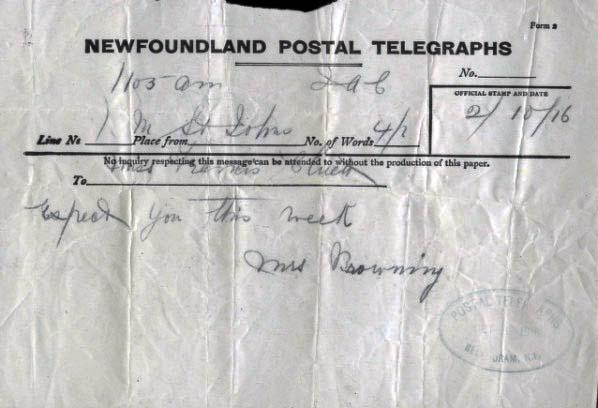
Telegram to Frances Cluett Centre for Newfoundland Studies, MUN
In the fall of 1916, after receiving a message form the Women’s Patriotic Association asking her to report for service, she left Belleoram on the S.S. Glencoe and travelled to Placentia where she continued the journey to St. John’s by train. There, she became a member of the Voluntary Aid Detachment (VAD) with the St. John Ambulance Corps. She eventually joined the British Expeditionary Force in France.
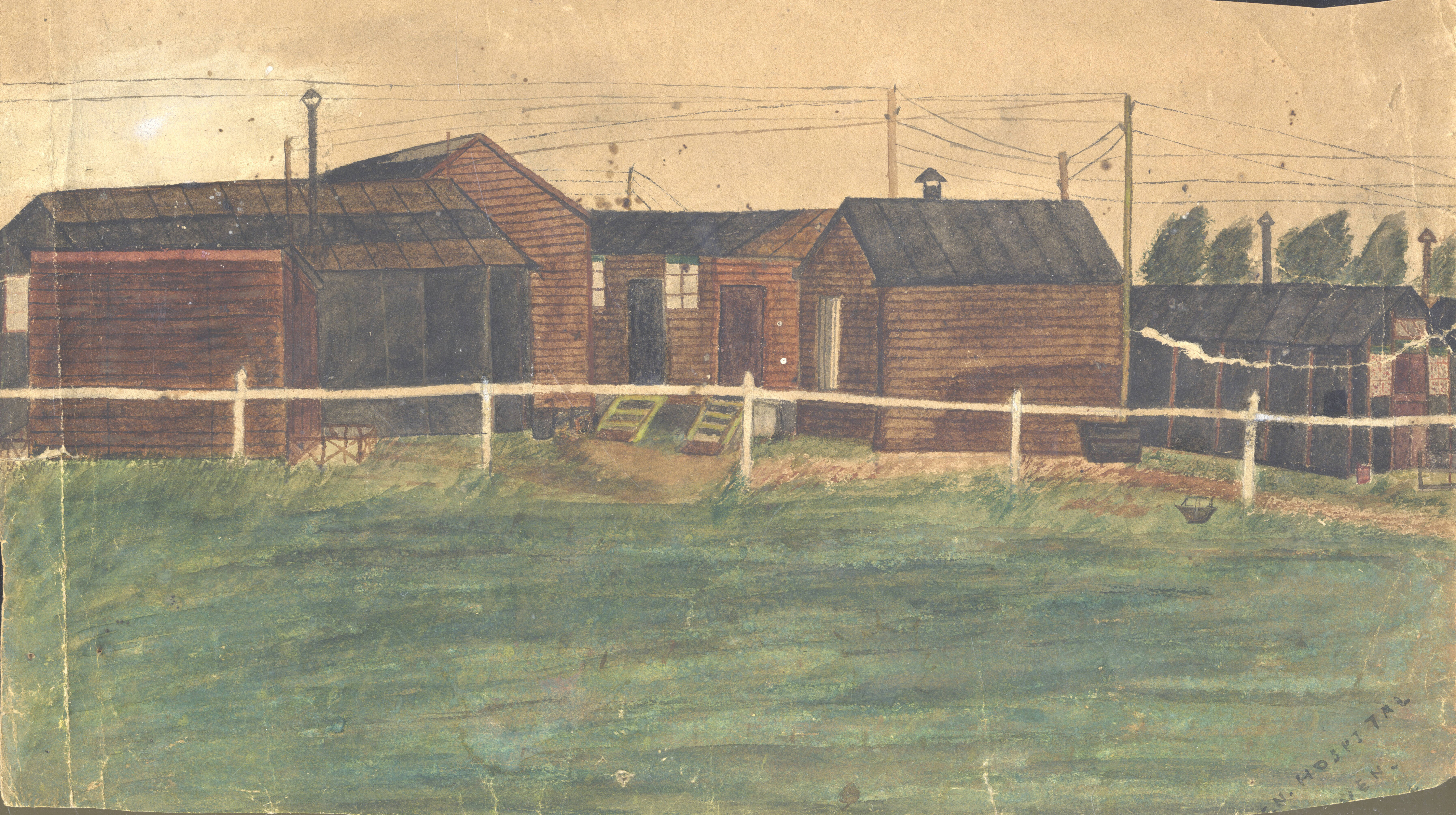
In St. John’s she spent several weeks in training; after which she traveled by train to Port aux Basques, crossed the Cabot Strait to Nova Scotia and then by train again to New York City. Her trip across the Atlantic started in New York and ended in Liverpool, England. From there she traveled to London for more training for work in a military hospital. By the spring of 1917 she was stationed at the 10th General Hospital in Rouen, France, a hospital that dealt with general battle casualties. In 1919 when the war ended she volunteered to spend another year. This time she was assigned to a British Military Hospital in Turkey. After the war she spent some time travelling in Europe before returning to Belleoram in 1920.
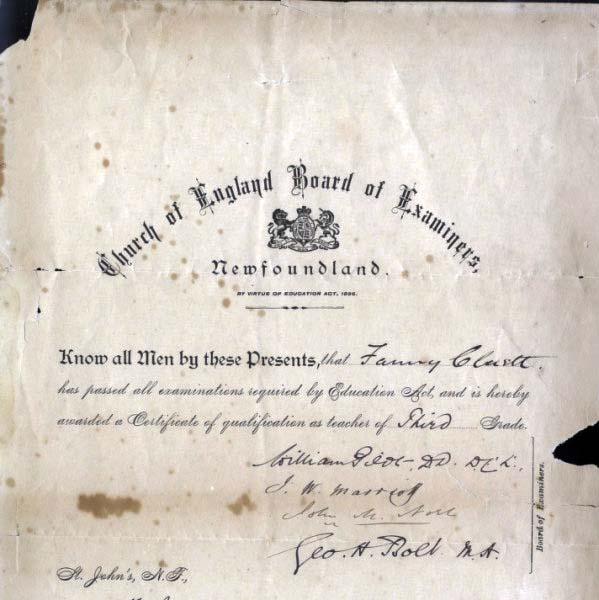
Frances Cluett Teaching Certificate Centre for Newfoundland Studies, MUN
Cluett attended the Normal School in St. John’s after the war which qualified her for a teaching career. The Normal School eventually became the Faculty of Education within Memorial University making Frances one of its earliest graduates. She spent the rest of her life in Belleoram where she taught primary school and operated a small general store.
We know of the experience of Frances Cluett as a VAD nurse through her letters home, her photograph album and watercolour paintings all of which are now held at the Centre for Newfoundland Studies at Memorial University. The Frances Cluett Collection also includes two St. John Ambulance Brigade badges. There is also a German Iron Cross medal which was given to her by a severely wounded German major who was one of her patients in a camp nursing German prisoners of war. Just before he died he gave her his Iron Cross and helmet.
In the collection there is also an autograph album completed during the years 1907 to 1910, and a small but interesting journal written by her as a lengthy letter to her sister Lilian in 1908 describing life in Belleoram. These letters, photographs, paintings, and writings give us insight into the life of one our own local heroes, who served as a VAD in World War I.
During her four years of service, Nurse Fanny Cluett wrote letters to her mother and sister. These letters dealt with her travel experiences, training, people she met, working conditions, the horrors of war and the incredible loss and suffering she witnessed as well as some of the Newfoundlanders she met there. In some letters she described the atrocities of war, the heroism of soldiers, and the despair she felt for so many young men dying so far away from their homes, including her cousin Vince Cluett. In a review of the book by Rompkey and Riggs, titled, In Search of the Fighting Newfoundlander, published in the Journal of Newfoundland Studies (2009), Martin Gerritsen said, “Cluett offers a view of the suffering. Supervising a ward of 26 beds, she often felt overwhelmed and guilty for not being able to provide adequate care. During major offensives the numbers of wounded could pile so high that many would die for the want of attention. Even for soldiers who survived their first few days in hospital, the road to recovery could be agonizingly painful and Cluett often cursed the harsh treatment methods used on severely wounded soldiers. Yet, amidst this sadness Cluett expressed surprise at her patients’ compassion and lack of self-pity, as even severely wounded soldiers tried to be upbeat and make life as easy as possible for the nurses around them.” p. 143.
Below are short excerpts from her letters. You can read the letters in more detail at Memorial University’s Digital Archives by clicking on the Letter Links below.
May 7th, 1917
I have the care of five wards at night; so you can imagine I am kept a bit busy. I sometimes feel very, very, sleepy around the hours of one and two; but sleep must be sacrificed by all accounts, as one must keep a look out for all sorts of things, such as amputation bleedings, deaths, drinks etc.
This is a very wicked world mother; you cannot realize what sufferings there are: Some of the misery will ever live in my memory: it seems to me now as though I shall always have sad sights in my eyes . . .
March 31st, 1918, Easter Sunday Morning
Dear Mother;
I am going to church at 11:15 a.m. for I am so terribly tired. We are awfully busy, nearly killed since this last rush: if this war does not soon end there won’t be a man living on the face of the earth. It is brutal, it is cold-blooded murder; it is hell upon earth. Oh! If you could only see and go through what we do mother [sic]; it is enough to drive one mad.
April 2nd 1918
I have not said anything about poor V(ince). I got a letter from his mother and R(—) ; and will answer both shortly. Tell Aunt Sarah I shall do my best for her. Did she get my letter? I used to think that perhaps V— and I would spend our vacation together. I think of him when I see the drafts go up the line, headed by the Officers. I knew when he was sick that he must be more than slightly wounded, as he never once wrote me, otherwise I should have had a very long letter. It was the battle of Cambrai, he was wounded in. All our boys got knocked out. Gas was used a lot. Poor V—’s wound was gassed as well. I cannot for a minute realize that he is dead.
Cluett’s last letter to her mother is dated November 21, 1920 from London just before she sets sail for Newfoundland.
We are reminded of ancestors and previous generations each time we enter or pass a cemetery; each time there is a conversation around family history, when we look at old family photographs and when we either read or research historic events.
They are more than names on dusty shelves; more than tombstones amid the overgrown grasses of a half-forgotten cemetery; more than simple words. They are people who lived and walked the same roads we walk today; watched the waves break on the same shore; felt joy, hunger and pain; laughed and cried with family and friends.
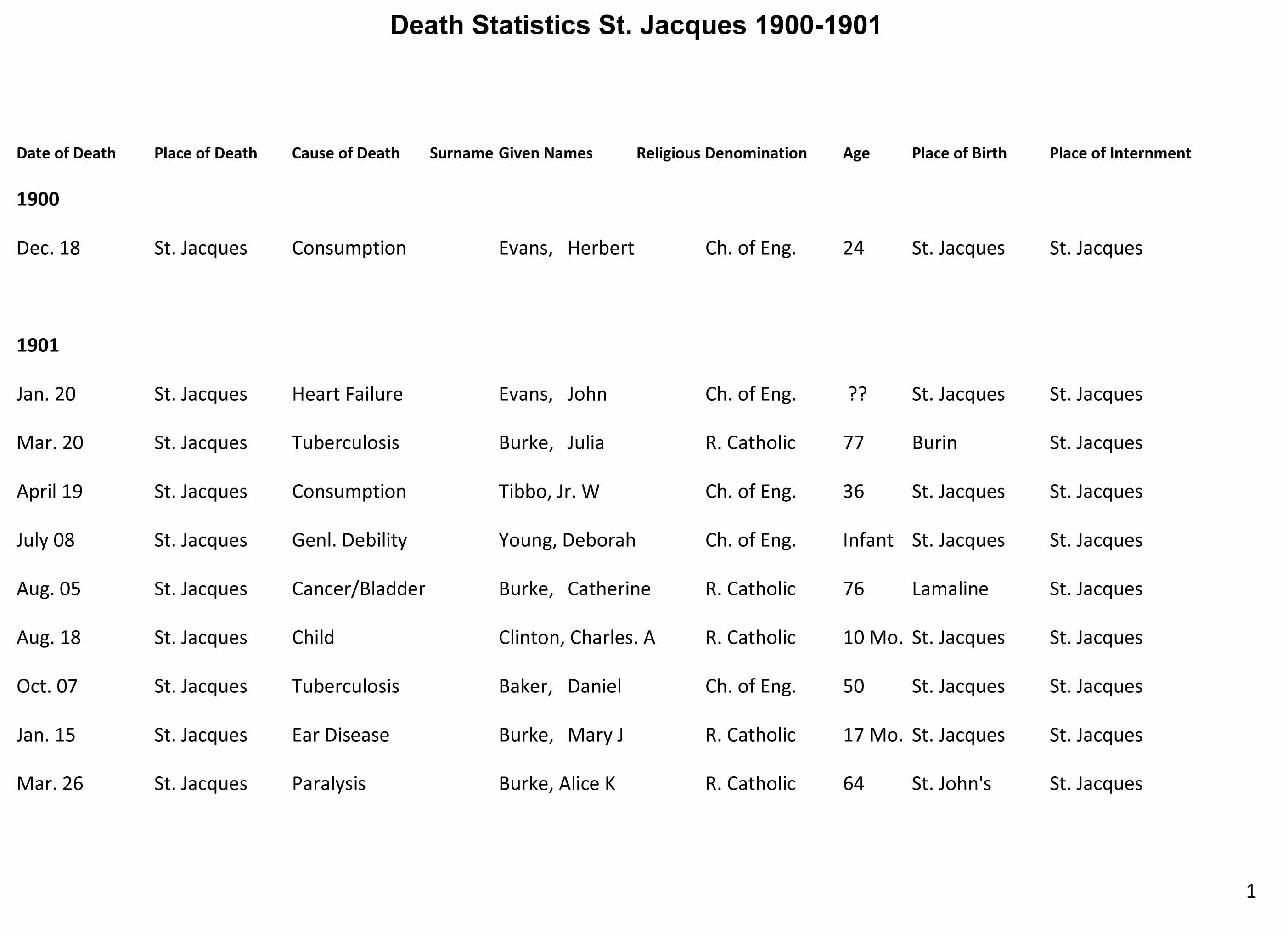
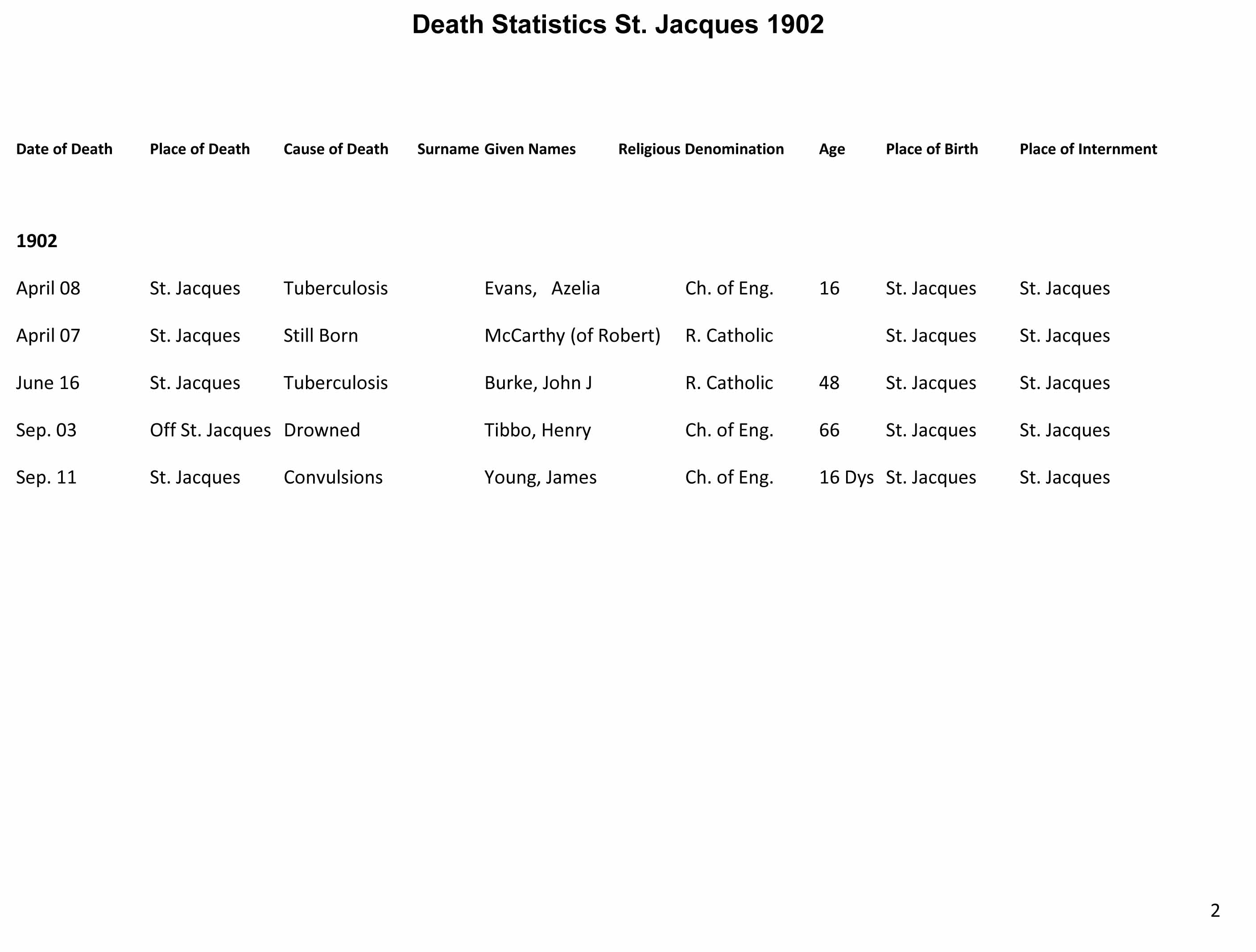
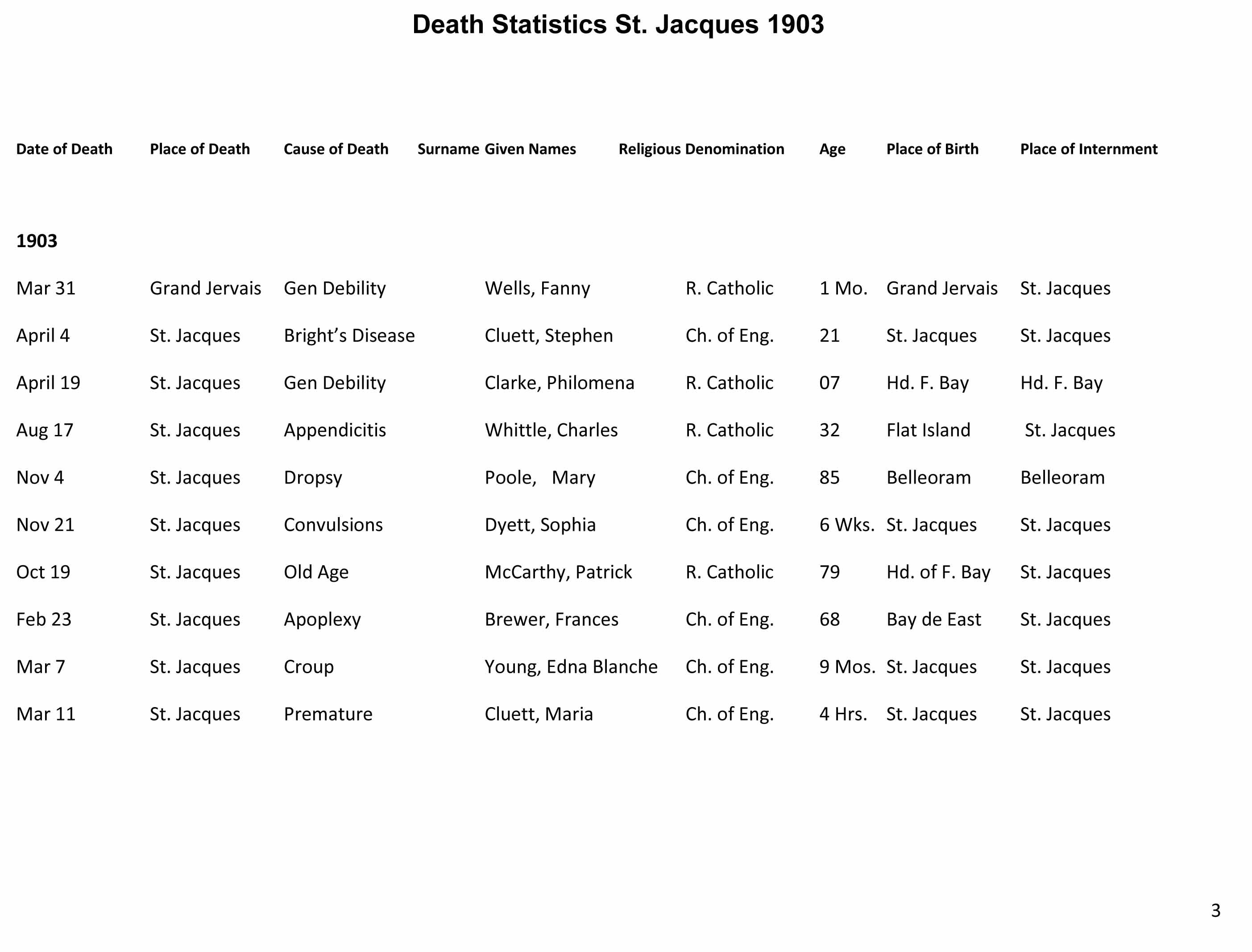
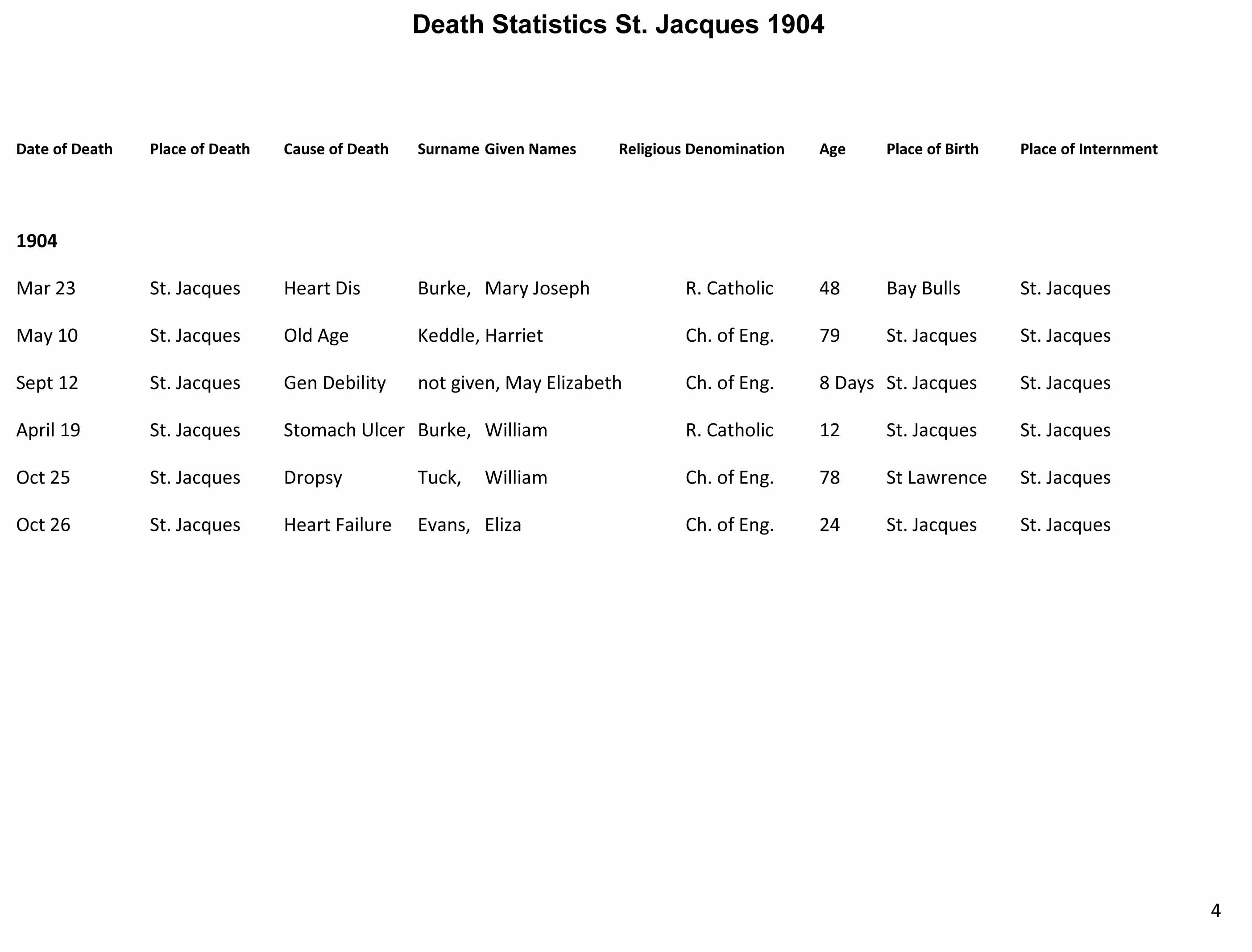
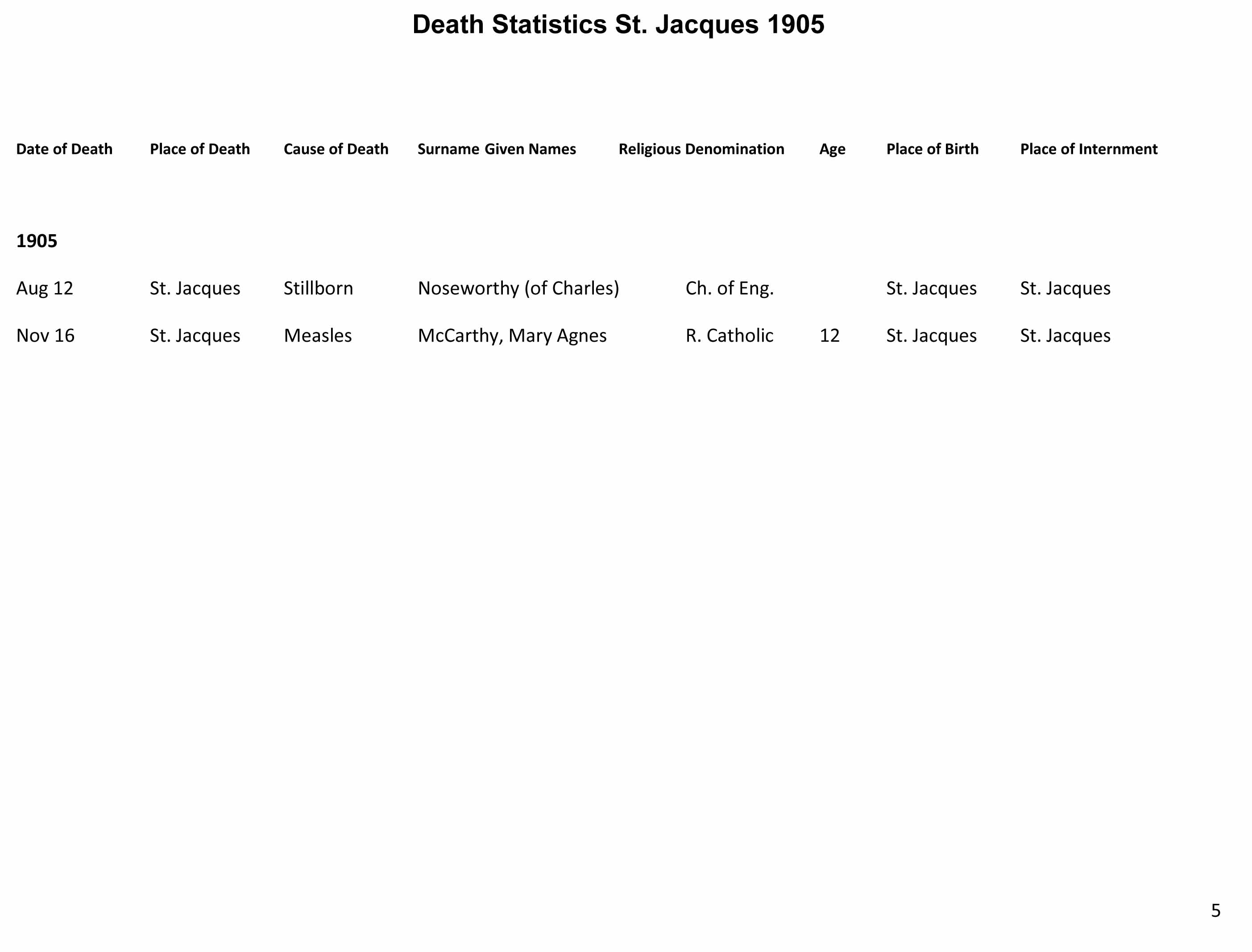
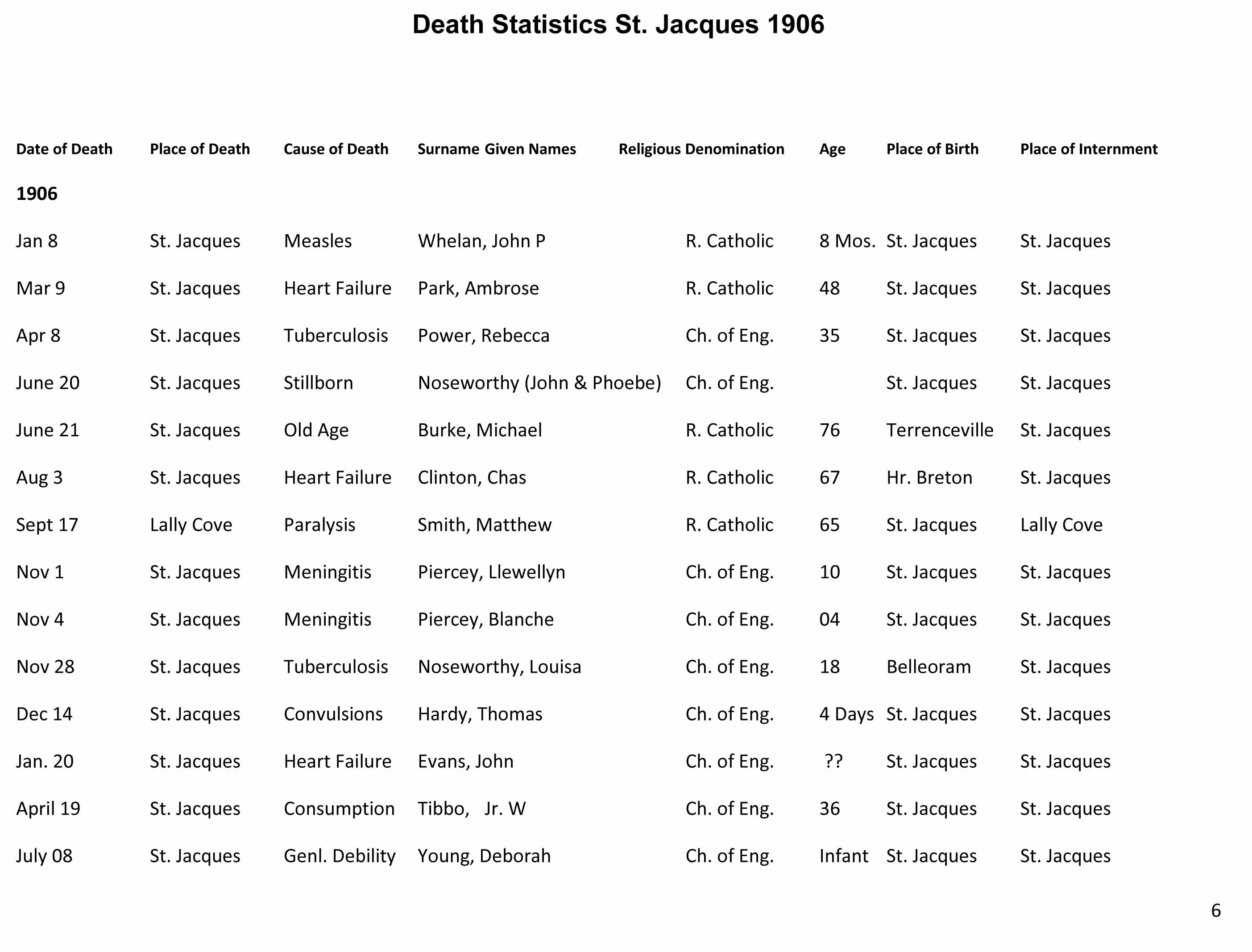
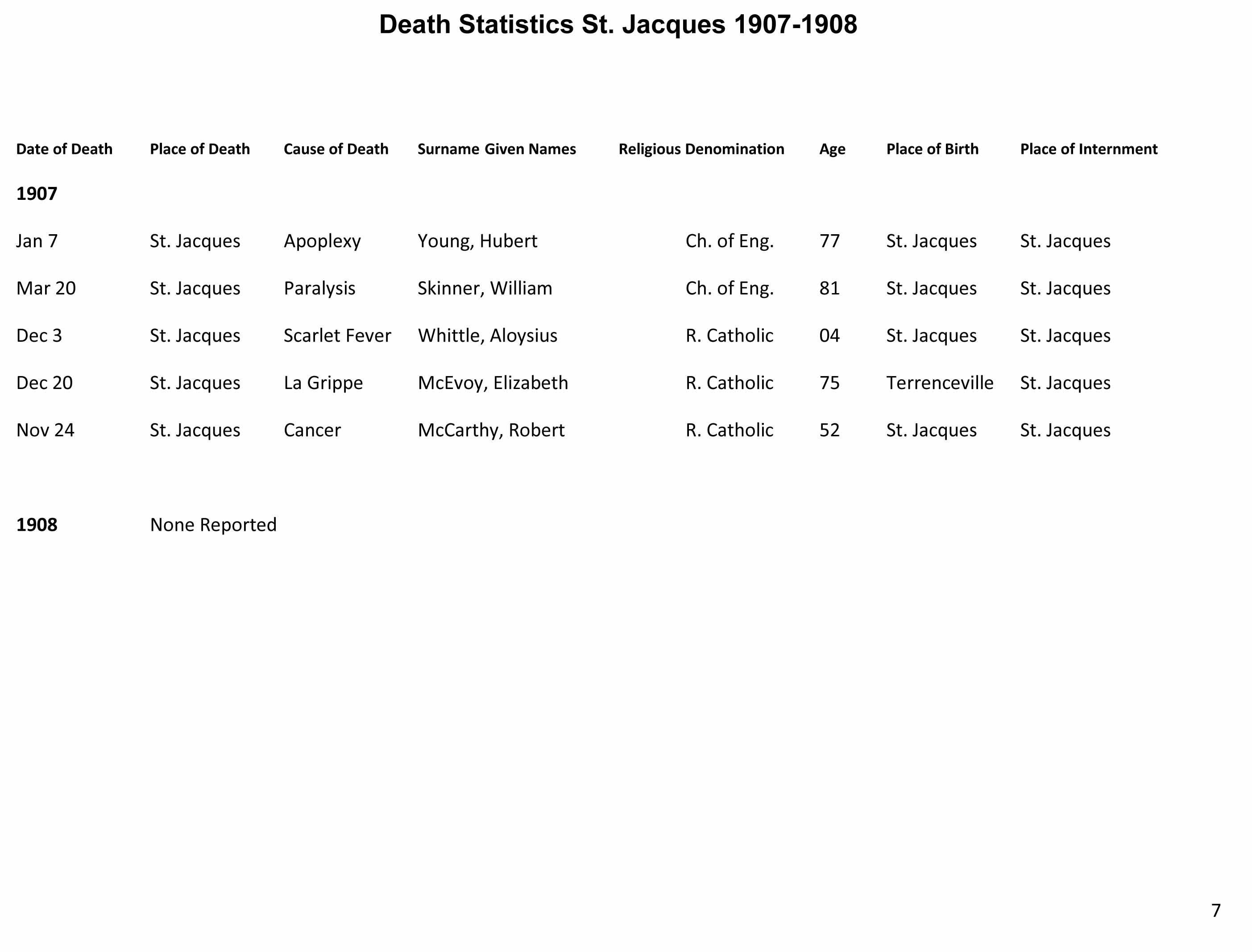
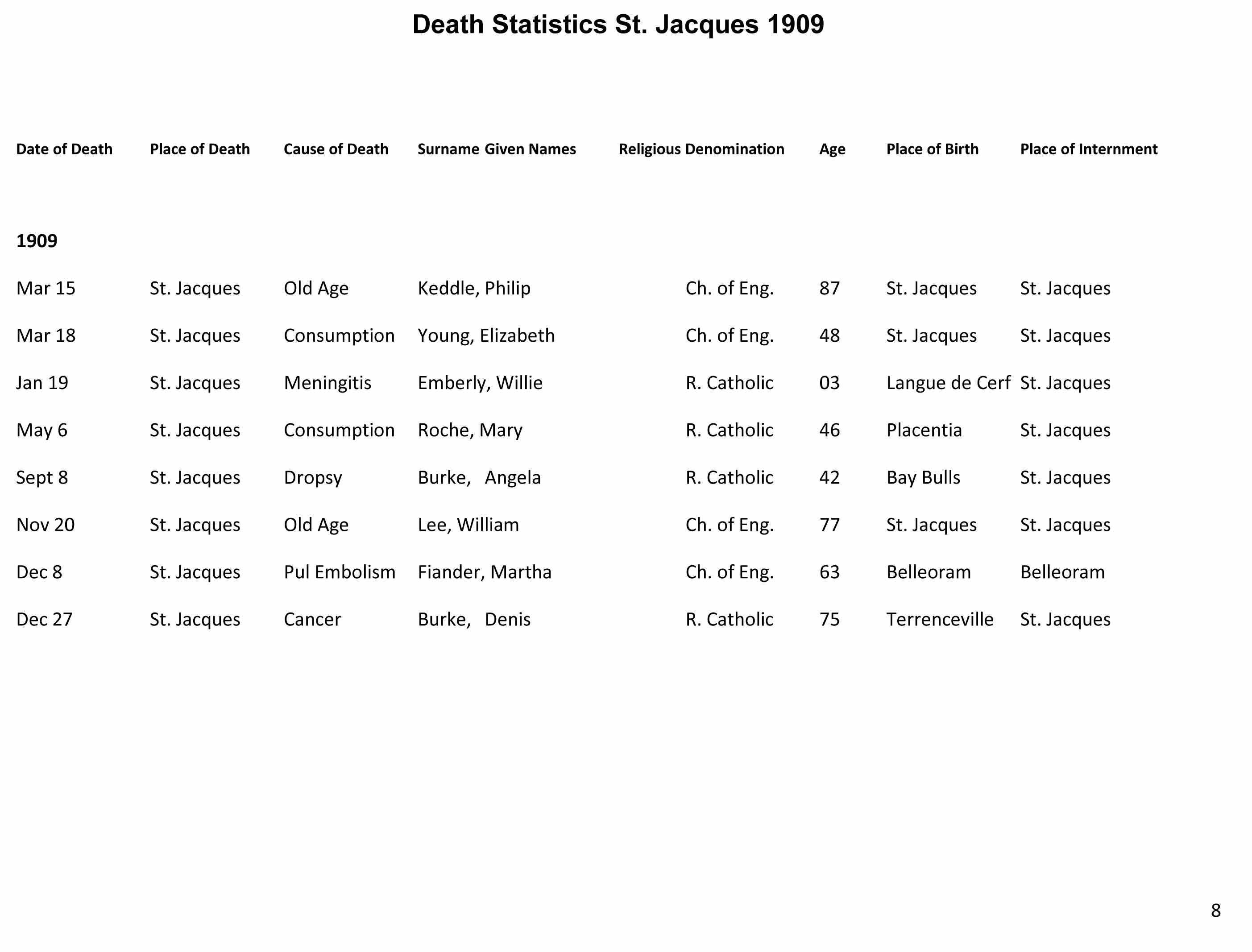
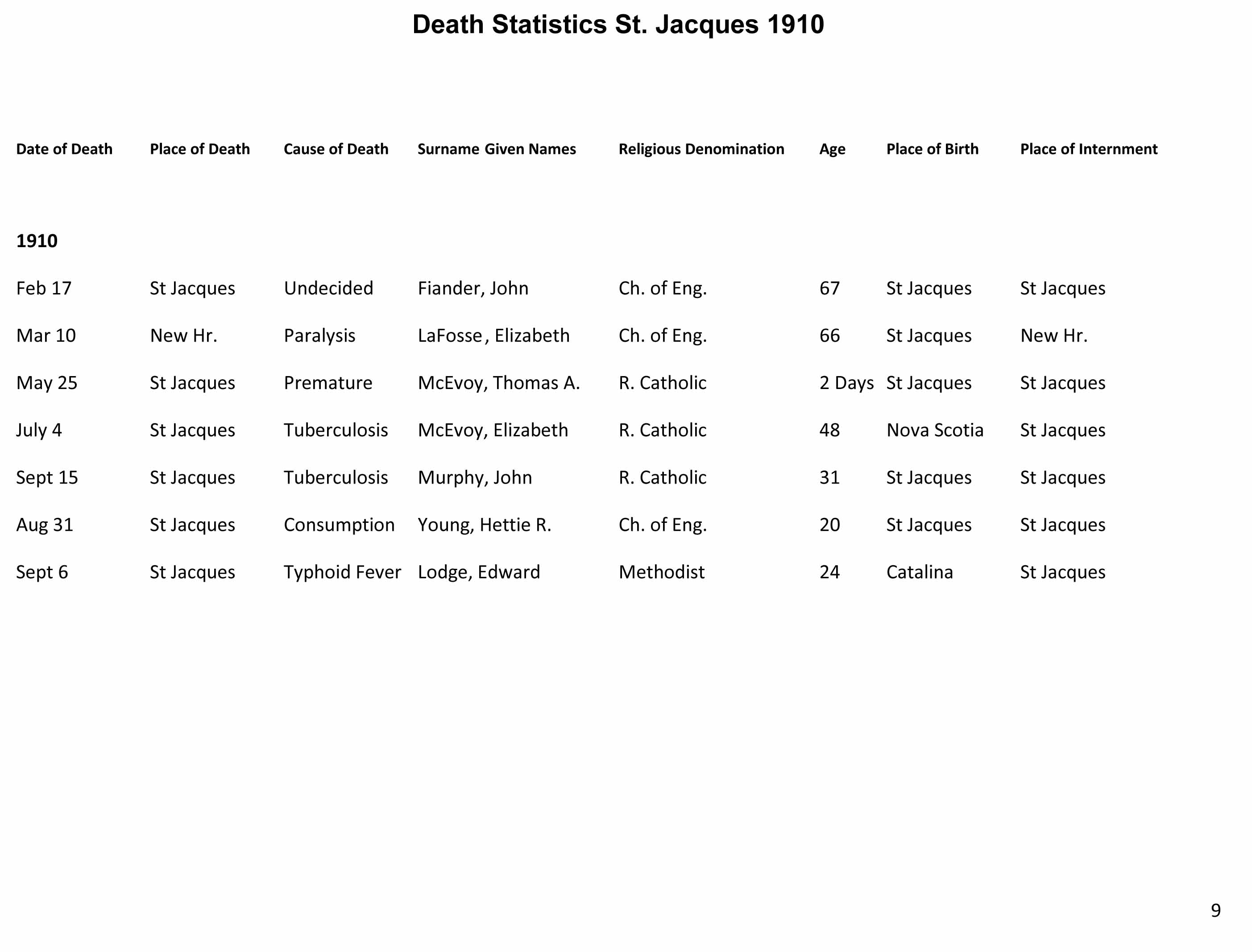
Recently I was looking through records of deaths in St. Jacques dating back to the 1850’s. I was struck by the number of people who died each year and their causes of death. It was also striking to see the number of children who died. In this post I want to share with you a window into a ten year period from 1900 to 1910 by looking at the names of those who died, how old they were and what caused their deaths. Since some of the medical terminology has changed in the ensuing century I’ve added a glossary of the more unusual terms identified as causes of death.
These people are no longer in living memory. You may have heard some of the names in stories. Some of the family names will be familiar while others will not. One of the questions that may come to mind is where are they buried? Many of these people are no longer identified in either the Anglican or Catholic cemeteries. Their grave markers have either crumbled or deteriorated and joined them in the soil. The next time someone tells you that the old part of the cemetery is full, trust them for what you see here is just one ten year period in the history of a community that has had people living and dying in it since the late 1700’s.
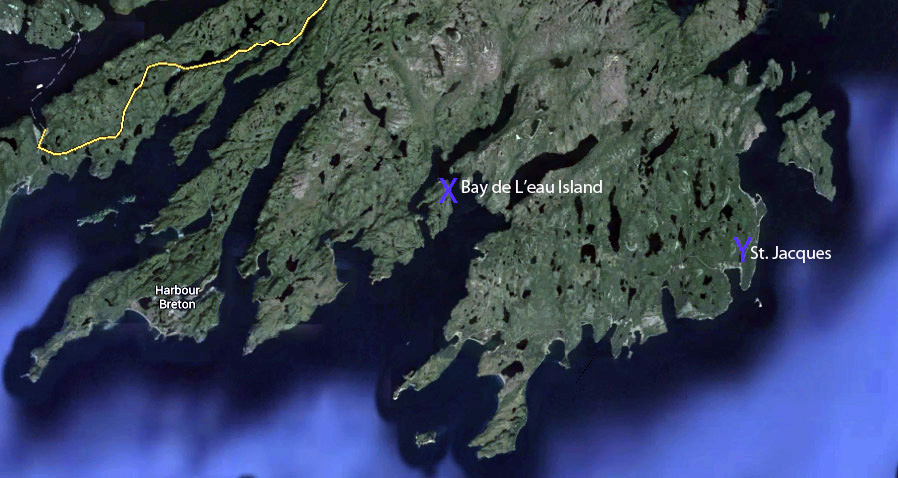
Location of Bay de L’eau and St. Jacques from Google Earth
St. Jacques has seen many family names come and go over the centuries. Throughout its history family names from many other places have been found here. People came here from such places as Terrenceville, Harbour Grace, Grand Jarvis, Harbour Breton, St. John’s, Bay du Nord, Lally Cove, Femme, Sagona, St. John’s Bay, Wreck Cove, Belleoram, Jacques Fontaine, St. Mary’s, St. Vincent’s, Barrow, Corbin, Marystown, Flat Island, Rencontre East, Oderin, Lamaline, St. Pierre, Rushoon, Champney’s, Trinity, Pool’s Cove, Bay L’Argent, Lawn, Fox Cove, Renews, McCallum, Greensport, Mose Ambrose, English Hr. East, English Hr. West, Balena, Lange de Serf, Change Island, Burin, St. Joseph’s, Furby’s Cove, Burgeo, Brunette, New Harbour, Harbour Mille, and from such countries as Canada, England, Wales, Ireland and Lebanon.
One group of people who came from a small island near the mouth of Fortune Bay, Bay de L’eau Island, has had a profound effect on the community in the over sixty years they have been living here. One of these families in particular today has a very visible presence. Why did they come to St. Jacques?
New T. Stoodley Home in St. Jacques
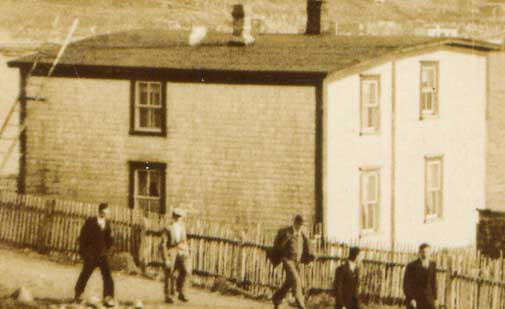
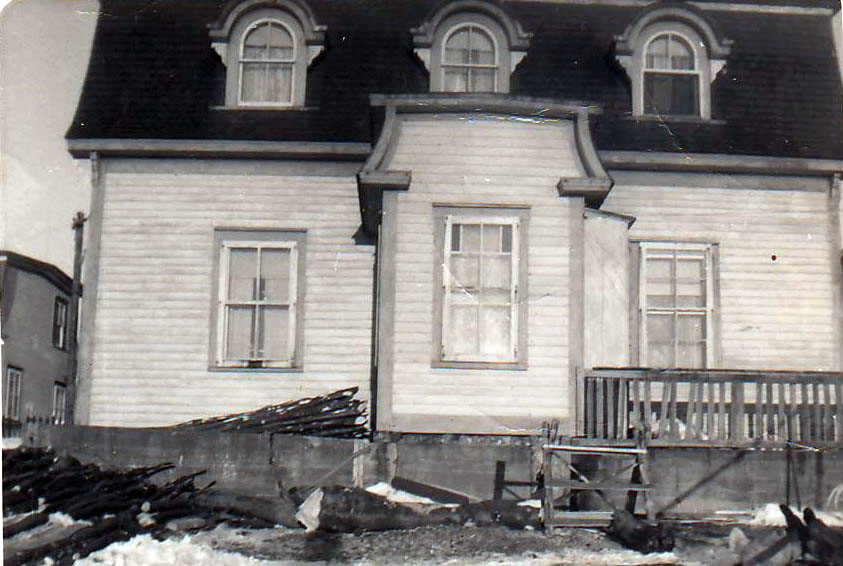
It all started when Tom Stoodley purchased a house in St. Jacques from the family of John Noseworthy with the intention of dismantling the house and having the material shipped to Bay de L’Eau Island where he planned to build a house for his new bride, Mary Lawrence. This was a common practice during those years. St. Jacques had experienced a population decline in the post-war years as the economy transitioned from schooners which harvested codfish for salting to trawlers which brought codfish fresh to markets. This decline resulted in empty houses throughout the community as we see today in other coastal communities where fishing as a way of life has come to an end and residents have left in search of employment elsewhere.
In other cases the vacant houses were purchased by enterprising local men who salvaged the building materials which they then sold in the local market.
Mr. Stoodley was accompanied by another man named Tom on this trip to St. Jacques; his still single brother-in-law, J. Thomas Lawrence. Both men conducted a thorough assessment of the property, met many local people who would eventually become lifelong friends, and returned to Bay de L’Eau. Upon their return, the talk of relocating from the island continued to grow, accentuated by an occasional family moving to nearby Harbour Breton. This was in advance of the Newfoundland government undertaking a resettlement program where they used a combination of force and incentive to move thousands of people out of centuries old, remote communities to growth centers where they could have access to medical, educational and other similar services.
Tom and Mary decided to move to St. Jacques and make this their new home rather than stick with their initial plan. This decision added fuel to the exodus off of Bay de L’Eau Island. Within a few years there would be no one left on the island to hear the waves crashing on the rocks during October storms or watch the seabirds riding the wind of late August. Neither would there be anyone to face the harsh wind driven snow and ice that lashed at the empty buildings still unrelentingly hugging their foundations.
New Lawrence Home – St. Jacques
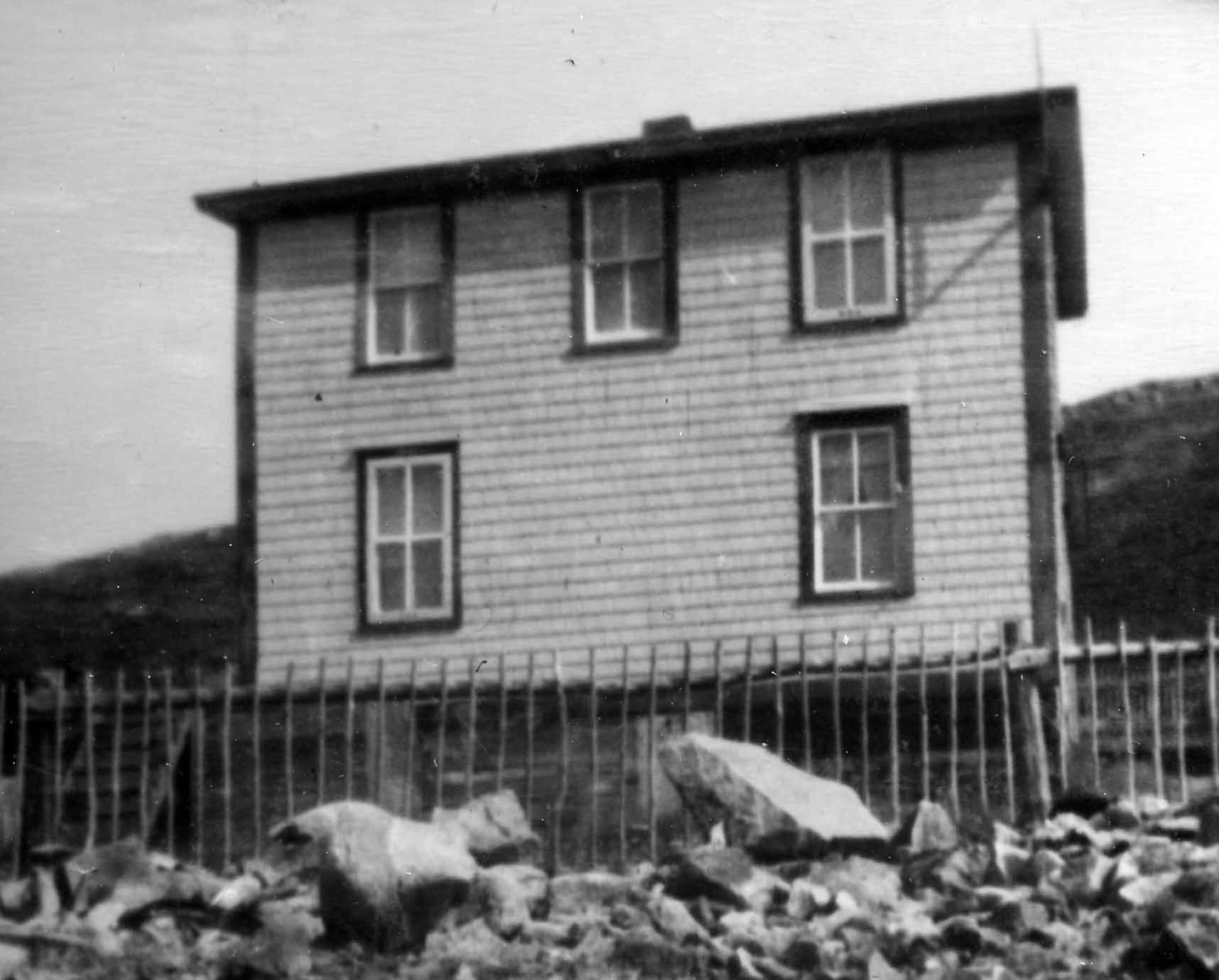
That was 1951. In 1952 Tom Lawrence purchased a house from Netta Johnson who had moved her family to Halifax the previous year following the death of her husband several years earlier. Tom Lawrence’s new home was located across the road from Tom Stoodley. Undoubtedly he had seen the house when visiting St. Jacques with Tom Stoodley. Tom, who was still single, moved his widowed mother Margaret and an unrelated older gentlemen into the house with him. There was no relationship between the old man, affectionately called Uncle Joe Bullen, and Mrs. Lawrence. Uncle Joe had no surviving relatives and nowhere to go as the residents of Bay de L’Eau Island left the place behind. As Tom Lawrence said to me many years later, “I couldn’t leave him there by himself. That wouldn’t be Christian.”
New Dominix Home in St. Jacques
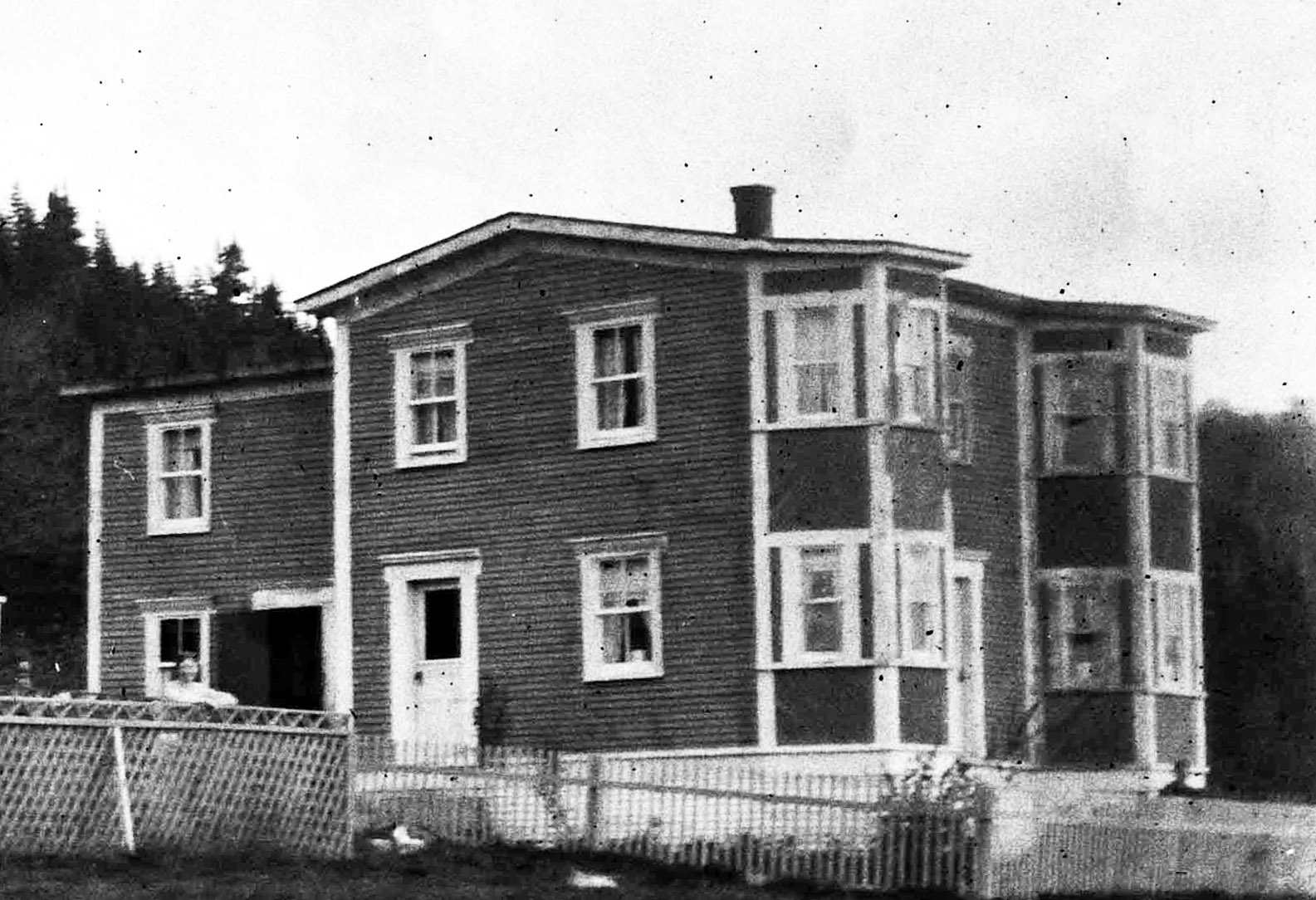
Around the same time a third man with Tom in his name moved his already growing family to St. Jacques from Bay de L’Eau Island. John Tom Dominix, his wife Esther, their four children, his father-in-law and his mother-in-law, John and Eva Strowbridge arrived to take up residence in a house once owned by Christopher and Lucy McCarthy.
New N. Stoodley Home in St. Jacques – far right
A few years later two families from Red Cove in Bay de L’Eau also bought houses in St. Jacques and moved to new homes. Ned Stoodley, Lucy and their three youngest children moved into a house recently vacated by Sammy-Jim and Martha Hynes who had moved to Port-au-Port on the West coast of Newfoundland. Tom Osborne, his wife Effie, their two sons and his mother Pearl and her husband Ben Strowbridge moved into a house they had purchased from Hazel Young who had a couple of years earlier moved to St. John’s to take up employment as Matron of the Red Cross Hostel.
So ended the influx, but not the legacy. Tom Lawrence soon met and married Emma (Burnsie) Skinner. They gave the community eight children. Tom and
New Osborne Home in St. Jacques
Mary Stoodley gave St. Jacques seven new residents over the years. John Tom and Esther added another eight children to their family. The size of Tom and Effie Osborne’s family and Ned and Lucy Stoodley’s family remained the same.
As families mature individuals move away to pursue interests of their own. Such was the case with these five families over the last sixty-odd years. Only one of the eight Lawrence children maintain a residence in St. Jacques though others do in the nearby community of English Harbour West. None of the seven Stoodley children live in the community. Two of them live nearby in Belleoram and Boxey. The Osborne family all moved to Arnold’s Cove and the family of Ned and Lucy Stoodley moved to Harbour Breton.
However, the Dominix family has shaped the current community in many ways with eight of their children with families in St. Jacques. Three other children live in nearby English Hr. West and Mose Ambrose. There are also seven of John Tom and Esther’s grandchildren married with families living in the community with several others living in the area. A quarter of the houses in St. Jacques are owned by members of the Dominix family! That is quite a legacy!
These families from Bay de L’Eau Island became an integral part of life in their new homes. They lived, worked, loved and contributed in every way to building community. Few can now remember when they weren’t here or even know how they arrived from Bay de L’Eau. How fortunate we all are that they chose to make St. Jacques their new home over sixty years ago.
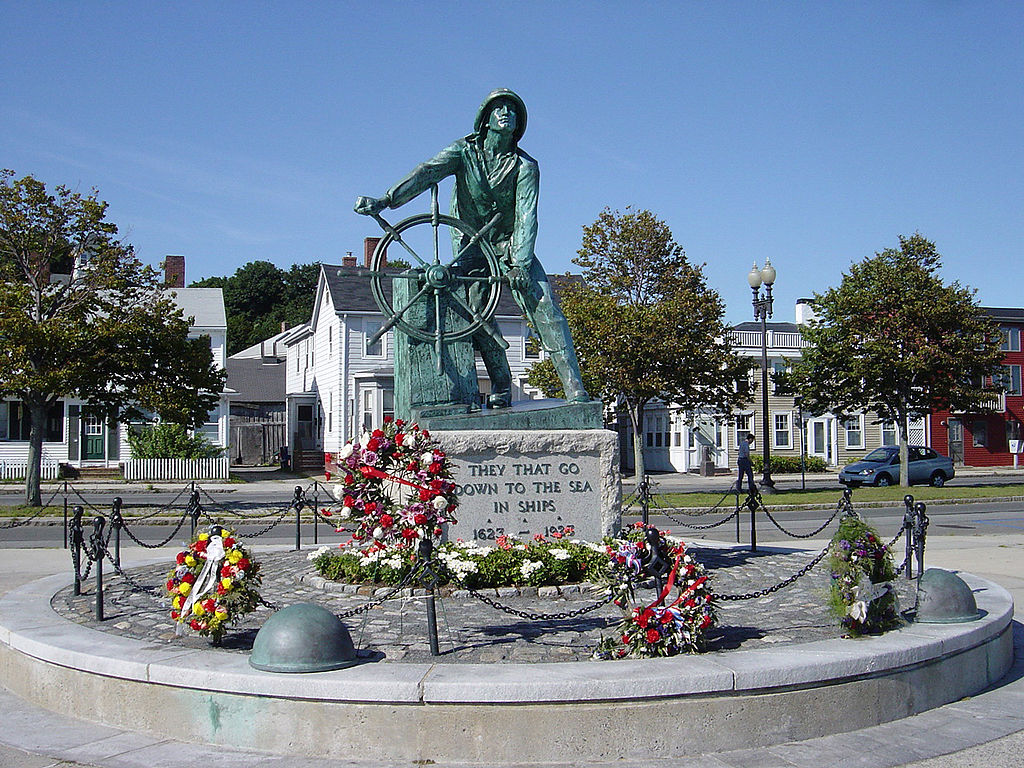
Five years ago I drove through the town of Gloucester, Massachusetts and saw the “Man at the Wheel” sculpture, a memorial to the many fishermen and ships who sailed from that port. It caused me to reflect on the relationships that existed between St. Jacques and Gloucester. There is the family connections of ancestors who moved to that legendary fishing port seeking employment and entrepreneurial opportunities they didn’t see in their Newfoundland future. There is also the connection between the fishermen of Fortune Bay who caught and sold their fish to such Gloucester companies as Gorton’s who operated a branch of their business in St. Jacques harbour over a hundred years ago. A third connection lies with the schooners from Gloucester who sailed to Fortune Bay in order to harvest herring during the winter fishery.
Man at the Wheel Creative Commons Licensing Wikipedia
During lunch at a restaurant facing onto Gloucester harbour I marveled at how small the port seemed in light of its massive historical reputation as one of the most successful fishing ports in North America. After lunch as we strolled along the pier and talked with Peter Souza whose grandmother, Emma Skinner, was born in St. Jacques. I tried to picture the schooners and their crews unloading their catch, processing fish and reconnecting with families and friends. At the same time I remembered that many of those men weren’t permanent residents of Gloucester. Hundreds of them still considered places like St. Jacques home, even though they spent most of their lives at sea and their shore time in rooming houses and shared accommodations in the Gloucester area. Sometimes they made it home for visits; sometimes their families lost contact and lost track of them. They simply became the relative who fished out of the ‘Boston States’ who never returned. Their final resting places were either at sea or in one of the many cemeteries in the region with little or no reference to their homes in Newfoundland or the other Atlantic provinces from whence they came.
That afternoon’s experience lay dormant for a couple of years until one evening when I was reviewing a compilation of research notes I saw something that triggered a memory; a story supported by very little detail that I had heard from several sources, of a man who had frozen to death on a beach in St. Jacques harbour. They all agreed that he had been trying to get back aboard his vessel which was at anchor in the harbour. Details of the circumstances varied slightly. One suggested he may have been visiting someone on shore and waited until too late in the evening to return to his ship. Another thought that he may have been visiting Belleoram or English Harbour and had walked to St. Jacques, arriving tired and cold to find his shipmates had returned to the schooner without him; thus deciding he would wait until daybreak when he might hail someone aboard ship to send a dory to pick him up. A third story had him attending a dance in the local parish hall where he had been drinking and had passed out on the beach before reaching his dory.
I was intrigued. I mentioned it to others who told me they too had heard the story, yet could offer no further information. Whenever I found a reference to visiting fishing schooners in St. Jacques harbour in the late nineteenth century I searched for any clue which might lead me to knowing more of the story. I hoped I might possibly learn the name of the man who went to sleep in the cold on the edge of an unforgiving ocean in the middle of winter to never awaken. I wondered who he was, where he was from, why he was there alone on the beach away from his schooner, who his family was, where they lived, and what happened to his body. I wondered how old he was and whether or not he had children whom he would never again tuck in at night or if he was single and lived alone.
Reading that short note renewed my interest in this man whose life ended on an ice-covered pebbled beach that fronts St. Jacques Barachoix and started me searching again for information. Grandfather, who was born in 1900, had told me the event occurred “before his time”, meaning prior to his birth. My intuition suggested that he might have been a sailor on an American schooner, perhaps out of the New England region since many of these ships visited St. Jacques and other communities in Fortune Bay during the half-century prior to his birth, in pursuit of the lucrative herring.
During the 19th century the Americans were keenly interested in the Newfoundland fishery in general. Both the United States and Newfoundland promoted a more formal relationship between them. However, access to fish was controlled by Britain since Newfoundland was a colony of that country. In 1871 Britain and the Unites States signed the Treaty of Washington which gave American fishermen better access to Canadian fish resources in exchange for more open access to American markets for Canadian goods. In 1873 Newfoundland became party to that treaty. Under it, certain Newfoundland exports received free entry into the American market in exchange for greater access to Newfoundland fish stocks, primarily herring.
According to Hillier (2002) “American fishermen took advantage of the treaty to develop a winter trade in frozen herring along the south (and later the west) coast, and frequently visited Newfoundland ports to purchase bait and other supplies.” This was the time period I started looking at in hopes of finding some trace for the unfortunate soul whose fishing career ended far from home on what in the summer time is one of the most pleasant of beaches, yet in winter is awash with water that can leave a coating of ice on footwear in seconds.
I again recalled my conversation with Peter Souza on the harbour front in Gloucester where he also told me about his efforts to restore the schooner Adventure, a project he had at that time been working on for years. He spoke of his Newfoundland and Portuguese family roots as he recounted the generations of fishermen from both countries who fished out of Gloucester, many of them sailing to Fortune Bay on schooners like The Adventure. I wondered if the mystery sailor might be one of those men.
After searching through detailed news reports covering several years regarding fishermen lost from Gloucester fishing vessels I found the following entry:
January 16th 1883 – Michael Brien, of schooner Hattie L. Newman, died of exposure on the beach at St. Jacques, Newfoundland
That discovery left me speechless. Nearly forty years of wondering who this man was had come to an end. I now knew his name and the name of the schooner from which he fished. Further research showed that the Schooner Hattie L. Newman was of 98.34 tons and sailed from the home port of Beverley, Massachusetts. The vessel was built in Newburyport in 1875 by Daniel Allen and Son of that town. A local Massachusetts fisheries report issued in 1882 told me that the Hattie L. Newman had arrived from Greenland September 18, 1882 with 100,000 pounds of flitched (steak cut) halibut and with 100,000 pounds of salt cod caught on the Flemish Cap before going to Greenland. It is likely that next trip of the Hattie L. Newman was northward again, for another catch of cod before making a winter voyage to Fortune Bay to secure a load of frozen herring.
Though I now knew it was Michael Brien who never made it back aboard ship on that January night in 1883, a question of why he didn’t make it still nagged at me. This feeling led to further searching which gave me the following story shared by a contributor on RootsWeb, apparently quoted from the book, Lone Voyager: The Extraordinary Adventures of Howard Blackburn Hero Fisherman of Gloucester by Joseph E. Garland. Published by Little, Brown and Company, Boston and Toronto, 1963.
Mr. Michael Brien, one of the crew of schooner Hattie L. Newman of this port (Gloucester), died at St. Jacques, Newfoundland, January 16, from the effects of exposure. He had been on a visit to the schooner Woods, and while returning to his own vessel in a dory became chilled, was driven ashore and perished on the beach.
The schooner “Woods” is likely the Henry N. Woods built in 1882 in Boothbay, Maine for George Norward and Son. She was known as part of the Gloucester Fleet that fished for herring and mackerel in the north Atlantic.
Michael Brien was probably rowing a dory across St. Jacques harbour under siege from January winds in the dark; fatigued after days of hard physical labour, cold and chilled to the bone as he forced every ounce of strength into the next stroke of his oars when he realized he wasn’t going to reach the Hattie L. Newman under his own steam. It is also probable that he made for shore hoping to find shelter until the light of morning when he would resume his trip. We know he didn’t find the shelter he was seeking nor did he reach his schooner alive.
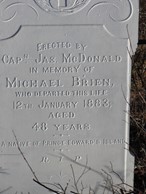
The name Michael Brien resonated in my head for several hours until I recalled a tombstone I had photographed in the St. Jacques Roman Catholic Cemetery years earlier. A quick scan through those images told me the next part of the story. There, amidst the bushes and grasses of the cemetery overlooking St. Jacques Barachoix beach was a marble slab marking the grave of Michael Brien.
The stone reads:
“Erected by Captn. Jas. McDonald in memory of Michael Brien who departed this life 12th. January 1883 aged 48 years – A native of Prince Edward Island.”
Tombstone – Michael Brien, Sacred Heart Cemetery, St. Jacques
There is a date discrepancy here of the twelfth and sixteenth as reported in Gloucester. That is likely an issue of communication.
When one question is answered another question appears. The question which emerges next is who is Captain Jas, McDonald and why did he pay the cost of erecting a tombstone to Michael Brien. Was he the Captain of the Hattie L. Newman? Was he a fellow Prince Edward Islander? I have been unable to determine this. Though McDonald was a name found in various communities along the south coast of Newfoundland historically it was not a name that has much legacy in St. Jacques. There are two other references to the McDonald name around that time. Another tombstone in the Roman Catholic cemetery bears the name of Captain John McDonald who died January 17th, 1883, aged 39 years. The stone bears no information of who erected it or the origin of Captain John McDonald. Church records for St. Bernard’s Parish, Fortune Bay, which maintained records for St. Jacques, 1874-1877, shows a Captain Hill McDonald who married Ellen Burke of St. Jacques. Are these McDonald’s connected? The name has disappeared from oral history in the community.
It is intriguing how one question leads to another then another; how the answer to the first question raises many other questions. Such is life; such is any attempt to uncover information of events which occurred before one’s time. In this instance Michael Brien died 131 years ago, as of this writing, and he has gone from being known by his contemporaries to being forgotten over time in the community of St. Jacques. Yet, like all mysteries and unexplained events, somewhere there exists information to pull away the cloak of not knowing. Even when we do so, we are often left with more of which we have no knowledge.
In acknowledgement of Michael Brien from Prince Edward Island, please read the following 1901 poem by Theodore Goodridge Roberts, The Dead Fisherman. If you can shed any light on Michael Brien or Captain Jas. McDonald please contact me at stjacquesblog@gmail.com
The Dead Fisherman
Now let him rest,
Toil-worn hands on nerveless breast.
Fish come into the silver bays,
And red suns go to the west.
But never again with wind and tide
Will he pull out from the harbour-side:
Never again will he stoop and toil
On the flakes where the fish are dried.
He knew these wonders—fog and wind;
The lifting dark with fire behind;
The slosh of surf in weedy rocks;
The flurries white and blind.
In dread and hunger he sailed and steered.
Famine and cold were the things he feared:
But now he feels no want nor doubt
Since the farthest cape was cleared.
Gulls wing over the laughing bay
Where he and his cares toiled yesterday;
And down where his lobster traps are piled
The green tide has its way.
When winds draw south, and ice drives in,
And the landwash shakes with crashing din,
Right well he’ll know, though his eyes be shut,
How the white spume hisses thin.
When sea smoke hides the crawling sea,
And black reefs crouch expectantly,
He’ll know the drag of the twisting tide
And the doomed brig’s agony.
Now let him sleep.
Nothing to win; nothing to keep;
Nothing to want; nothing to fear—
Buried so soft and deep!
There is something magical about sitting in a darkened theatre filled with strangers watching short films and seeing your hometown shared with them there on the big screen. That same magic resonates when you see the name of someone you know from that hometown roll up in the screen credits. The feeling of being special is amplified when hometown faces of people you know in the films stare back at you. It is somewhat like being in a noisy crowd where conversations are whizzing by you at lightning speed and someone speaks your name. Instantly you become aware and your attention is drawn to the direction your ears tell you to look. Seeing something familiar and intimate on the screen has the same effect; your awareness of what is being shown is accentuated, bringing appreciation to ethereal heights because of the emotional attachment. And you wonder, is there anyone else in this room who feels the same way?
Nickel Film Festival 2014
Such was the case with the 14th Annual Nickel Independent Film Festival held in St. John’s recently which featured works by film makers Ruth Lawrence and Justin Oakey, both of whom have their roots and influences in St. Jacques. Ruth has an illustrious career as actor, writer, and film maker which continues to ascend. Justin is early into a career as film maker, video producer and musician.
Ruth Lawrence’s film, titled La Quelle Affaire, is about a young woman who meets up with her boyfriend at a table where everything is edible. The film is based on Danielle Devereaux’s poem Quelle Affaire, which according to the author’s remarks when introducing the film, is the briefest poem she has ever written, comprising only the following two lines:
“‘You are what you eat,’ dieters are told.
I ate my lover’s wedding band; now I’m good as gold.”
La Quelle Affaire 2014
The Nickel Program describes the film as “Using natural winter light and edible props, this film explores the sensual and gut-wrenching nature of a love affair. Shot and edited by Brad Gover, with music by Sherry Ryan, and starring Meghan Greeley and Stephen Dunn.”
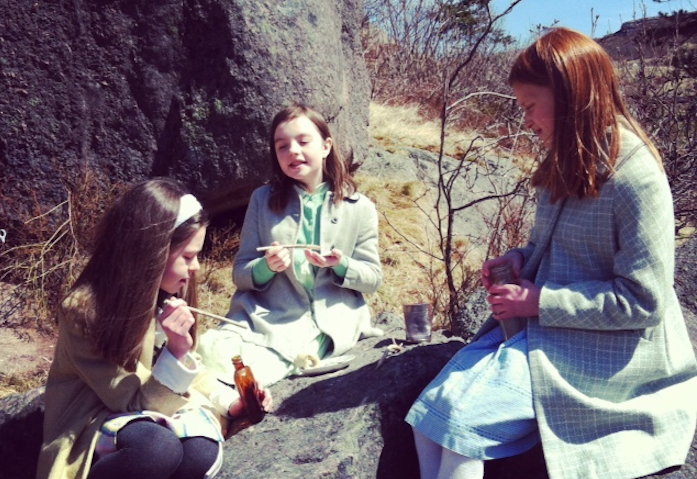
Opening night of the Festival featured another of Ruth Lawrence’s films which is gathering critical acclaim across the country, Talus and Scree. The title is inspired by the clusters of different sized rocks we see scattered around the base of hills in Newfoundland and elsewhere. The film deals with the doubts that emerge in childhood when events are not fully understood. The story, inspired by true events surrounding a younger sister who died in childhood, revolves around the two sisters.
Talus and Scree 2014
Kate, who is eleven years old, is urged by her mother to permit her younger sister Daisy to join with her in play. An accident occurs which could have been life-threatening to Daisy. A few months later when Daisy falls seriously ill, Kate is thrown into emotional turmoil. Thirty years later, Kate comes to grips with her unfounded guilt held over from what happened on that innocent day of play.
Written and directed by Ruth Lawrence, produced by Krysta Rudofsky under the PictureStart program (Telefilm/NIFCO) in May 2013. The Director of Photography is Stephanie Weber-BIron. It won the Linda Joy Award in September 2012 and the Women in Film & Television-Atlantic’s AAP Award in July 2013. The cast includes Emily Dawe, Tegan Macdonald, Claire Donnan, Julia Halfyard, Erin Mackey, Jennifer Nakashima, and Roger Maunder.
It has shown at the Atlantic Film Festival (Halifax) 2013, St. John’s International Women’s Film Festival 2013, Silver Wave Film Festival (Fredericton, Festival Top 10) 2014, and the Women In Film and Television International Showcase 2014, among others. Talus & Scree has made it to the CBC Short Film Face-Off, 2014.
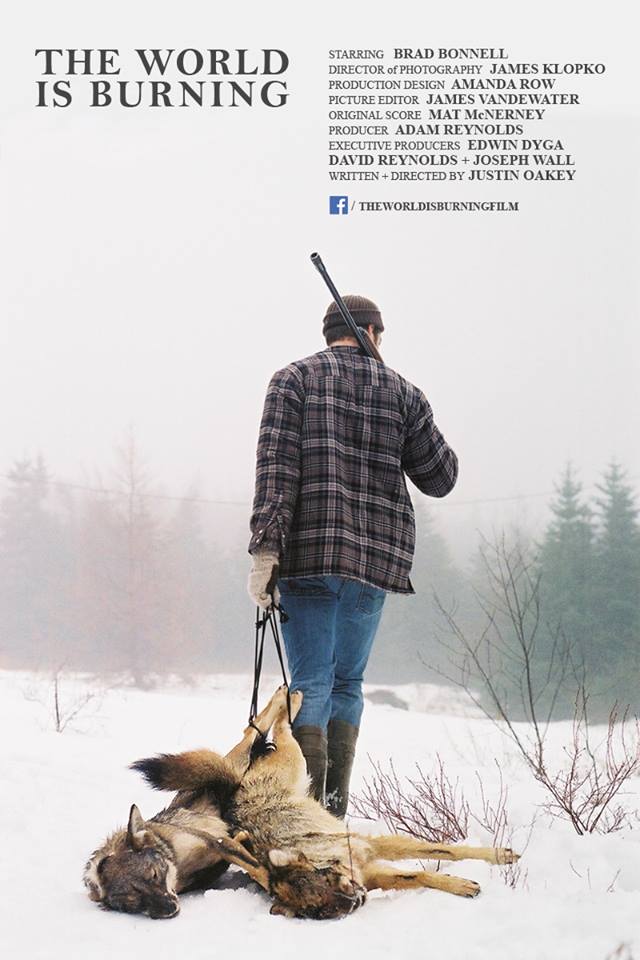
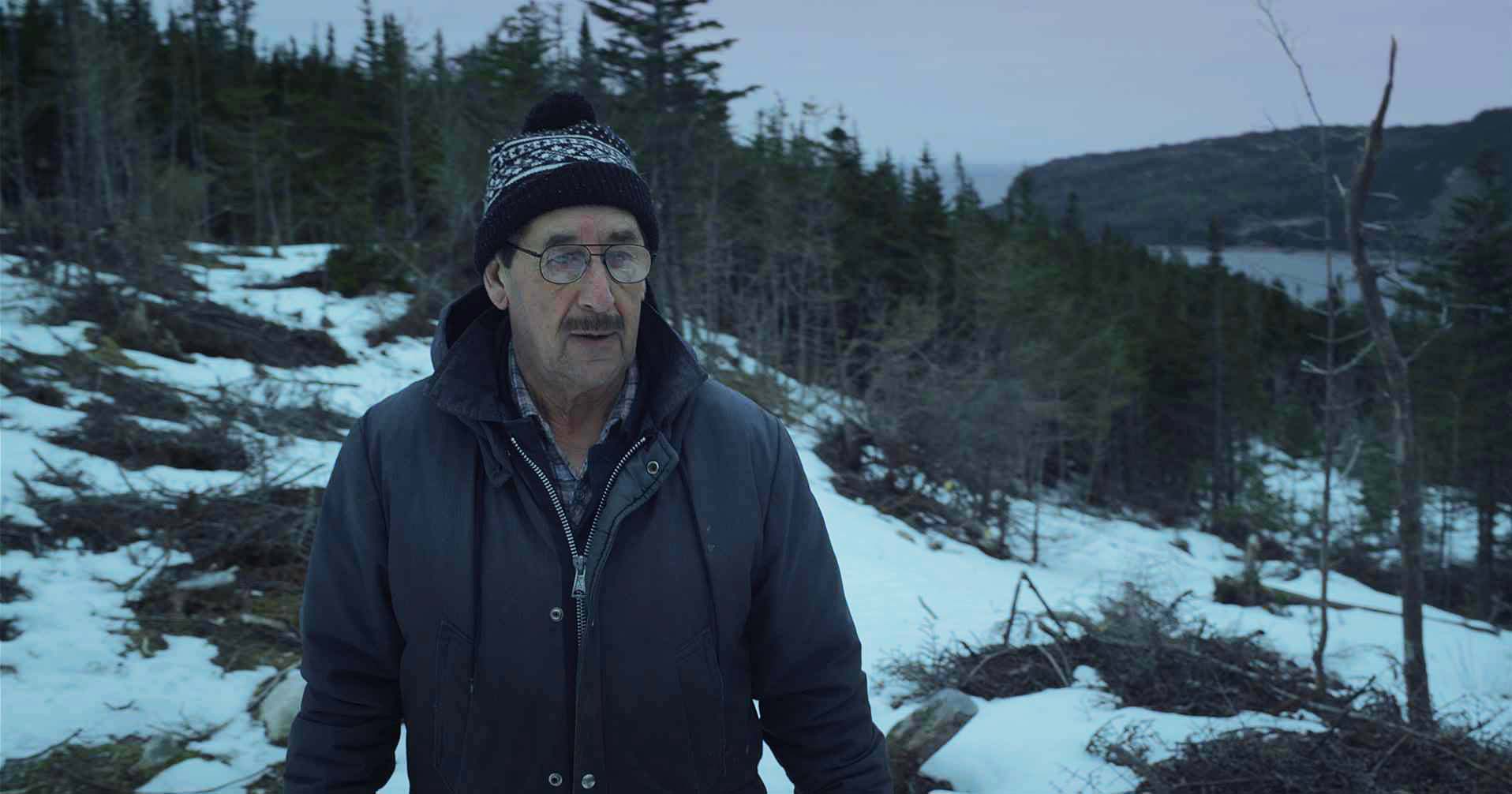
Justin Oakey’s film, titled The World Is Burning is based upon a real life experience of his grandfather, Albert Oakey, who still resides in St. Jacques. Albert was ‘in the woods’ one day when he was stalked by Coyotes, an unnerving experienced for anyone, particularly when you are alone in the wilderness. He was successful in driving them off and returning safely home. Justin’s father relayed the story to Justin who lives and works in Toronto. The story stimulated the creative forces within him and the idea for The World is Burning was born. The Nickel program describes the film in this way:
After his grandfather is fatally attacked by coyotes, a young Newfoundlander returns to his rural hometown to be with his family. His return becomes a reunion
Albert Oakey
with a traditional lifestyle he had left behind when, late one night, he finds himself deep in the forest hunting the coyotes.
Written and directed and produced by Justin Oakey and co-produced by Adam Reynolds the roles are performed by Brad Bonnell, Bruce Brenton, Janet O’Reilly, Albert Oakey and Tasha Potter. This film has shown at the 2013 Atlantic Film Festival (Halifax), the Court des Iles festival in Tahiti, the Jozi Film Festival in South Africa and the AsterFest International Film Festival in Macedonia, among others.
St. Jacques currently has a population of about 140 people who reside there year-round. During the warmer months of the year that population increases with visitors, former residents and those who reside there for part of the year. During the second weekend of August the population soars during the South Coast Arts Festival. For the past three years the Nickel Roadshow has taken its films to the Community Centre in St. Jacques. We expect this year will be no different. We also expect to be screening both Talus and Scree and The World is Burning. If you are in or near St. Jacques during the second week of August drop by to see what I mean about that magical feeling you get when the familiar is up there on the big screen.
There is no doubt that this fair island of ours owes its heritage to the migratory fishermen who travelled here from European countries hundreds of years ago. In their earliest days they fished from spring to fall, cured and dried their catches onshore, then returned home to Europe before winter arrived in the North Atlantic.
The Newfoundland fishery emerged with increased strength on the international market in the early 1800’s with a decline in American and French fisheries. As a result, greater numbers of English and Irish fishermen decided to take up permanent settlement in Newfoundland instead of travelling back and forth to Europe each year. Fishing involved the entire family in those days with men, women and children actively engaged in heading, splitting, salting, and drying cod in the harbours along the coast. A hook and line method was the dominant method of catching fish during those years however, forward thinking entrepreneurial fishermen were early adopters of new methods such as cod seines, trawl lines and gill nets.
Most communities scattered along the enormous erratic coastline of Newfoundland were first occupied by these fishermen who chose to establish a new life in this new world. St. Jacques is no exception. We do not know who the first fishermen were who set sight on this beautiful harbour and imagined it as a home where they would raise their families. We do know some of the fishermen who arrived here in the early days of the 1800’s. Among them was a man from the West Country of England, William Skinner. The book, Origins of English Settlement in Newfoundland, provides great insight into early settlement patterns in southern Newfoundland. [Clicking on this title, Origins of English Settlement in Newfoundland opens a pdf copy of the book. You will need adobe reader installed.]
None of us are capable of looking into the future and seeing our descendants several hundred years from now. However, were it possible, William Skinner’s heart would swell with pride to see so many generations of men who owe their origin to his decision to settle in St. Jacques and who have followed with making a living on the ocean. One would not try to document every instance of William Skinner’s descendants in a short piece such as this, thus I will narrow the scope to illustrate the lineage. Undoubtedly, there are other descendants who have chosen a life on the ocean.
William had two daughters and three sons, George, Abram and James, two of whom we know went on to own their own schooners as had their father. George died at age 25. James had four sons and five daughters. All four sons became fishermen; three of whom, spent their entire lives on the sea. Abram had one son and three daughters. His son would go on to become a war hero in two world wars. The next generation saw men take their vessels across the world’s oceans and back. Today’s generations are doing the same.
We don’t know the name or size of any vessels owned by William Skinner; however, we can be certain it was of sufficient size to ply the waters on the north side of Fortune Bay. His daily ritual involved a rise before daylight, rowing or sailing his boat to the fishing grounds outside the harbour and returning before the end of day to process the catch. Inshore fishing in those days was a family affair with wives, sons and daughters all at work cutting, splitting and curing fish. As soon as boys were old enough they worked in the boat alongside their father harvesting cod. We can be certain that William and Elizabeth Skinner’s two sons, Abram and James, were introduced to their careers as fishermen in this way.
Abram and his wife Kate raised three daughters and one son, Edgar. Captain Abe owned and operated his own schooners until at age fifty-nine when he ran aground in his 56 ton Hesperia as she approached Point Platte on the northwest side of Miquelon in late December, 1916 carrying a load of coal. There were no survivors. Edgar volunteered for service with The Newfoundland Regiment during WWI. After the war he worked his way up to Captain on large vessels and volunteered for service in WWII where he became Commanding Officer of several Navy vessels including the HMCS Arrowhead. He was involved in the Battle of the St. Lawrence and the Battle of the Atlantic. Captain Abe’s grandson Lester also served as Commanding Officer in the Canadian Navy during WWII. He was serving on the HMCS Victoriaville when Germany surrendered its infamous U190 on the Grand Banks at the end of the war.
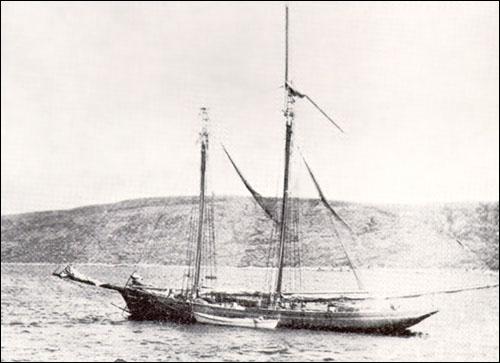
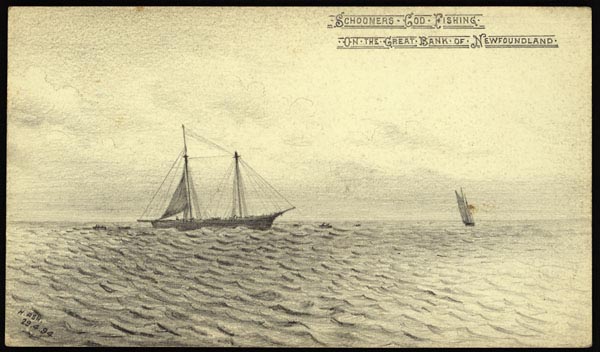
Typical Schooner used to fish the Newfoundland Grand Banks c1890 – Public Domain
James had five daughters and four sons – William, Albert (Bert), Ralph, and Louis; all of whom worked on the ocean, some more than others. William served with the Merchant Navy during WWI. He was fondly nicknamed ‘Uncle Billow’ by family members. There is some speculation that ‘Billow’ Skinner acquired his name from his love of the sea and his choices to work on the sea. While that may be accurate, it isn’t hard to imagine this third generation family from England reading, in a still fresh West Country accent, the works of Rudyard Kipling to their children in the evening under the soft glow of a kerosene lamp, particularly The Jungle Book and the poem Seal Lullaby which reads as follows:
Oh! Hush thee, my baby, the night is behind us,
And black are the waters that sparkled so green.
The moon, o’er the combers, looks downward to find us,
At rest in the hollows that rustle between.
Where billow meets billow, then soft be thy pillow,
Oh weary wee flipperling, curl at thy ease!
The storm shall not wake thee, nor shark overtake thee,
Asleep in the arms of the slow swinging seas!
Such imagery can easily lead one to see how a child named Bill who liked sea stories might be nicknamed ‘Billow’.
After the war “Uncle Billow” sailed with his brother, Captain Ralph Skinner until his death on July 9, 1923. He was fatally injured aboard ship from an accident while 80 miles offshore on the deck of the schooner Dorothy O, a 122 ton Schooner built at Shelburne, Nova Scotia, under Ralph’s command. The Dorothy O was owned by the Belleoram branch of Harvey and Co. of St. John’s. Ralph Skinner was a renowned captain who commanded a series of vessels which took him throughout the North and South Atlantic. During his retirement years he lived in Belleoram.
William (Billow) Skinner’s son Eric followed his father’s lead and served with the Merchant Marine during WWII. Eric repeatedly made courageous and dangerous trips across the Atlantic Ocean between Canada and England on cargo ships in the face of massive German U-boat attacks during the Battle of the Atlantic. During a period which covered most of the war, 1940-46, Eric sailed to such British ports as Liverpool, Manchester, and London delivering desperately needed goods for the war effort in Europe. After the war he chose to live and work on the land.
Bert fished out of St. Jacques as part of the inshore fishery, salting and drying his catch on flakes located along the seashore in an area known as ‘the bottom’ of the harbour. He did this until illness forced him to withdraw from active work at a relatively young age; an illness which claimed his life at age forty-two.
Louis Skinner and his sister Emma moved to the United States. There, Lou became quite successful in the fishing industry in Gloucester, Massachusetts. Emma married into the well-known Anderson family who also shared a fishing heritage. Descendants of Louis Skinner and his sister Emma can be found in many cities and towns throughout New England.
The call of the ocean seemed to have escaped the men of next generation of Skinners in St. Jacques. However, Bert’s daughter Emma married legendary fishing captain Thomas Lawrence and their sons were next to hear the call of their great-great grandfather and seek out a life on the sea. Four of their sons grew into careers that took them away from the land. Their eldest son Albert went to sea on his father’s trawler in his early twenties where he worked in a number of capacities including ships cook for several years. His first ocean going experience was on a trawler known locally as the Rupert Brand VIII although it had been renamed the Zerda by this time, when the corporate ownership of BC Packers shifted to Fishery Products in Harbour Breton. Albert built upon his lengthy experience through formal schooling where he acquired a succession of certificates until he reached the stature of Captain as his father had done.
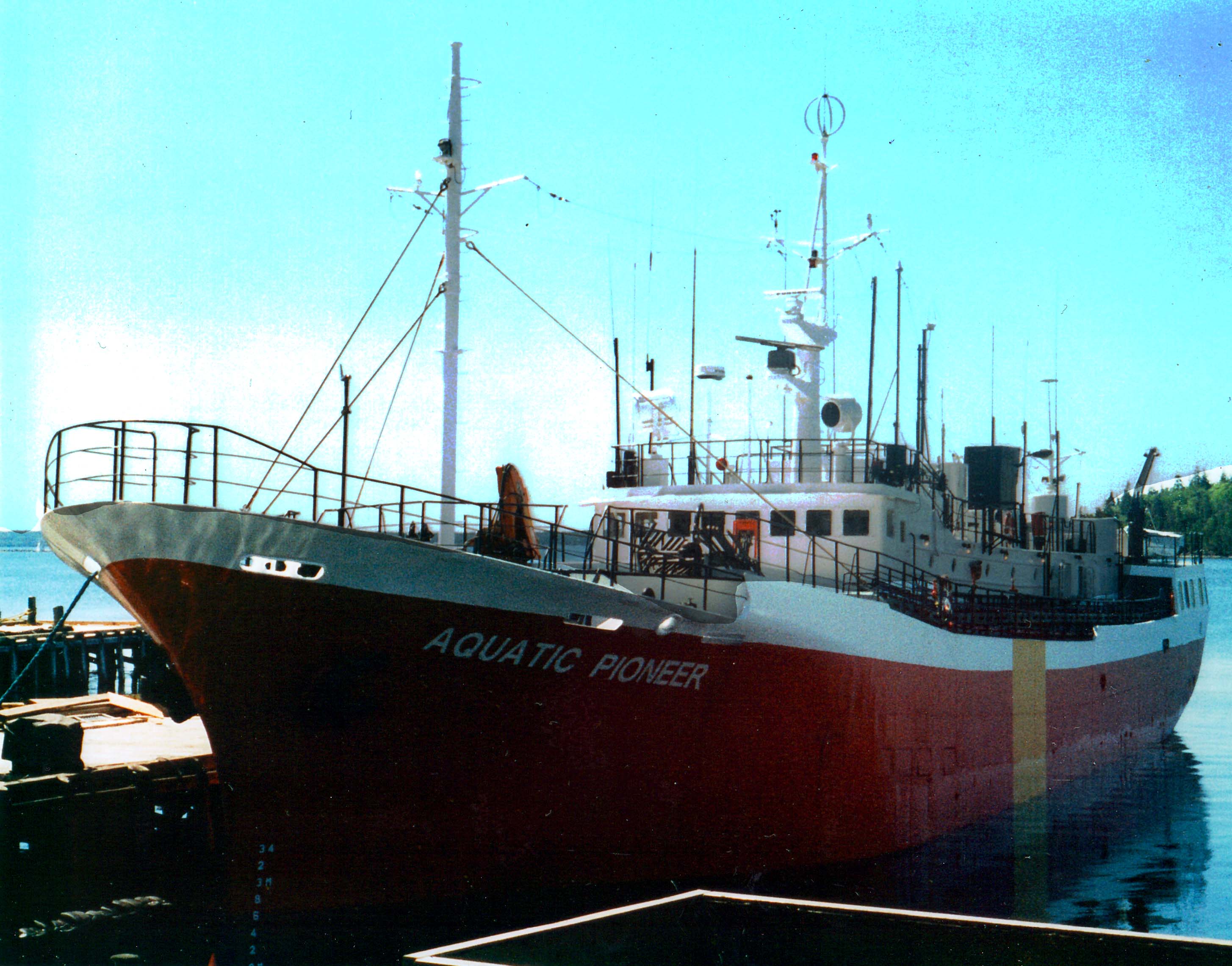
The Aquatic Pioneer
Along the way he served as relieving captain, mate, and Bosun on many recognizable fishing trawlers, including the Zweeloo, Zula, Zeeland and Newfoundland Breeze, the Newfoundland Bounty, Newfoundland Breaker, the Penny Hope II, Zebride and Zerda, as well as the Gaultois. At one point in his career he travelled to Japan and skippered a deep sea tuna boat, the Aquatic Pioneer, from Misaka, Japan across the Pacific Ocean to the Panama Canal and up through the Atlantic to Holyrood, Newfoundland. Since then he captained a succession of fishing vessels including fishing for turbot off Greenland and on deep water factory freezer clam harvesters the Atlantic Vigor and Atlantic Concord; after which he moved into a management position with a major seafood producer in Atlantic Canada.
Sam Lawrence has worked on trawlers, inshore fishing boats, long liners, and spent time with his brother Albert tuna fishing in the South Atlantic as well as working in the aquaculture industry farming Atlantic salmon. He continues to fish off the south coast of Newfoundland. These days he is harvesting crab and whelk. Click on whelk to open a pdf file explaining this fishery. You will need adobe reader installed.
Barge Captain R. Lawrence
Ray Lawrence chose a somewhat different career on the ocean. After fishing on a Nova Scotia lobster boat for some time and working in marine related industries he saw a future in the oil industry. He worked off of Sable Island for several years then found opportunities internationally and has worked on offshore drilling rigs around the world. Through determination, experience and training he has risen to the top position of Captain on a rig drilling off the coast of Viet Nam, an occupation which sees him flying halfway around the world twelve times each year.
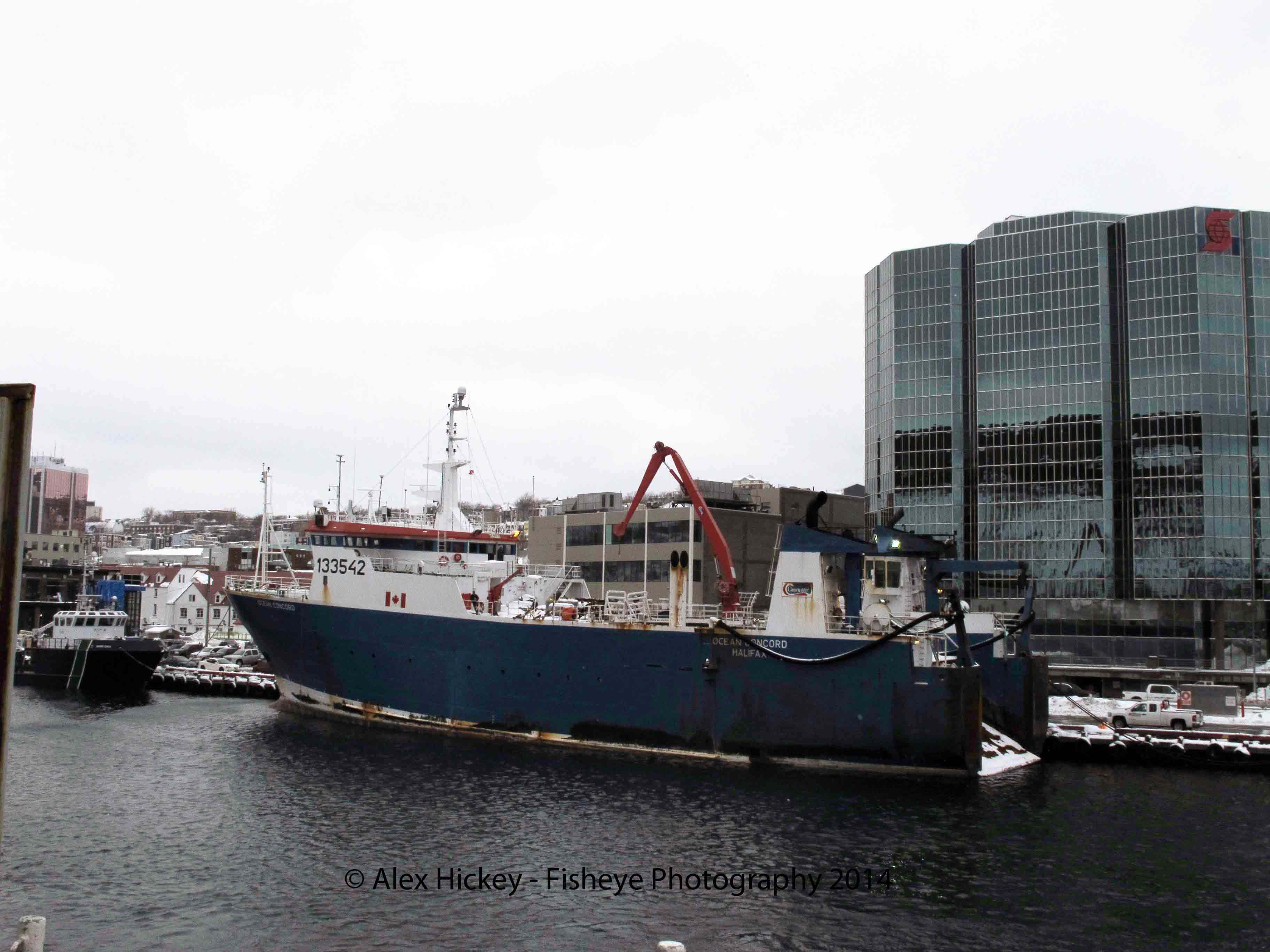
Ocean Concord, St. John’s, NL 2014
The youngest brother Roy is a ships officer, second mate, on his way to a captain’s ticket. His recent work has been on the Ocean Concord and Arctic Endurance, deep sea clam harvesters whose products are ready for market when they reach shore. Roy has over twenty years’ experience working on a number of fishing vessels in the same industry. Of the next generation, Albert’s son Craig is currently serving with the Canadian Navy and Sam’s son Peter is working on an offshore oil rig in the United States.
Today, the work of William Skinner of St. Jacques is still carried on in the capable hands of men five and six generations beyond him. Like William, who immigrated to Newfoundland from his home in England so long ago to establish a life in St. Jacques, his descendants travel all around the globe in carrying out their work in ocean industries. The thread of salt water which ties them all together has both supported their lives and taken their lives, for a life lived on the sea is forever one of risk and danger. William, following a life in unison with the sea, set out a course of events which took him from England to Newfoundland. Little did he know that his descendants would close the circle by continuing his journey across all of the world’s major oceans and more than once fly over the west country of England on their journeys homeward!
The lives of Newfoundland fishermen and their vessels have been celebrated in song for generations. One in particular resonates whenever I reflect on these men, their dedication and hard work. The song, I Am a Fisherman, written by Bud Davidge and recorded by Gordon Drake, captures the essence and fortitude of men who seek to make their living from the sea.
Read the lyrics below then listen to Gordon Drake sing that testament to fishermen everywhere.
I Am a Fisherman
I Am a Fisherman, Me
I am a fisherman, me
I have no other life but the sea
With God all around my spirit is free
For I am a fisherman, me
I have known people who scorn
The man who can ride on the storm
What blind souls indeed who do not know the peace
Of the boat lying still on the mooring
I’ve felt the gentle swell roll
In the cradle that’s rocked to and fro
Somewhere in my veins are the soft sleepy strains
Of a mother’s voice waiting at home
To not see the joy of return
On the faces of families who yearn
For the tide to bring in
All those tired happy men
Is to not know the passion that burns
Have you been to St. Jacques for a visit recently? I was there a couple of days ago and the visit recharged my batteries. Like salmon who return to the stream in which they were hatched I feel the constant pull back to that community. I know from your comments and messages that many of you feel the same way. I have an advantage of proximity which many others do not have. Today I discovered that our old friend Google has posted it’s Street View of St. Jacques. Click on Street View of St. Jacquesto be taken to a position on the road just west of the Roman Catholic Cemetery. From here you can follow the road through town. Pause now and then to look all around you. Street View permits a 360 degree rotation from any position.
Use you mouse or the arrow keys on your computer to navigate the roads. Watch out for the potholes! It is almost like being there. You may even see someone on the road or in their garden you recognize. I know, I did! After your trip ‘home’ leave a comment below and tell me about your visit. I’d love to hear from you.



 All Things St. Jacques, NL