Posted by: alexhickey | June 8, 2014

The Oceangoing Skinners of St. Jacques ©

There is no doubt that this fair island of ours owes its heritage to the migratory fishermen who travelled here from European countries hundreds of years ago. In their earliest days they fished from spring to fall, cured and dried their catches onshore, then returned home to Europe before winter arrived in the North Atlantic.

The Newfoundland fishery emerged with increased strength on the international market in the early 1800’s with a decline in American and French fisheries. As a result, greater numbers of English and Irish fishermen decided to take up permanent settlement in Newfoundland instead of travelling back and forth to Europe each year. Fishing involved the entire family in those days with men, women and children actively engaged in heading, splitting, salting, and drying cod in the harbours along the coast. A hook and line method was the dominant method of catching fish during those years however, forward thinking entrepreneurial fishermen were early adopters of new methods such as cod seines, trawl lines and gill nets.

Most communities scattered along the enormous erratic coastline of Newfoundland were first occupied by these fishermen who chose to establish a new life in this new world. St. Jacques is no exception. We do not know who the first fishermen were who set sight on this beautiful harbour and imagined it as a home where they would raise their families. We do know some of the fishermen who arrived here in the early days of the 1800’s. Among them was a man from the West Country of England, William Skinner. The book, Origins of English Settlement in Newfoundland, provides great insight into early settlement patterns in southern Newfoundland. [Clicking on this title, Origins of English Settlement in Newfoundland opens a pdf copy of the book. You will need adobe reader installed.]

None of us are capable of looking into the future and seeing our descendants several hundred years from now. However, were it possible, William Skinner’s heart would swell with pride to see so many generations of men who owe their origin to his decision to settle in St. Jacques and who have followed with making a living on the ocean. One would not try to document every instance of William Skinner’s descendants in a short piece such as this, thus I will narrow the scope to illustrate the lineage. Undoubtedly, there are other descendants who have chosen a life on the ocean.

William had two daughters and three sons, George, Abram and James, two of whom we know went on to own their own schooners as had their father. George died at age 25. James had four sons and five daughters. All four sons became fishermen; three of whom, spent their entire lives on the sea. Abram had one son and three daughters. His son would go on to become a war hero in two world wars. The next generation saw men take their vessels across the world’s oceans and back. Today’s generations are doing the same.

We don’t know the name or size of any vessels owned by William Skinner; however, we can be certain it was of sufficient size to ply the waters on the north side of Fortune Bay. His daily ritual involved a rise before daylight, rowing or sailing his boat to the fishing grounds outside the harbour and returning before the end of day to process the catch. Inshore fishing in those days was a family affair with wives, sons and daughters all at work cutting, splitting and curing fish. As soon as boys were old enough they worked in the boat alongside their father harvesting cod. We can be certain that William and Elizabeth Skinner’s two sons, Abram and James, were introduced to their careers as fishermen in this way.

Abram and his wife Kate raised three daughters and one son, Edgar. Captain Abe owned and operated his own schooners until at age fifty-nine when he ran aground in his 56 ton Hesperia as she approached Point Platte on the northwest side of Miquelon in late December, 1916 carrying a load of coal. There were no survivors. Edgar volunteered for service with The Newfoundland Regiment during WWI. After the war he worked his way up to Captain on large vessels and volunteered for service in WWII where he became Commanding Officer of several Navy vessels including the HMCS Arrowhead. He was involved in the Battle of the St. Lawrence and the Battle of the Atlantic. Captain Abe’s grandson Lester also served as Commanding Officer in the Canadian Navy during WWII. He was serving on the HMCS Victoriaville when Germany surrendered its infamous U190 on the Grand Banks at the end of the war.
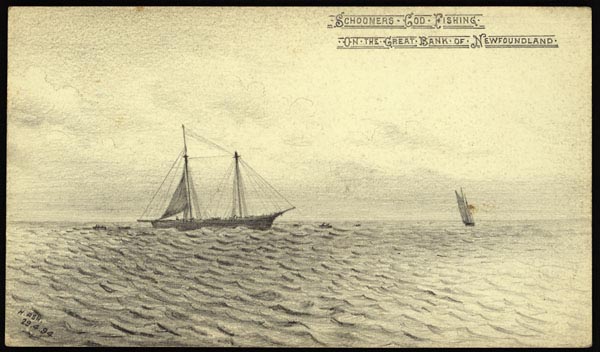
sepia image of sailing schooner at sea

Typical Schooner used to fish the Newfoundland Grand Banks c1890 – Public Domain

James had five daughters and four sons – William, Albert (Bert), Ralph, and Louis; all of whom worked on the ocean, some more than others. William served with the Merchant Navy during WWI. He was fondly nicknamed ‘Uncle Billow’ by family members. There is some speculation that ‘Billow’ Skinner acquired his name from his love of the sea and his choices to work on the sea. While that may be accurate, it isn’t hard to imagine this third generation family from England reading, in a still fresh West Country accent, the works of Rudyard Kipling to their children in the evening under the soft glow of a kerosene lamp, particularly The Jungle Book and the poem Seal Lullaby which reads as follows:

Oh! Hush thee, my baby, the night is behind us,
And black are the waters that sparkled so green.
The moon, o’er the combers, looks downward to find us,
At rest in the hollows that rustle between.
Where billow meets billow, then soft be thy pillow,
Oh weary wee flipperling, curl at thy ease!
The storm shall not wake thee, nor shark overtake thee,
Asleep in the arms of the slow swinging seas!

Such imagery can easily lead one to see how a child named Bill who liked sea stories might be nicknamed ‘Billow’.

After the war “Uncle Billow” sailed with his brother, Captain Ralph Skinner until his death on July 9, 1923. He was fatally injured aboard ship from an accident while 80 miles offshore on the deck of the schooner Dorothy O, a 122 ton Schooner built at Shelburne, Nova Scotia, under Ralph’s command. The Dorothy O was owned by the Belleoram branch of Harvey and Co. of St. John’s. Ralph Skinner was a renowned captain who commanded a series of vessels which took him throughout the North and South Atlantic. During his retirement years he lived in Belleoram.

William (Billow) Skinner’s son Eric followed his father’s lead and served with the Merchant Marine during WWII. Eric repeatedly made courageous and dangerous trips across the Atlantic Ocean between Canada and England on cargo ships in the face of massive German U-boat attacks during the Battle of the Atlantic. During a period which covered most of the war, 1940-46, Eric sailed to such British ports as Liverpool, Manchester, and London delivering desperately needed goods for the war effort in Europe. After the war he chose to live and work on the land.

Bert fished out of St. Jacques as part of the inshore fishery, salting and drying his catch on flakes located along the seashore in an area known as ‘the bottom’ of the harbour. He did this until illness forced him to withdraw from active work at a relatively young age; an illness which claimed his life at age forty-two.

Louis Skinner and his sister Emma moved to the United States. There, Lou became quite successful in the fishing industry in Gloucester, Massachusetts. Emma married into the well-known Anderson family who also shared a fishing heritage. Descendants of Louis Skinner and his sister Emma can be found in many cities and towns throughout New England.

The call of the ocean seemed to have escaped the men of next generation of Skinners in St. Jacques. However, Bert’s daughter Emma married legendary fishing captain Thomas Lawrence and their sons were next to hear the call of their great-great grandfather and seek out a life on the sea.  Four of their sons grew into careers that took them away from the land. Their eldest son Albert went to sea on his father’s trawler in his early twenties where he worked in a number of capacities including ships cook for several years. His first ocean going experience was on a trawler known locally as the Rupert Brand VIII although it had been renamed the Zerda by this time, when the corporate ownership of BC Packers shifted to Fishery Products in Harbour Breton. Albert built upon his lengthy experience through formal schooling where he acquired a succession of certificates until he reached the stature of Captain as his father had done.
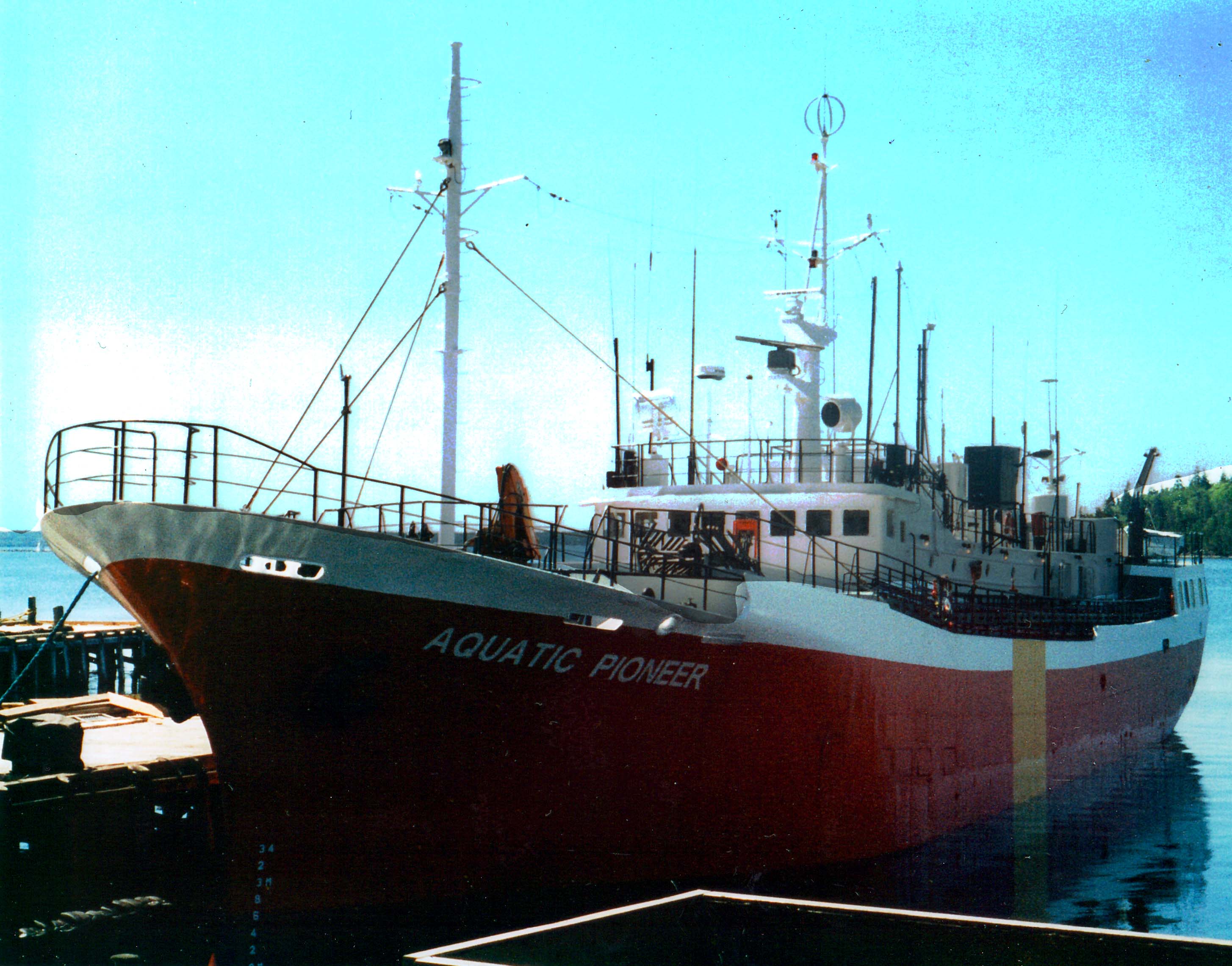
the aquatic pioneer fishing vessel

The Aquatic Pioneer

Along the way he served as relieving captain, mate, and Bosun on many recognizable fishing trawlers, including the Zweeloo, Zula, Zeeland and Newfoundland Breeze, the Newfoundland Bounty, Newfoundland Breaker, the Penny Hope II, Zebride and Zerda, as well as the Gaultois. At one point in his career he travelled to Japan and skippered a deep sea tuna boat, the Aquatic Pioneer, from Misaka, Japan across the Pacific Ocean to the Panama Canal and up through the Atlantic to Holyrood, Newfoundland. Since then he captained a succession of fishing vessels including fishing for turbot off Greenland and on deep water factory freezer clam harvesters the Atlantic Vigor and Atlantic Concord; after which he moved into a management position with a major seafood producer in Atlantic Canada.

Sam Lawrence has worked on trawlers, inshore fishing boats, long liners, and spent time with his brother Albert tuna fishing in the South Atlantic as well as working in the aquaculture industry farming Atlantic salmon. He continues to fish off the south coast of Newfoundland. These days he is harvesting crab and whelk. Click on whelk to open a pdf file explaining this fishery. You will need adobe reader installed.

 

barge captain lawrence

Barge Captain R. Lawrence

Ray Lawrence chose a somewhat different career on the ocean. After fishing on a Nova Scotia lobster boat for some time and working in marine related industries he saw a future in the oil industry. He worked off of Sable Island for several years then found opportunities internationally and has worked on offshore drilling rigs around the world. Through determination, experience and training he has risen to the top position of Captain on a rig drilling off the coast of Viet Nam, an occupation which sees him flying halfway around the world twelve times each year.
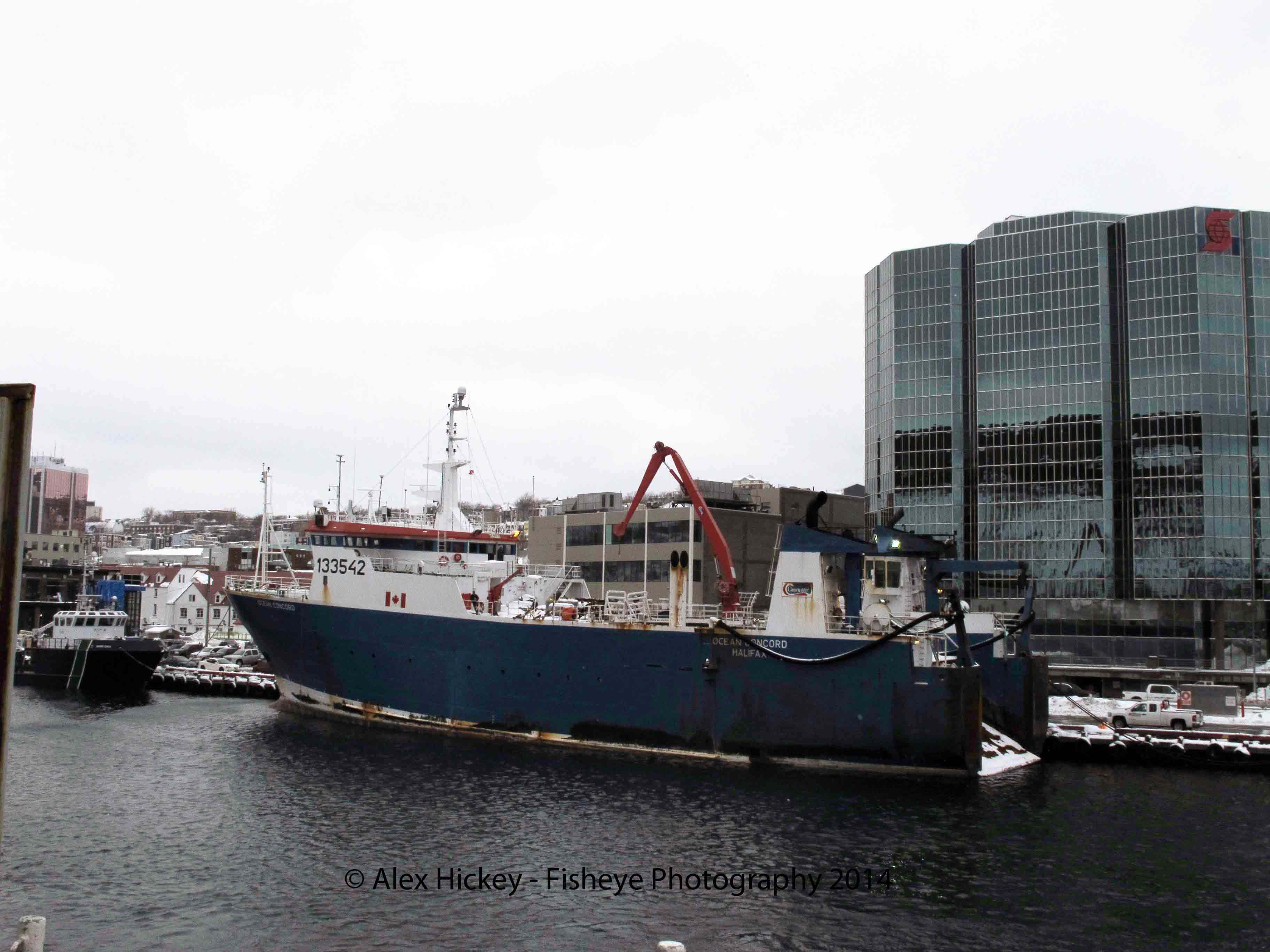
ship ocean concord st. john's, nl 2014

Ocean Concord, St. John’s, NL 2014

The youngest brother Roy is a ships officer, second mate, on his way to a captain’s ticket. His recent work has been on the Ocean Concord and Arctic Endurance, deep sea clam harvesters whose products are ready for market when they reach shore. Roy has over twenty years’ experience working on a number of fishing vessels in the same industry. Of the next generation, Albert’s son Craig is currently serving with the Canadian Navy and Sam’s son Peter is working on an offshore oil rig in the United States.

Today, the work of William Skinner of St. Jacques is still carried on in the capable hands of men five and six generations beyond him. Like William, who immigrated to Newfoundland from his home in England so long ago to establish a life in St. Jacques, his descendants travel all around the globe in carrying out their work in ocean industries. The thread of salt water which ties them all together has both supported their lives and taken their lives, for a life lived on the sea is forever one of risk and danger. William, following a life in unison with the sea, set out a course of events which took him from England to Newfoundland. Little did he know that his descendants would close the circle by continuing his journey across all of the world’s major oceans and more than once fly over the west country of England on their journeys homeward!
The lives of Newfoundland fishermen and their vessels have been celebrated in song for generations. One in particular resonates whenever I reflect on these men, their dedication and hard work. The song, I Am a Fisherman, written by Bud Davidge and recorded by Gordon Drake, captures the essence and fortitude of men who seek to make their living from the sea.

Read the lyrics below then listen to Gordon Drake sing that testament to fishermen everywhere.

I Am a Fisherman

I Am a Fisherman, Me
I am a fisherman, me
I have no other life but the sea
With God all around my spirit is free
For I am a fisherman, me

I have known people who scorn
The man who can ride on the storm
What blind souls indeed who do not know the peace
Of the boat lying still on the mooring

I’ve felt the gentle swell roll
In the cradle that’s rocked to and fro
Somewhere in my veins are the soft sleepy strains
Of a mother’s voice waiting at home

To not see the joy of return
On the faces of families who yearn
For the tide to bring in
All those tired happy men
Is to not know the passion that burns

In the souls of those fisher folk free
Who have no other life but the sea
With God all around and the swell of the ground
I’m proud as a fisherman, me
©Bud Davidge, Used with Permission
Posted by: alexhickey | April 26, 2014

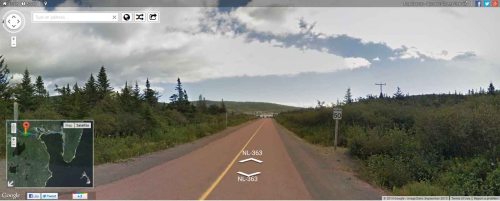
Google Street View – St. Jacques

Have you been to St. Jacques for a visit recently? I was there a couple of days ago and the visit recharged my batteries.  Like salmon who return to the stream in which they were hatched I feel the constant pull back to that community.  I know from your comments and messages that many of you feel the same way.  I have an advantage of proximity which many others do not have.  Today I discovered that our old friend Google has posted it’s Street View of St. Jacques.  Click on Street View of St. Jacques to be taken to a position on the road just west of the Roman Catholic Cemetery.  From here you can follow the road through town.  Pause now and then to look all around you.  Street View permits a 360 degree rotation from any position.

Use you mouse or the arrow keys on your computer to navigate the roads.  Watch out for the potholes!  It is almost like being there.  You may even see someone on the road or in their garden you recognize.  I know, I did!  After your trip ‘home’ leave a comment below and tell me about your visit.  I’d love to hear from you.

Google-street-view-stjacques

Google Street View Entering St. Jacques

Posted by: alexhickey | April 23, 2014

’tis the season to … ©

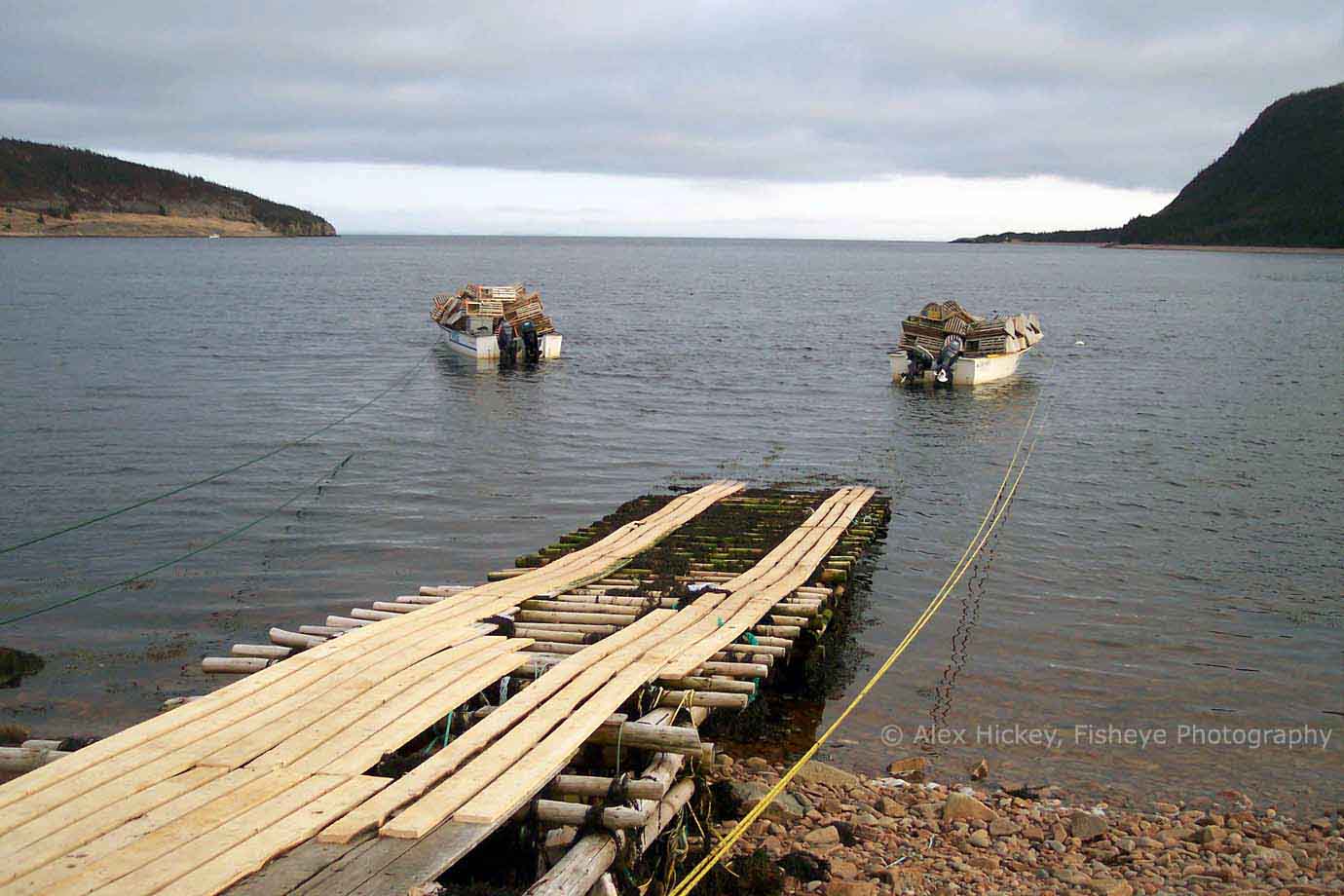
two white open boats at anchor laden with wooden lobster pots

Ready for Morning

2:00 AM …
3:00 AM …
3:30 AM … he looks at the clock again. Each minute feels like an hour, each turning of the hour an eternity. Enough of this, he thinks and jumps out of bed, looks out the window into the waning darkness, checking for lights at his buddy’s house, then pours his first black coffee of the day. None of the fishermen in St. Jacques are sleeping well this morning. Today, their lobster pots go in the water!

When the season opens fishermen methodically place their pots in favourite locations, some of which they may have used for years. Once the pots are set there is a required waiting period of forty-eight hours before they can be hauled. The excitement and anticipation of first catch makes this the longest forty-eight hours of the year.
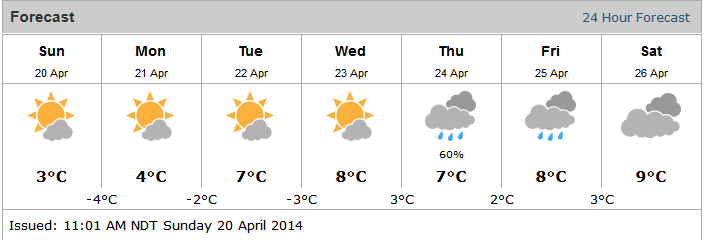
Everyone keeps an eye on the sky, the ocean, the moon, tides and an ear to the weather forecast. Wind is a concern for these Newfoundland lobster fishermen who typically work from relatively small open boats. It also affects catch rates. A wind storm can see pots left in the water for several days and that’s not good for the fishers or the lobsters. A pot that runs out of bait stops fishing; lobsters facing tumultuous water seem not to be on the move as much. A severe storm can result in loss of fishing gear. License limitations on the number of pots allowed make every one precious.

Winds at the start of this year’s season were forecast to be gusting to 60 km. On the north side of Fortune Bay a northerly wind is fair when close to shore; however, it can be a difficult wind to deal with once you are outside the shelter of harbours like St. Jacques. If you are fishing on the southern side of the bay it’s near impossible.

chart showing weather forecast for the week of April 20th to april 25th 2014

Environment Canada 20-04-2014

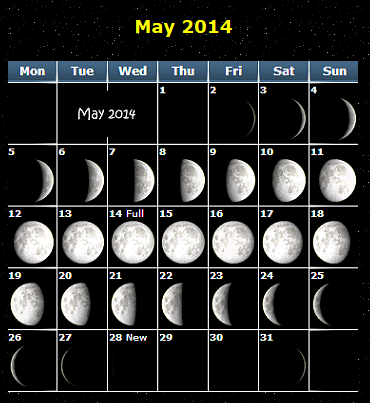
And what about the moon? More lobsters are caught just before a full moon and tend to decrease as the moon wanes. Research in Australia shows this can increase by ten percent and decrease by five percent with the change of the moon. They think it has to do with more food sources being exposed during the higher tides of the full moon prompting more lobsters to be on the move.

Below is a chart showing the phases of the moon for May, 2014.

phases of moon chart may 2014

May

Check out sea conditions in the St. Jacques/Belleoram area by clicking on tide-forecast. Check out the information broadcast from the weather station located on Sagona Island in Fortune Bay to see what weather conditions are like in St. Jacques on any given day.

Lobster Fishing Area 11 consists of Fortune Bay extending along the south coast of Newfoundland to a point about 15 miles west of Burgeo. In the days leading up to the opening of the season everyone wants to know what will be the opening price for Newfoundland Lobster. The market dynamics around lobster pricing is complex and subject to may variables; however, one indicator which provides a picture of what might be, are the prices in neighbouring provinces of Nova Scotia, PEI and New Brunswick. The Fish, Food and Allied Workers Union tracks the prices in those provinces.

Lobster catches have been good in recent years. This can be attributed to several factors. The number of fishermen has decreased as a result of a government license buy-out program; the total number of pots per license holder has been reduced; and probably most important, the voluntary V-notching of spawning female lobsters as a conservation measure.
The men and women who work in the lobster boats from now until late June are neither Johnny-come-latelies nor dilettantes. They turn their faces to the sub-zero winds that blow in off the North Atlantic, sink their hands into the icy waters of Fortune Bay and have half a day’s work completed by the time most of the rest of us begin our day. At the beginning of the season pots are set in deeper water then moved closer to shore in more shallow water as the season wears on. Early in the season a ten-hour trip is not uncommon; later, that can be reduced to six hours each day.

Early in the morning the sound of outboard motors inform the community that the boats are going out. Tom and Ros, Neil and Marlene, Levi and Tanya, Keith and George, and Edgar and Shayne are much wider awake than the rest of us as they set out for their daily work on the ocean.

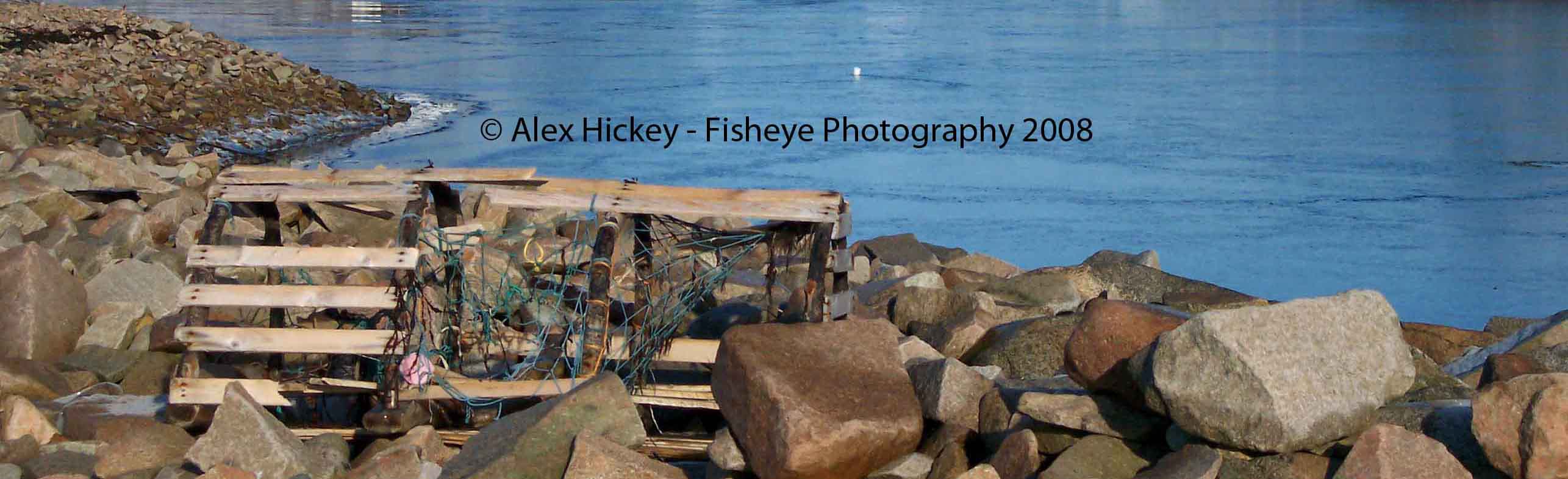
Lobster fishing practices have changed over the years. Pots are no longer hauled using the back-breaking hand-over-hand style. Fishermen now use a mechanized pot hauler. The traditional wooden pots that men so carefully crafted throughout the winter months for generations are being replaced by wire mesh structures which require far less maintenance and deliver bigger catches. Soon, broken lobster pots washed up on the beach will be gone from our sight.

broken lobster pot washed up on shoreline

Broken Lobster Pot

Take a look at a video profile of the Newfoundland Lobster Fishery produced by the Newfoundland Fish Food and Allied Workers Union.


Curt Brown of the Gulf of Maine Research Institute filmed a lobster trap going into the water and fishing. In this video you can see the bait bag and a lobster feeding on the bait.

If you’d like to know more about lobster industry check out the links below:

Lobster by Trap – Newfoundland’s South Coast Lobster Fishing Area 11
How Newfoundland Seafood is Fished – Lobster
Department of Fisheries and Oceans Background Paper on Newfoundland Lobster
V Notching: Conserving for Tomorrow by Rose Walsh of the Fish Harvesters’ Resource Centres (FRC)
V Notching Explained
Telling the Difference Between Male and Female Lobsters
Shelling a Lobster
How the Lobster Clawed Its Way Up: A crustacean’s climb from pauper’s fare to modern-day delicacy, by April Dembosky, Mother Jones, March/April 2006 Issue


Posted by: alexhickey | April 13, 2014

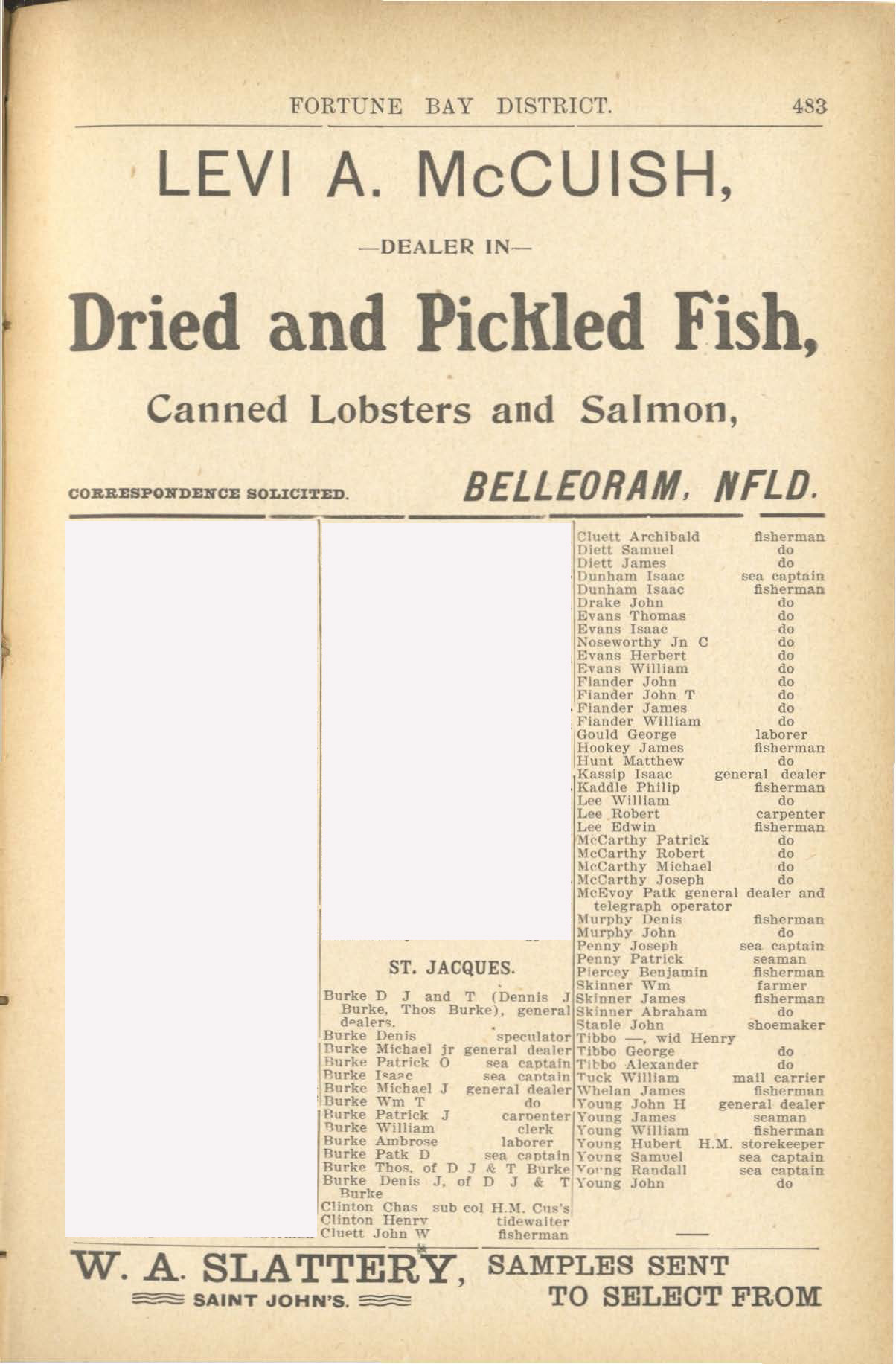
McAlpine’s Directory – St. Jacques, 1904©

Census reports are a great source of information for historians and those interested in genealogy. Though there are census reports of Newfoundland’s population prior to the 1900’s which one can find online these days they do not provide information on all communities in the country. The south coast of Newfoundland, particularly Fortune Bay, doesn’t show up in great detail in many of these reports.

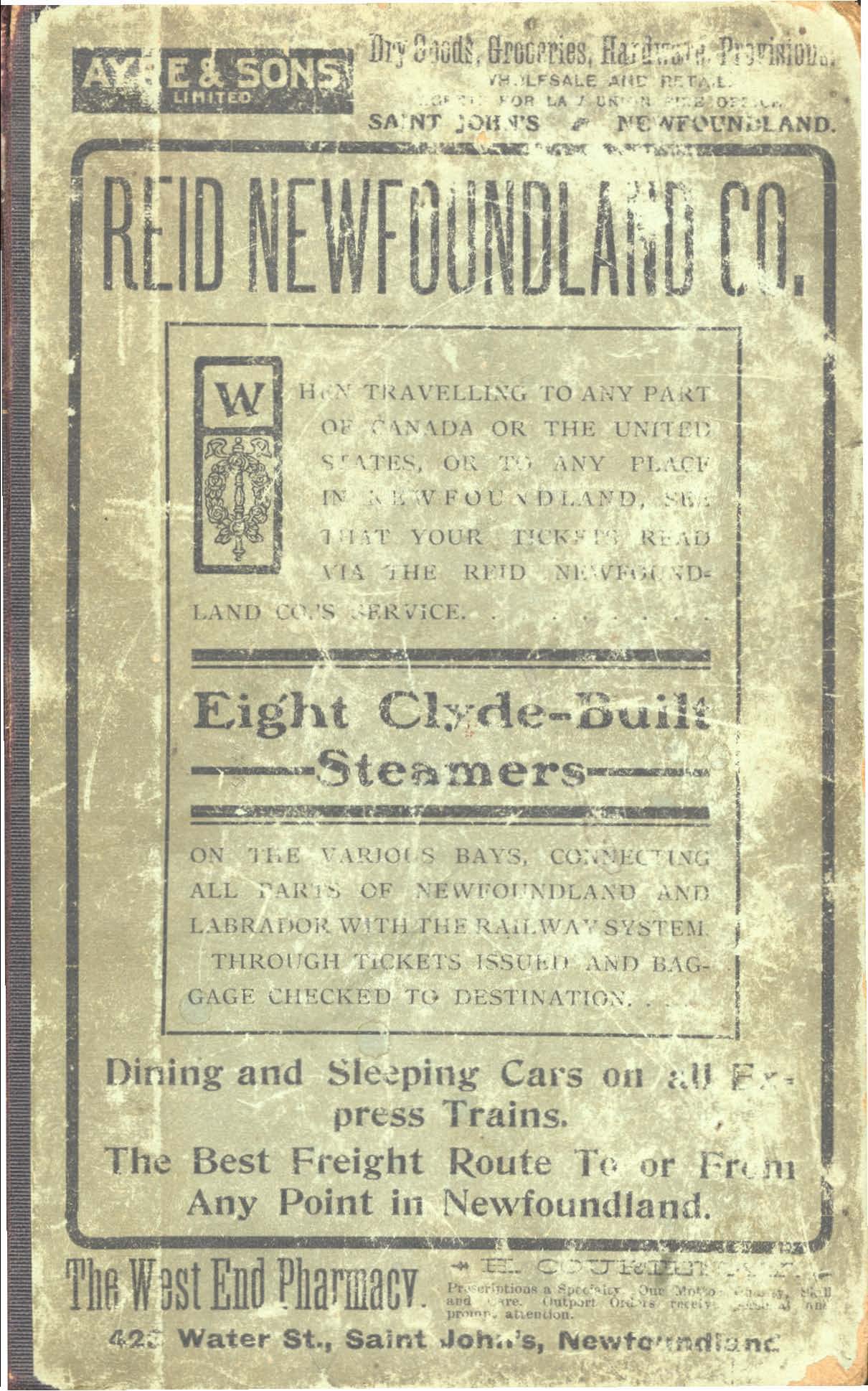
McAlpine's Directory

McAlpine’s Directory

Published between 1870 and the outbreak of World War I, the McAlpine’s Directories were a series of books published by the McAlpine Publishing Company of Halifax, Nova Scotia, which included lists of businesses and heads of households for communities on the island. They were also published for the Maritime Provinces and Canada. These directories were heavily laced with advertising throughout. They were used to locate businesses and to find names of people to contact in various communities when conducting business or correspondence. They also had the appeal of seeing who lived in the many small communities scattered around the island. Our telephone books of today are similar directories.

Cover 1904 McAlpine Directory, Newfoundland

Cover 1904 McAlpine’s Directory, Newfoundland

St. Jacques Entry, 1904 McAlpne Directory

St. Jacques Entry, 1904 McAlpine’s Directory


Below is an excerpt from the 1904 McAlpine’s Directory for Newfoundland with corrections for misspelled names in the original. This wasn’t a census, therefore only the ‘heads of households’ were listed. Spouses and children were not included. As a result we cannot get a clear indication of the total population of St. Jacques in that year.
McAlpine’s 1904 Directory – St. Jacques

Burke D J and T , Dennis J Burke, Thomas Burke  General Dealers
Burke Denis  Speculator
Burke Michael Jr.  General Dealer
Burke Patrick O  Sea Captain
Burke Isaac  Sea Captain
Burke Michael J  General Dealer
Burke William T  General Dealer
Burke Patrick J  Carpenter
Burke William  Clerk
Burke Ambrose  Laborer
Burke Patrick D  Sea Captain
Burke Thomas of  D J & T Burke
Burke Denis J of  D J & T Burke
Clinton Charles  Sub-Collector H.M. Customs
Clinton Henry  Tidewaiter
Cluett John W  Fisherman
Cluett Archibald  Fisherman
Dyett Samuel  Fisherman
Dyett James  Fisherman
Dinham Isaac  Sea Captain
Dinham Isaac  Fisherman
Drake John  Fisherman
Evans Thomas  Fisherman
Evans Isaac  Fisherman
Noseworthy John C  Fisherman
Evans Herbert  Fisherman
Evans William  Fisherman
Fiander John  Fisherman
Fiander John T  Fisherman
Fiander James  Fisherman
Fiander William  Fisherman
Gould George  Laborer
Oakey James  Fisherman
Hunt Matthew  Fisherman
Kassip Isaac  General Dealer
Kiddle Philip  Fisherman
Lee William  Fisherman
Lee Robert  Carpenter
Lee Edwin  Fisherman
McCarthy Patrick  Fisherman
McCarthy Robert  Fisherman
McCarthy Michael  Fisherman
McCarthy Joseph  Fisherman
McEvoy Patrick  General Dealer and Telegraph Operator
Murphy Denis  Fisherman
Murphy John  Fisherman
Penny Joseph  Sea Captain
Penny Patrick  Seaman
Piercey Benjamin  Fisherman
Skinner William  Farmer
Skinner James  Fisherman
Skinner Abraham  Fisherman
Staple John  Shoemaker
Tibbo —- Widow of Henry
Tibbo George  Fisherman
Tibbo Alexander  Fisherman
Tuck William  Mail Carrier
Whelan James  Fisherman
Young John H  General Dealer
Young James  Seaman
Young William  Fisherman
Young Hubert  H.M. storekeeper
Young Samuel  Sea Captain
Young Randall  Sea Captain
Young John  Sea Captain

The complete McAlpine’s Director of Newfoundland for the Year 1904 is available online at Memorial University`s Digital Collections. You can download a PDF version of the document by clicking here.

Posted by: alexhickey | March 26, 2014

“Home is where we start from …” T.S. Eliot ©

Memory is a funny thing. You can be busily doing something and out of the blue springs a memory which causes you to pause and savour the moment, reflect and sometimes smile, then you carry on as before. This happened to me a few weeks ago. I was re-reading a book of one of Newfoundland’s foremost poets, Tom Dawe. In fact it was the title poem of his 1993 collection, In Hardy Country. As I read the first line of the second verse my friend John Burke immediately came to mind. My first reflective thought was, “St. Jacques is John’s Hardy Country.” I hadn’t considered that before despite a long friendship and shared interests among which are the people and events of St. Jacques.
The first two verses of Dawe’s poem In Hardy Country read as below:

For me it is no country overseas,

no Avon, Berkshire, Dorset,
no Hampshire, Wiltshire, Somerset,
no ancient temples, or mounds anymore,
no West Country nappe all manicured now
for a museum trade,
no classical Max Gate drawing-room
where Florence died.

For me, its those drawn outport people

In Bonfire Night,
the nip of a north wind, and mummers’
accordions rising on a moon …
As the fire expires,
the stranger in the kitchen
in spinning a story
about one of the last criminals
to be hanged
out through a courthouse window
For a crowd on Water Street …

A quote which John has used to establish himself to audiences is from T. S. Eliot’s second poem of the The Four Quartets, East Coker, particularly the first line of the last verse which is, “Home is where one starts from.” It is this quote which came to mind and triggered my observation that there is resonance between Tom Dawe’s poem and the works of Thomas Hardy in the life and writings of John Burke as amplified by this explicit sentiment of T. S. Eliot. Below is an excerpt from Eliot’s poem:

Home is where one starts from. As we grow older
The world becomes stranger, the pattern more complicated
Of dead and living. Not the intense moment
Isolated, with no before and after,
But a lifetime burning in every moment
And not the lifetime of one man only
But of old stones that cannot be deciphered.

Listen to Eliot read this poem by clicking here.

In an interview with Tom Dawe in 1994 after his collection was published, the MUN Gazette carried a review of the work and posed a question about the title, In Hardy Country, to which he said, “I used the allusion to Thomas Hardy because in his novels and poetry I recognized a lot of the people. He talked about things that were so familiar while growing up in the outport, like Bonfire Night, and Mummering.” These things were part of John’s growing up as well and shaped him as much as they did Hardy and Dawe. Hardy’s sixth novel, The Return of the Native, opens at the scene of a bonfire not unlike many John witnessed and contributed to during his years in St. Jacques.

This all begs the question of “Who is Thomas Hardy?” Hardy was an English poet and novelist who lived in the late 1800’s and set his works in a western part of England he referred to as Wessex. Today Wessex is commonly known as Hardy Country. The connection between Wessex and Newfoundland is one of migration and settlement from that part of England known as The West Country to the new world of Newfoundland. The Wessex Society of Newfoundland, founded by Memorial University Professor Otto Tucker, has this to say about that relationship:

Beginning in the early 17th century, immigrants from the West of England (mainly from Wessex) began to settle in Newfoundland. By the early 1800s they had founded numerous fishing villages and towns and comprised about 60 percent of the resident population. The Wessex component was the largest ethno-European group to settle Newfoundland and Labrador. Most of these immigrants (80-85%) originated in the counties of Devon, Dorset, Hampshire and Somerset, with notable additions from the adjacent counties of Wiltshire, Gloucestershire, and Cornwall. The main embarkation ports were Bristol (whence John Cabot sailed in 1497 to discover the ‘new founde land’ and its prolific cod stocks; and whence John Guy founded the first English colony in Canada at Cupids in 1610), and later Poole, Dartmouth, Teignmouth, Plymouth, and Topsham. By far the largest numbers sailed out of Poole … These place-origins were all part of the recruiting hinterlands of ports involved in the transatlantic migratory fishery and Newfoundland trade carried on from West of England ports for over three centuries.

This video will give you a sense of the countryside where Thomas Hardy lived in Wessex:

Another friend who has read most of Hardy’s works echoes Dawe’s comments, saying that reading Hardy is as though you are listening to people of your own heritage along the south coast of Newfoundland. Anyone who wishes to delve further into settlement patterns in Newfoundland should consult the work of Gordon Hancock in his book So longe as there comes noe women: Origins of English Settlement in Newfoundland.

John Burke was born in St. Jacques on September 21, 1937, the tenth of eleven children of Rita and Tony Burke. At age 13, he left the harbour when the family moved to St. John’s. While John has lived in many harbours since he left St. Jacques all those years ago, as he will tell you without hesitation, there really is only one home for him – St. Jacques.

John, a graduate of Memorial University and the University of Toronto, taught English in several Ontario High Schools between 1963 and 1995. After retirement from teaching, he worked as a Story-Teller and a Motivational Speaker where he drew on the richness of his childhood memories and gave examples of the courage, the steadfastness, resilience and humour of those who influenced him in his early years in St. Jacques. He has led numerous retreats and days of reflection with volunteer and professional groups, all the while drawing upon his “home” in St. Jacques.

john burke performing auts and uncles 1997

John Burke performing Aunts and Uncles, 1997

John returned to St. Jacques in 1997 to attend the South Coast Arts Festival and to present a dramatic presentation, “Aunts and Uncles” – a one-person tribute to those who enriched his life during his childhood years. John’s performance delighted the audience at the Community Centre which was filled near capacity.

John is also a published author whose early life experiences provided him motivation and substance for his writings. He drew upon reminiscences of his childhood for a series which appeared regularly in the Slice of Life column in the St. John’s, NL newspaper, The Telegram. You can get a sense of John Burke’s Hardy Country by reading this excerpt from The Hills of Home, part of a column published in The Telegram on February 11, 2004.

As in every harbour, every hill had a name, as did every path. Some rocks had names too. Three hills defined St. Jacques, the Bottle Hill, the Big Hill and the Winter House Hill. As children, we saw the Bottle Hill as friendly. To this day, from our side of the harbour, it resembles an extinct volcano. In mainland Canada, it would be called a mountain but Newfoundlanders are far more modest. It was simply a hill. The Bottle Hill was a friendly hill. That’s where the good giant lived, we believed. From its shaly peak, on a clear day, one could see straight across Fortune Bay. Because it was a friendly hill, we were allowed to climb up, rock by sedimentary rock, until we reached the summit. There it was customary to flail ones arms and yell, hoping your conquest might be observed by someone across the harbour. Fat chance of that, but try telling that to a 12-year-old boy.

The Big Hill is a mere hillock compared to the Bottle Hill. It is a gently sloping land formation down at the bottom of the harbour, anchored from time immemorial by the Anglican Church. Each autumn, the hill was dotted with berry pickers feasting on its abundance of partridge berries. On the upper reaches of the hill, where it levels off to marshland, pitcher plants and bakeapples grew in abundance.
“Stay clear of the Winter House Hill,” we were warned, “because that’s where the wicked witch lives.” The first snow of winter poured down over that hill. It is the smallest of all the three hills, yet it is the deadliest. I did not venture up the Winter House Hill during the 13 years I lived in St. Jacques. Returning home in the 1980s, fit and in my 40s, I decided I would climb all three hills in one day. In the morning, I scaled the Bottle Hill in jig time. The Big Hill was a piece of cake. But on the Winter House Hill, the wicked witch was awaiting me.

It was a glorious, sunny summer day. The tom-tits were singing in the trees below the hill. Camera in hand, I was about to finish my project, photographing the harbour South, East and West. The lush, marshy ground under my feet gave me the sensation of walking on a deep broadloom. Using the small supple saplings for support, I climbed to the crest, only a narrow rocky ledge. I teetered on the edge, fighting to maintain my balance. Suddenly, the warm, sunny breeze turned frighteningly chilly. I was convinced I heard the wicked witch’s cackle as I fought for my balance.

I could have fallen off the craggy perch, a drop of some 30 feet on the harbour side, or I could have gone tumbling in the mossy undergrowth until I ended up, God knows where, out in the Back Cove. What I was told at age four finally sank in at age 40, “Stay off the Winter House Hill.” I gingerly allowed the trusted saplings to guide me down safely at the side of the rocky ledge. As I cautiously descended to the safety of the moss below, I could still hear that menacing cackle of the wicked witch. I decided that day I would never again venture into her territory. I still do believe in witches and the value of childhood admonitions.

This then is John Burke’s Hardy Country – the hills, people and stories of the community which shaped him as a child and as a man. In turn, his collection of columns, stories and anecdotes centered on childhood experiences in St. Jacques assist the rest of us in knowing life as he knew it enabling us to see in our own lives similarities and nuances which like Thomas Hardy and Tom Dawe help us define for ourselves our own Hardy Country. Today when John reflects on his country, his inspiration and his fondest memories, like many of us Newfoundlanders, his mind takes him to St, Jacques and the hills of his home and like T. S. Eliot, many of us agree, home is where we start from.

Posted by: alexhickey | March 7, 2014

My Friend George Paul©

What might a young man from St. Jacques do in 1942 when he is told he is too young to enlist as a soldier in World War II?  It’s been a long time since

A man in the uniform of the Newfoundland Ranger Force standing with hands behind his back, feet braced, on a frozen lake with a strip of land in the background.  Image is black and white.

Newfoundland Ranger, George Paul

George Paul found himself in that situation.  Today, at eighty-eight, he will heartily chuckle in his deep baritone voice that he immediately signed up for the Newfoundland Ranger Force.

Before I share one of Georges’ stories let me tell you about this man whom I have considered a very dear friend for over twenty years.  George called me one evening many years ago to introduce himself and discuss what he had heard was my interest in the heritage of his home community – St. Jacques.  That phone call has resulted in many hours of telephone conversations in the intervening years as well as countless pages of letters back and forth between us.

Though George is of my father’s generation; in fact he was one of his boyhood friends, our mutual respect for the rich and emotionally laden history of the community we both were born into has allowed us to bridge those years quite comfortably.  I am much richer for the many thoughtful, reflective and historically accurate exchanges of information that have passed between us since we met.

Google map of a coastal harbour showing terrain and green vegetation surrounding the water on three sides.

Enlarge to view the location of George Paul’s home in St. Jacques

The Paul family lived a short distance back from the road at the bottom of what was known as Staple’s Hill, later known as Dyett’s Hill, in St. Jacques.  Today, a Canada Post mail box sits in front of where the house once stood.  The house was next door to what is today, St. Jacques Mini Mart. Click the Google map of St. Jacques on the left to view the location of his house.

George joined the Rangers in 1942, an act which set him on a course which took him to most parts of Canada – east, west, south and north.  During those years he has accumulated a wealth of stories and anecdotes which can keep one enthralled for hours.  One of his earliest postings with The Rangers was in Burin.  It was there he had a close encounter with the Truxton and Pollux disaster , where American troop ships ran aground near Lawn and St. Lawrence on the Burin Peninsula under severe winter storm conditions with enormous loss of life on February 18, 1942.

This was his first posting.  He had assumed duties under Sergeant Ian Glendinning just six months following the loss of the Truxton and Pollux.  After three weeks on the job Sergeant Glendinning went on leave. It was while the Sergeant was on leave that two local boys made a surprising discovery in the Bartlett’s Cove beach not far from the office of the Newfoundland Ranger.

George was summoned from his office in Burin to investigate.  Two men, Mr. P. Penney and Mr. R McDougall, whom the boys had told of their discovery, accompanied him to the beach where they observed what appeared to be a body buried in the sand.  There, with the assistance of these two local residents, this young Ranger oversaw the exhumation of another young man who had successfully enlisted in the Navy of his country, the United States, and now lay

Map of Burin Peninsula showing the raod between the two locations of Burin and St. Lawrence.

Burin Peninsula

dead upon a friendly but foreign shore.   His name was stenciled along the waistband of his navy type fleece lined underwear, otherwise known as “long-johns”, the only garment remaining on him.  Apparently the cold water and cold, salt-laden sand had acted as a preservative, for the body of Seaman 1st Class Private F. L. Edwards appeared as on the day he drowned.  It would be years later that George found out that the initials F.L. stood for Floyd Lee when he read a book by Newfoundland author Cassie Brown, about the Truxton and Pollux disaster, titled Standing Into Danger.

Burin is approximately 80 kilometres from St. Lawrence by road.  Look at the map on the left to see that distance by sea. Click to enlarge.

Private Edward’s body was hoisted on a hand-barrow, a carrying device with handles at both ends of a platform; a transporting implement which was typically used to carry salt fish.  As the men carried the body along a rugged footpath it was challenging to maintain balance and retain their precious cargo.  Word spread quickly of the discovery as is the case among small communities when something like this occurs. As they approached the main road they met the Reverend Parson Clinch of the Church of England Parish in Collins Cove who lent his assistance and advice.

George, being of the Roman Catholic faith, had been contemplating contacting the Catholic priest for assistance; however, as he said to me, “Parson Clinch was of such a tremendous assistance – counsel wise and in other ways”, that he was asked to preside over the burial.

In Georges words,  “It was a Christian burial—that is what I was aiming for; away from that mound of cold, salt-water sand where the sea had deposited its victim—miles and miles and miles from an overhanging cliff where seaman first class, Floyd Lee Edwards, along with others, took refuge from a battered and broken ship until the relentless tide and a gale of wind swept them one-by-one from the ledge of the cliff to which they were confined as I learned later.”

A formal report was forwarded to Chief Ranger Fraser at headquarters in St. John’s which officially marked the end of George Pauls’ responsibilities in this matter.  According to George,  “Parson Clench sent full particulars of the event to authorities in Washington, and sometime thereafter (about two or three weeks later) I had the occasion to be in his company again, and he told me that he had received a nice letter back from President Roosevelt in which he said to thank me personally, for services rendered.”

There was no information on Floyd that could give local authorities a home address or contact whom they could reach with news of the retrieval of his body.   Through the years George Paul has lamented their inability to contact family and let them know that their son was given a decent burial.  He made several attempts by writing officials in the United States and even survivors of the tragedy; however, to no avail.  He received responses to these inquiries thanking him for what he had done and for trying to locate the family.

Newfoundland Ranger George Paul was transferred to Goose Bay, Labrador shortly after this event early in 1943. He returned to the island of Newfoundland in 1945 when he was posted in Grand Bank, again on the Burin Peninsula.  It was then that George learned that the body of Floyd Lee Edwards had been exhumed and transferred from the Ship Cove cemetery to the Roman Catholic Cemetery in Burin and later disinterred again when a U.S. ship visited the area and the remains returned to the United States.  Just where Seaman 1st Class Private F. L. Edwards was laid to rest in the United States I do not know.

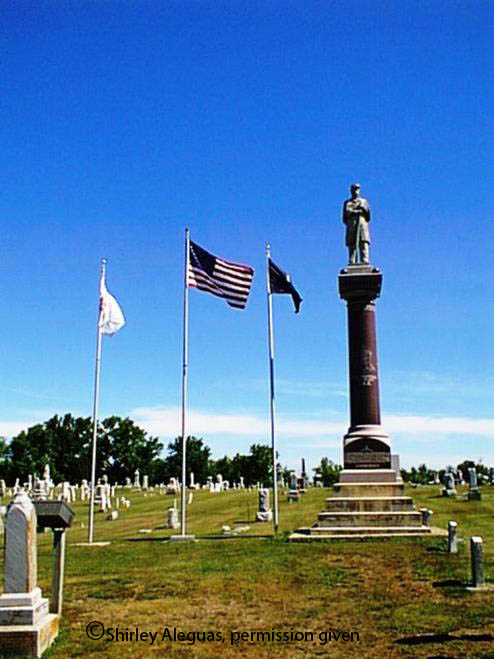
Cemetery grave markers on yellow grass, American flags flying, blue sky in background.

Macoupin County Cemetery, Girard, Illinois
About a year ago I revisited this event with George and through research was able to determine that Floyd Lee Edwards was the only son of William and Melissa Edwards of Girard, Illinois.  He was born in 1908; enlisted in the US navy and was assigned to the USS Pollux.  His father had died in 1939 just before the outbreak of WW II.  His mother died in 1951 without ever knowing where her son’s body ended up after the tragedy.

The photo on the left shows the Macoupin County Cemetery in Girard where his parents are buried and where Floyd is remembered for his untimely sacrifice to his country

Near their tombstones there is a stone marker which reads:

EDWARDS, Floyd Lee , W2, S1/C , Navy, USS Pallox(sic), 18 Feb 1942, Girard Cemetery Girard Twp Girard IL

Floyd’s name is included in the Girard Book of the Dead of WWII, of which an excerpt is shown on the right.

page thirteen from Girard, Illinois Boog of the Dead showing a list of soldiers who died in war

Girard, Illinois – Book of the Dead, p. 13.

Though I know nothing of the personality or life of Floyd Lee Edwards, the story relayed to me by George Paul brought a very personal and up-close view of war tragedy on our own shores.  It also spoke volumes to me of the character of my friend and the deep empathy he feels for his fellow human beings.  Whenever I think of this story I imagine that young man from St. Jacques, who too had tried to enlist to fight the same enemy, as he stood observing the process of retrieval as it unfolded before him and I remember the passion in his voice as he told it to me over sixty years later.

Posted by: alexhickey | February 8, 2014

A Story of a House Part II ©

When a family leaves a house they take with them what they can reasonably expect to make use of in their new house.   Some things just won’t fit, are too cumbersome or have no practical use in the new place so they either get discarded or left behind for the new owners to deal with.  That was no different for Hazel Young’s house which was profiled in Part 1 of this posting.

At which point in time the house became known as Hazel Young’s house I am not certain; however, it occurred sometime between the death of her father and the death of her mother who had been ailing in her later years. When Hazel moved to St. John’s to take up employment as the Director of the Red Cross Hostel, known as Devon House, she judiciously chose what would go and what would stay.  I have seen several dishes and pieces of furniture that once occupied space in the house that were given to close friends prior to her departure.  One large object she didn’t take was prepared for shipment to her by the next family who bought the house after they had moved in.

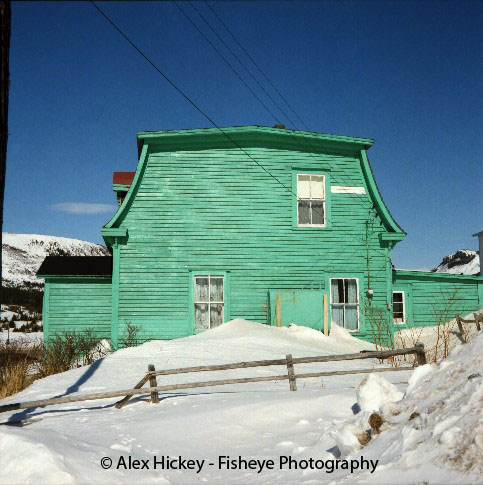
white snow in foreground with a green two-story house occupying the middle ground with a blue sky in the background.

South View of House

Resettlement happened throughout Fortune Bay in the 1950’s as elsewhere in the province. Some people from smaller communities in Fortune Bay chose to move to St. Jacques.  One of these families was the Osbornes from Red Cove who bought Hazel Young’s house.  They moved in, made friends in the neighbourhood and became part of the community almost immediately.  In very little time folks were no longer referring to the house as belonging to the Youngs.  It had become the Osborne house. Once again the feet of children echoed throughout the rooms and the doors were open to visitors as before.

Minor changes were noted by local residents such as when Uncle Ben moved the back door, changed a window or painted the wooden shingles on the sides of the house.  Aunt Pearl built a small retail store in the garden which generated more traffic than the house had seen in years.  Relatives of the Osbornes came to visit, introducing the neighbours to new acquaintances whom they’d never heard of before thereby extending the reach of the community even further.  The boys’ dad worked away from home on a Department of Fisheries vessel transporting bait to depots throughout the province. Thus there were joyous events when he returned; everyone shared the excitement when Mr. Osborne was coming home. There was also excitement when electricity came to St. Jacques and life took on a different order. Aunt Pearl no longer made ice cream by hand. One year Uncle Ben passed on and the dynamics changed again. A few years later, a decade after moving in, the Osborne family moved again; this time to a growth centre in Placentia Bay, Arnold’s Cove, leaving the house vacant once more.

There were no boards on the windows or no for sale signs in the yard – just an empty house in the midst of a changing neighbourhood.  Friends of the Osborne boys grew up and moved away to study at school or to work.  Other children, too young to know the Osbornes, grew to know it as a vacant house. Then one day word spread through the community that the house would have new residents; an elderly family from Bay du Nord were being resettled to St. Jacques.  The Farrells were coming to town.   Uncle Jack and Aunt Win Farrell along with Winifred’s sister Aunt Gen Lundrigan arrived on the steamer with their belongings and promptly brought lights back to the house at night.

Uncle Jack, as he was known to all though related to but a few, had served as cook on a medical vessel that travelled throughout Fortune Bay, the Lady Anderson.  As a result he was widely known in the community.  His nieces had married in St. Jacques years before and his brother, the renowned teacher Tom Farrell, had already moved to the community a year or so earlier.  Just as before, the house was transformed to become the Farrell house.  Again, minor structural changes were made as the new occupants made the house their home.  Neighbourhood dynamics were different because of their age; however, it took but a short time for the three new neighbours to know everyone by first name.  Aunt Gen, a former post mistress in Bay du Nord, was quite accustomed to daily conversations with folks as they went about their business.  She resumed that role in St. Jacques, chatting up a storm with all ages she encountered. She was as feisty and bold as her sister was quiet and demure.  Uncle Jack was there enjoying his retirement and the many Farrell, Lundrigan and Fitz-Patrick family members who came to visit from other parts of Newfoundland and Canada.

With the passage of time things change and people reach the limits of their lives.  This was the case for the Uncles and Aunts in the Farrell house. With darkened windows at night and no sounds of doors closing throughout the day, the house resumed its pattern of remaining silent and elegant on the side of the road, settling just a bit more on its haunches.

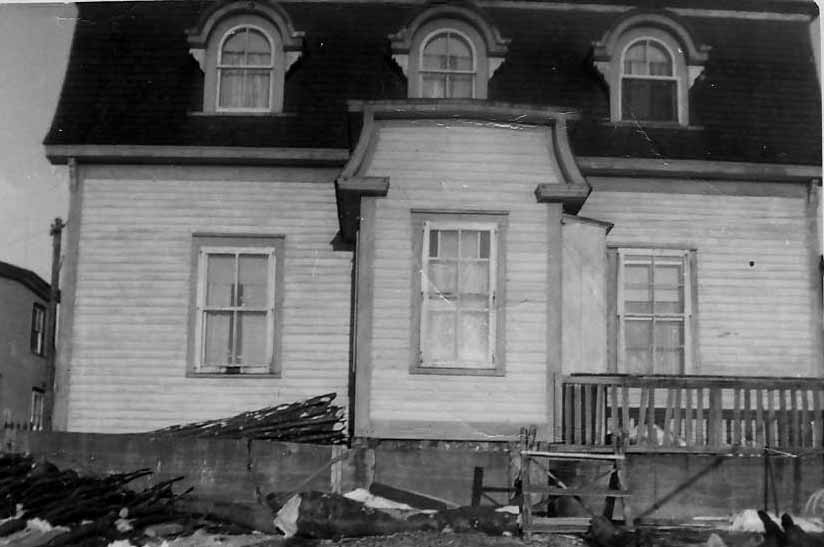
Before long, however, the doors were opening and closing again as a younger family commenced moving from their single story house in the neighbourhood into the old Farrell property. The McCarthys, with young children, carried their personal belongings into the house and spread their ownership throughout the rooms.  Bill and Mabel proceeded to nurture and grow their family inside those walls.  They too made minor structural changes to accommodate their needs and to modernize aspects of the house to changing standards. A brick chimney disappeared, and another shinier one received more extensive use as heating was centralized with a wood stove in the front kitchen. Again, windows underwent changes, particularly the dormers on the second story, which were removed and their openings closed in.  Years flashed by and older children moved out leaving a much smaller family in the large wooden house.  Bill and Mable, with motivation fueled by health issues, moved away to Grand Falls, closing the doors on the house again.

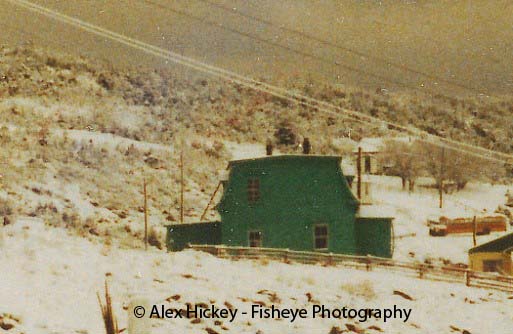
winter scene with a green house in the middle of the image; snow in the foreground and trees covered with snow in the background.

North Side of House

This time the fire had barely cooled in the kitchen stove when news that the house had been sold began to circulate.  Someone from next door, who grew up in the shadow of the house and mingled with most of the families that lived there, had purchased it as a summer home.  A young Hickey man, they said, was going to renovate the place and put it back to what it looked like when the Young’s lived there.  Unlike all previous owners, he didn’t move his family in and occupy the house year round; he went about effecting changes which highlighted the character of the old house.  Walls were exposed to show the original pine boards positioned vertically to create single partition walls; modern wall panels were removed to reveal layer upon layer of multi-coloured wall paper pasted there by generations of different families – a collective effort of branding and identity.

The small veranda which had been removed many years prior, was replaced by a large open deck, designed to celebrate the vista in front of the house; a view which Sam and Martha looked at across the harbour many evenings as the warm, orange-gold of the sun’s rays spread across the walls of their parlour; a view the Osbornes still treasure in their memories; a view the Farrells noted was much different from Bay du Nord but equally as beautiful; a view that the McCarthys were very familiar with.

Memories of the rooms in that house live in many places on this planet; in the hearts and minds of those who either lived inside the walls or visited those who did live there.  It still leans a little, as though pausing to reflect, to remember the voices, the sounds, the feelings, the dreams and the disappointments of those it sheltered.  Each new owner inherited a house which was transformed into a home unique to them; cherished and cared for by them with limited knowledge of those who walked through those same spaces just years before them.  Some things managed to remain, to hold on to the home and give future residents just a glimpse into the lives of its previous owners.  Mr. Osborne had the pleasure of building a packing crate large enough to house an ornate, hardwood horse sleigh and ship it to Hazel Young that harkened back to Victorian times and the nostalgic image of sleighs at Christmas time.  The Farrell’s inherited a wood stove which gave off enough heat to induce drowsiness within minutes of entering their back kitchen as it had done for a couple of generations. The McCarthys found odd dishes remaining on kitchen shelves; dishes that had graced tables and meals bringing nurture to people whose lives were unknown to them.  The latest owner found a newspaper with coverage of the referendum that saw Newfoundland choose to join the Canadian Confederation; a school report card from one of the McCarthy children; and a discarded vintage tobacco tin probably left behind by the Farrells.

Last year I gave my brother assistance removing weeds from what used to be a delicate flower garden on the southern side of the house and found a silver teaspoon created in 1882 in Pennsylvania. It caused me to stop and look around, not for more silverware, but for the presence of all those people who had also stood on that spot, who had sung and cried in the space surrounding me, who had called this house their home; a home unlike any other, special to them and special for years to come.

The Osbornes, Farrells, Lundrigan, McCarthys and Hickeys who have shared this old second empire style of architecture also share a common thread which was anchored to the ground beneath the house when Sam Young and his brothers laid the foundation well over a century ago; a thread of continuity across time, one which extends forward whenever a new set of hands join the greater family whose common heritage is time spent under its mansard style roof.

Posted by: alexhickey | January 25, 2014

A Story of a House: Part 1©

On the east side of St. Jacques sits a house that has settled on its foundation, looking comfortable in its slightly tilted angle; evidence that it has been there for some time.  It reminds me of sitting in a chair and settling into the cushion, eventually feeling too snug and lazy to move.  Though the house hasn’t moved, several attachments have been removed, the local road has crept closer and closer to its side and families have moved in and out of it for over a hundred years.

young residence located on the east side of st jacques

Former Sam Young Residence St. Jacques

The house has a mansard style roof which today makes it stand out from those surrounding it.  The Mansard roof gets its name from the French architect François Mansart (1598-1666) of the Beaux Arts School of Architecture in Paris, France.  Mansart revived the style which had been popular during the era of French Renaissance architecture. It received another revival in the 1850’s during the reign of Napoleon III, known as the Second Empire.  Since then the Mansard style roof has been frequently referred to as a Second Empire style.  The style became quite popular between the 1860’s and 1880’s in parts of North America, including Newfoundland. View good examples of this style in Newfoundland here. A great number of houses were built with this style of roof following the Great Fire of 1892 in St. John’s.

A Mansard style roof has two slopes.  On the side of the house on the upper story is a gently curving slope accentuated by Dormer Windows. From the top of this curving slope, starting at the eaves, the roof has a low slope which is sometimes locally referred to as a flat roof, even though it has about a twelve inch pitch.  It was the development of roofing materials such as felt which enabled this design to work.  Other materials such as wooden shingles could not allow enough water to run off with such a low slope.

The roof style emerged from a very practical need to expand attic space. Under a peaked roof the slope prevented there being much headroom.  By changing the slope and flattening out the roof, a building gained an almost complete story, making the space much more functional.  On top of that, it looks good.

The dormer windows have been removed from this house giving it a streamlined look.  Other than that, the roof remains as it was, when constructed sometime between

White two story manaard style house surrounded by other similar houses.  Grassy area and tree covered hillside in background.

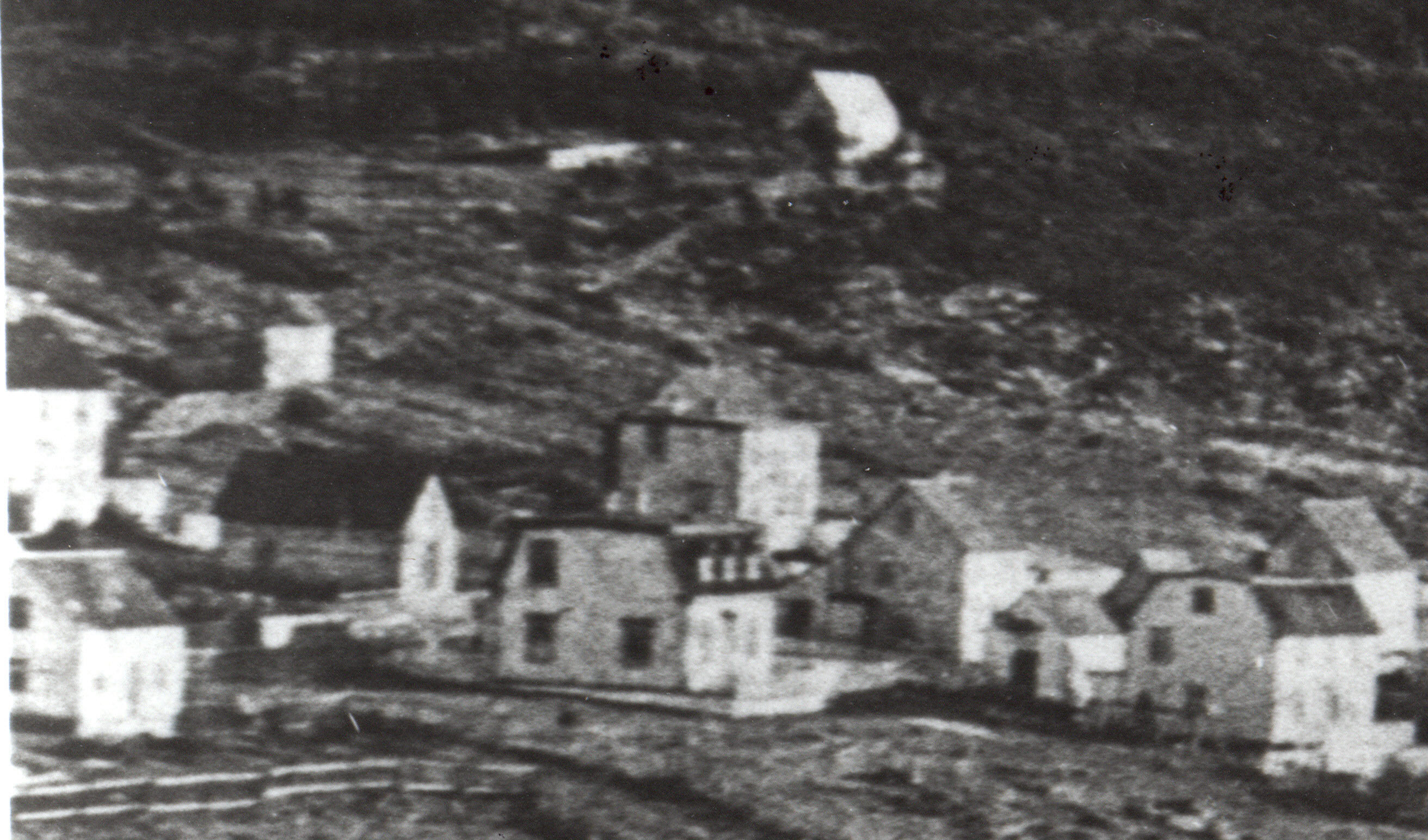
Young family homes in St. Jacques c. 1900

1890 and 1910.  This is one of two identical houses built by the Young family on opposite sides of the road which ran along the east side of St. Jacques leading to the government wharf and Burke’s Cove.  This house was owned by Samuel Young.  The house across the road was owned by Randall Young.  There is a story which says that a third house was to be built for the third brother, John; however, a downturn in the family fishing business brought on by the loss of two schooners within a couple of years curtailed that plan.  Consequently, John lived in an equally as big, but older salt box style house nearby. Their sister, Bertha, lived in a house with a roof style which resembled the Mansards but had a fixed, steeper slope set above the second story making room for an attic space.  This may have been the original family home owned by their parents James and Sarah Young.

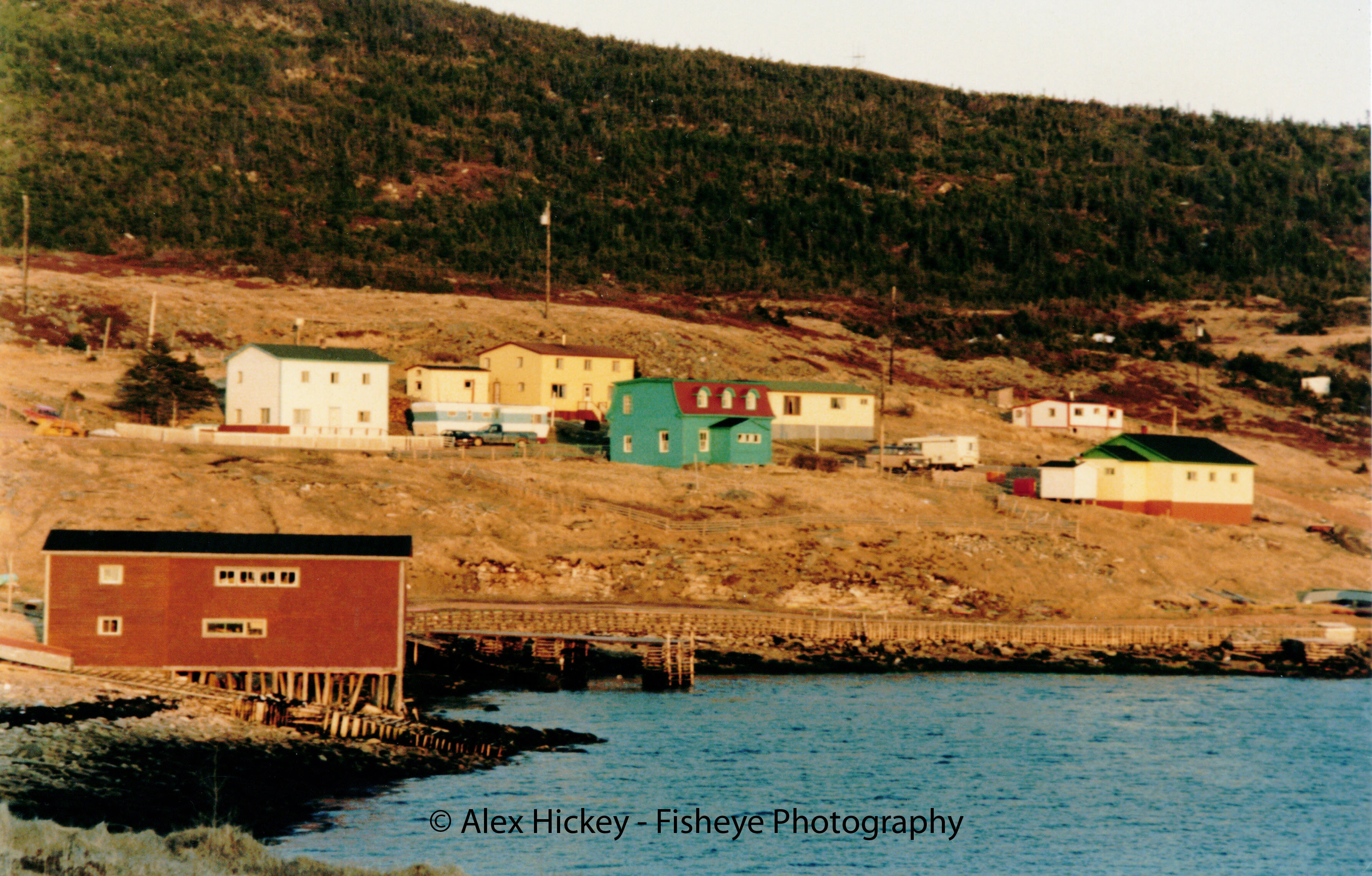
Samuel Young’s house overlooks St. Jacques harbour; the living room window still serving up a vista against the hills of the western side highlighted by Bottle Hill and the expanse of water in between.  Directly below, lies the shoreline where the Young Brothers Fisheries company operated.  Their three ‘big stores’, as they were called, have been replaced by contemporary fishing sheds and stages.  The cove where their two and three masted schooners berthed, hosts small fishing and pleasure boats now. Yet, in quiet evenings it is still possible to hear the echoes of anchor chains and water splashes from the work of men securing their homes away from home.

Blue ocean water in foreground. A red two story fishing premise in the lower left. Yellowed grass along a slope beyond the ocean capped by a row of houses. Starting from the left the housea are white, yellow, green and white. A tree covered hillside sits behind the houses.

Sam Young’s House as it appeared in the 1970’s

If we examine the 1921 Census for St. Jacques we see who was living in this house.   There were Samuel J. Young, his wife Martha (Reeves) who was from St. Lawrence and their three children, Hazel, William (named after his great-grandfather) and James (named after his grand-father).  They also had a daughter Ada who had moved to the United States and married before the date of this census.

Samuel Young

Young Samuel J. M Head Married 1863 Sep. 58 St. Jacques
Young Martha (Reeves) F Wife Married 1874 Feb. 47 St. Lawrence
Young Hazel F Daughter Single 1904 Nov. 16 St. Jacques
Young William R. M Son Single 1907 June 14 St. Jacques
Young James R. M Son Single 1909 Sep. 12 St. Jacques

As with every family, children grow up and their parent’s generation passes on. Samuel died on February 18th 1934; Martha died September 18th 1955 in the house where she had spent all of her married life. Ada moved to Flint Michigan, United States; William moved to St. John’s, Newfoundland; James moved to Halifax, Nova Scotia; while Hazel remained at home and cared for her ailing mother.  Following her death Hazel too moved to St. John’s, Newfoundland.  When she did, the final member of the Young family that lived in this house turned the key for the last time.

Over the years there have been descendants of Sam and Aunt Mattie who found their way back to St. Jacques to gaze upon the house, to stare out into the harbour and to reminisce with local residents who remembered them.  Now, there are very few who feel a tangible link to the couple who made a life for themselves and their children in this house.  None was more poignant than the visit of Ada Young’s daughter Margaret who visited the house for the first time in her early eighties.  Expecting to see only a building that once was lived in by her mother who left St. Jacques in 1919, she instead felt what is was like to stand in the garden of her grandmother, pick a budding rose from her grandmother’s rose bush and climb the stairs to a bedroom where her mother slept as a child.

When someone stands in a space and physically connects memories, stories, emotions and dreams together in a single moment there are no words to describe the experience, no means by which the chain of human contact can be expressed.  Such was the instance when Margaret and her daughter came back to the house and once again brought the feet of Young’s across the threshold.

What memories are there in the boards which constitute the walls of a house? What traces of people are left behind in the rooms after they leave? What makes a house the home of ancestors?  What is the story of a house?  This has been a tiny glimpse into the story of Sam and Mattie Young’s house.

Posted by: alexhickey | December 24, 2013

The Last Light at the End of the Harbour ©

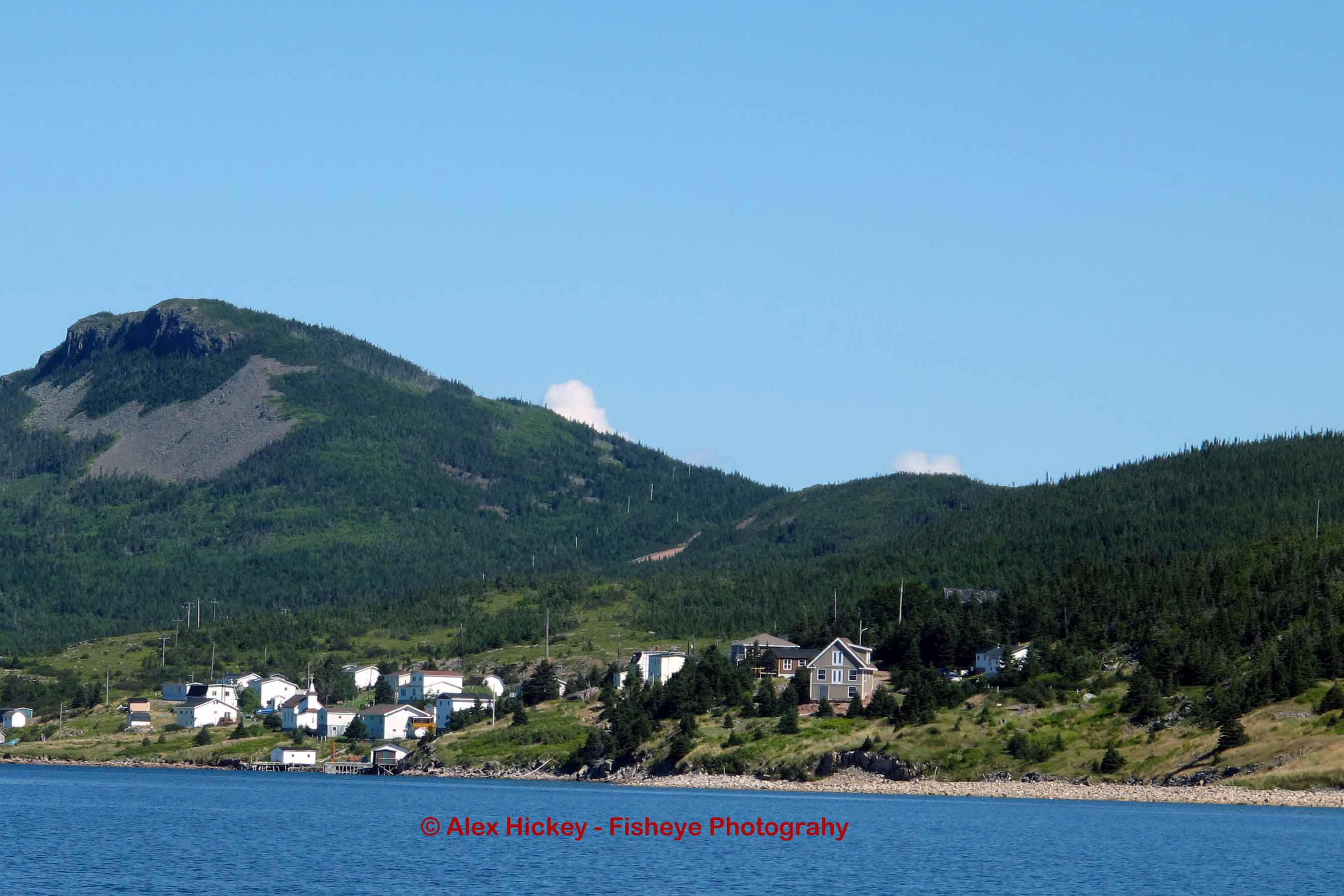
View of St. Jacques harbour from the ocean with houses in the foreground, gren vegetation of grass and evergreen trees.  In the background is a larger mountain against a blue sky.

Eastern Side – St. Jacques

There was a time when there were lighted windows in houses from one side of the entrance to St. Jacques Harbour to the other.  From Burkes Cove to Louis ’s Cove, people had cleared trees back from the seashore and claimed it as a place to live.  The eastern entrance to the harbour is now marked by the

remnants of a once majestic breakwater that extended several hundred feet from shore.  The breakwater offered protection to the businesses and houses of the Burke families positioned on the hillside behind it and served to break the southerly waves which frequently find their way deep into the harbour.  The western side is defined by a craggy headland, a natural breakwater, which also offers a degree of protection. It was behind this protection that the Power and Fudge families lived in recent memory.

Today there are fewer people living in St. Jacques and more empty space between many of the houses. No one lives at the entrance to the harbour any more. Each year fewer residents remain who witnessed the glow of kerosene lamps emitting their warm amber glow through kitchen windows after the fall of darkness. At the same time the little community is holding its own with new families lighting new lamps and renewing the lives of older houses, former residents returning after retirement and people moving in from other communities nearby. This year, though, we shall miss the last light at the end of the harbour.

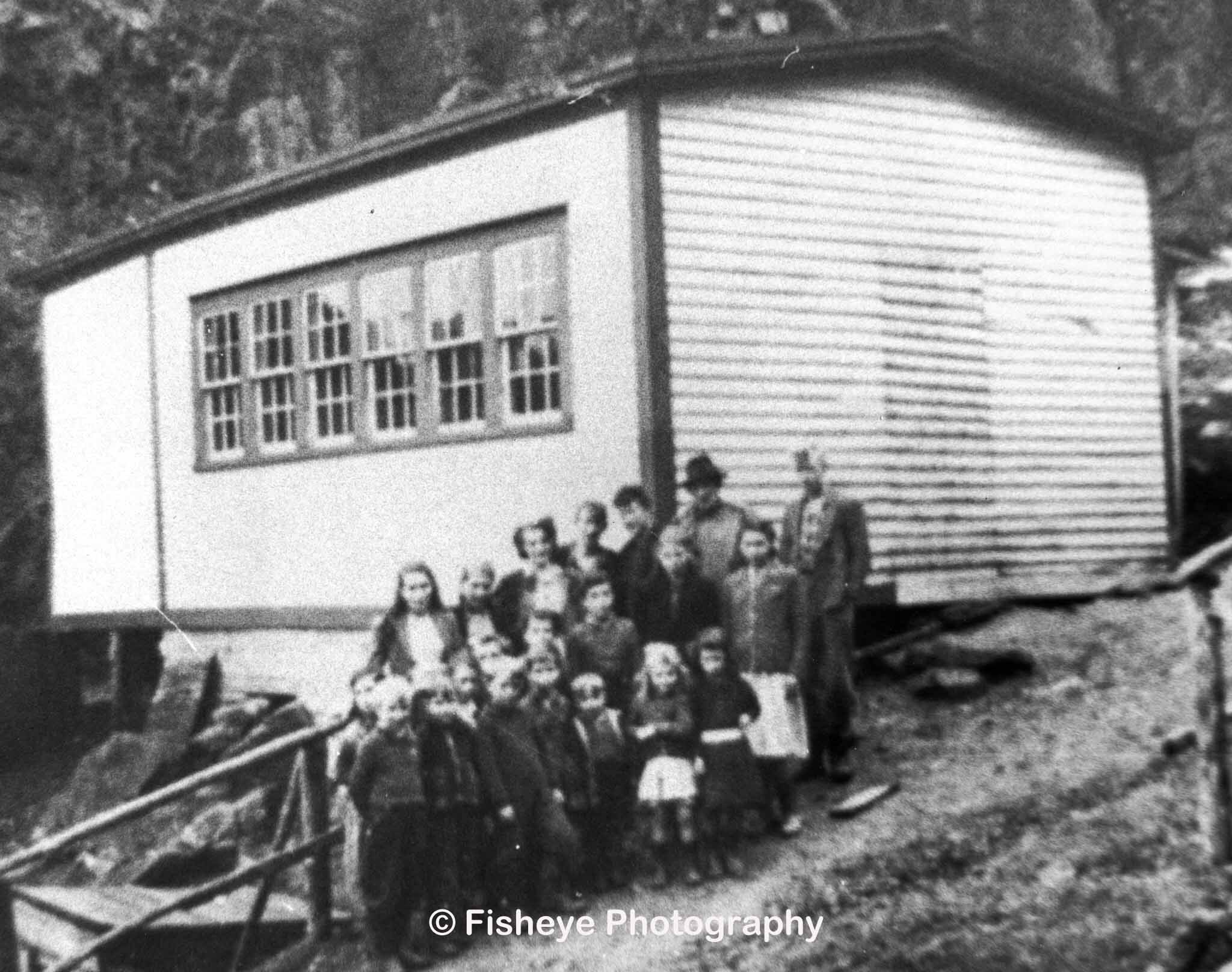
A group of school children of various ages with their male teacher standing in front of a one room white clapboard school house. Photo was taken around 1945.

One room school house in Bay du Nord

Alice Farrell`s arrival in St. Jacques was probably her first trip away from the security and comfort of her home in Bay du Nord.  As the Bar Haven rounded Eastern Point and passed by the breakwater, giving it a respectful distance because of the shoal waters nearby, the schoolhouse, a brilliantly white single story building on the hillside above the old Sacred Heart Church, seemed to wink at her. Here she was, the daughter of one of the patriarchs of Bay du Nord, a man known throughout Fortune Bay and beyond for his leadership and teaching skills, Teacher Tom.  That affectionate title served to not only help distinguish him from the three other Tom Farrell’s in the town, Red Tom, Black Tom and Long Tom, but to afford him respect for his role and contribution to the lives of all its residents. That afternoon she didn`t know that the rest of her life would unfold near the shadow of that old church and that the light from her living room window would be the last light on the eastern side of the harbour for several years.

The arrival of any young woman in town, especially a new school teacher, was bound to raise the interests of young gentlemen and the day Alice stepped onto the wharf one young man named Fred smiled inwardly and nervously looked her way, thinking he had never seen anyone as lovely before; not in his years working on the Andrews Air Force base in Argentia or in Buchans where he had just started a new job.  Whether Alice noticed him or not we don`t know; however, we do know they found the love of their lives in each other and were to spend over fifty years together in the neighbourhood near the end of the harbour.

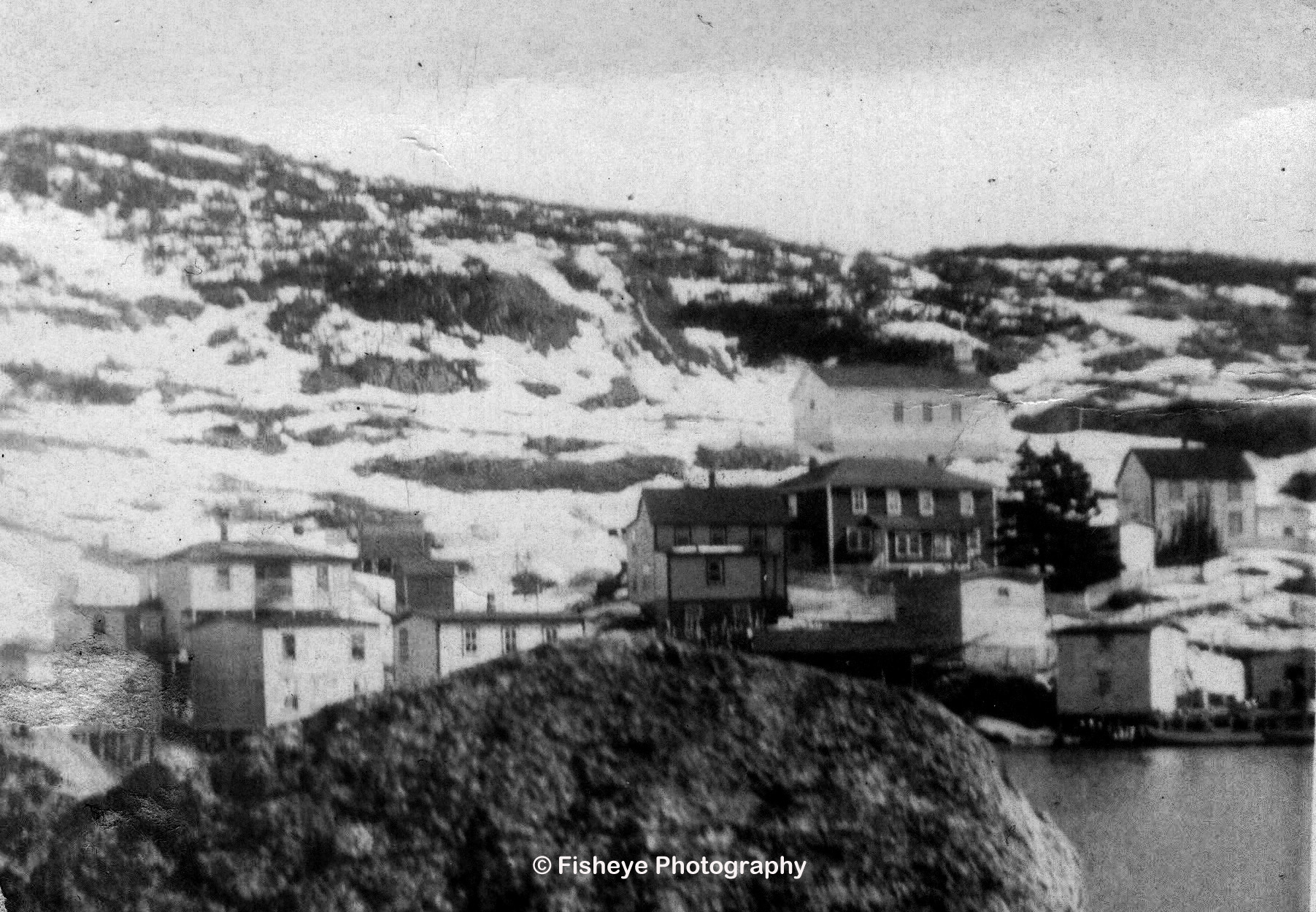
black and white photograph ofresettled community of bay du nord. A large boulder is seen in the foreground, white two-story houses in the middle ground and a snow-covered hillside in the background.

Bay du Nord, Fortune Bay

Her career as a teacher didn`t last all that long, for soon after marriage children required near full-time attention; yet she defined herself as `teacher` to all of us.  Quite proudly, on many occasions, she slipped quietly from her standing place in the kitchen beside the doorway to the living room to retrieve, from among her treasures stored in the bedroom, a cheque made out to Miss Alice Farrell.  Upon leaving Bay du Nord, Teacher Tom had offered a rather special piece of advice, saying, keep your first cheque, don`t cash it, for if you don`t, you will never be broke. She heeded that advice and in doing so preserved what was to become one of the most tangible links she had to her father.  It was just months before she joined him in whatever place departed teachers gather that she, with a smile of near childish delight, once again retrieved the cheque and told me the story.  She would look at it after telling the story, smile almost imperceptibly and say, perhaps to herself or perhaps to him, `yes, I`ve kept it all these years.`

Like many partners in marriage the relationship goes beyond that which we see as visitors or extended family and is known only to children and even at that is known differently depending on the age and birth order for all relationships change and blossom in different ways over time.  Fred was a storyteller who loved to sit on his straight-back chair at the end of the kitchen table and engage every visitor who crossed his threshold in a yarn and a laugh.  Alice would sometimes sit on whatever chair was empty during those visits; however, as often as not, she would stand and move in the magic triangle between the stove, the fridge and the door to the living room.  She wasn`t shy about injecting herself into a conversation or offering her personal take on the topic under discussion though she didn`t do it at the expense of Fred`s engagement.  Such was their relationship.

The house where Alice spent her last years wasn`t their matrimonial home though it was less than a stone`s throw away from it.  When Fred and Alice married they bought a huge two-story house poised atop the hill guarding the roadway which led to Burkes Cove.  The house had previously been lived in by the family of Anthony J  Burke, better known to townsfolk as Tony Burke, whose family had moved to St. John`s a few years earlier.  If you drive to the end of the road on the eastern side of the harbour and turn around, you will drive in an almost complete circle through where that house once stood.

A stately, imposing structure it was, with high ceilings and spacious rooms and a sturdy staircase rising from the front entrance to the second floor.  A small bridge near the rear was used to gain access to the back porch which was the usual means of entry for everyone. Beyond that door was a bench where Alice made sure the water buckets were full of fresh drinking water, carried daily from the well. In the kitchen she could sit at the end of the table, look to her left and observe the to and fro of marine traffic in the harbour.  A window on the front gave her an unobstructed panorama of the harbour including the area below the hill where she could watch Fred`s dory approach his fishing stage.

It was a big but cold house that, when built, met every criteria of good construction when the accepted standard for winter heating was nowhere near the expectations of Alice and Fred`s generation.  Insulation was not part of the construction plan.  When the house next to them became available due to its owners Joe and Veronica Earle moving to Terrenceville to be near their daughter, Fred and Alice bought it and moved the family next door. The old house was demolished and her view out the Bay restored. In a few years the old Sacred Heart Church was also demolished and her panoramic view of the harbour restored. Alice was a fixture in the living room window, her observation deck for all that happened around her.  In later years she had her telephone located near that window and when in conversation found the window ledge a most convenient place to rest her arms.

I recall, when I was a small child, there were near daily treks out the road, up over Clinton`s Hill, past Mr. St. Croix`s empty house, past the McEvoy`s vacant house, along the carefully constructed rock walls which lined the road above Joe and Bessie McCarthy`s house to Pat and Patricia`s then a final leg past the church to Alice`s house.  I`m not sure if it was the smell of freshly baked bread that lured me in that direction or the welcoming atmosphere I felt in her presence. When I lived in St. Jacques a nightly walk would result in turning around to walk back home once I reached the light shining from Alice`s window.  After I moved away each visit home meant at least one stop to sit and chat with Fred and Alice; to catch up on family news, the latest events in the fishery, to get answers to my many questions about the people they knew during their early years together and the older generations they had encountered along their way.   If the light was on over the door, that was an open invitation to come inside for a visit.

Some years ago when the municipality, out of fiscal restraint, reduced the number of street lights in the town Fred decided to install his own light which was visible from all around the harbour.  The light at Alice`s house now illuminated her neighbourhood at night. By then they were back to the two of them sharing the house. All of the children had moved out gradually until one day they probably looked at each other and wondered where all of the time had gone. It is said that this is the point in the life of a married couple where they get to know each other again. The intervening years between the first child and now were defined by raising children and working for a living; the things that too frequently keep us busy until there is no time left.

Alice Farrell could look back over her life in St. Jacques and see a parade of children come and go through her doors.  She could place her finger on a calendar and show you the date and time that her parents, Uncle Jack Farrell, his wife Winifred and Win’s sister Genevieve moved to St. Jacques as well as when the last person left her home community of Bay du Nord when it was resettled. That calendar also showed when her father and mother moved again; this time to Sydney, Nova Scotia.  Written on it as well was the date her sister Patricia married Fred`s brother Pat, in whose house she stayed when first arriving on the Bar Haven. She could, at a glance, tell you the events of her first day as a teacher in the one-room, all-grade, Sacred Heart School and of the day she and Fred were married.

colour photograph of alice hickey, head and shoulders pose with greenery and water showing in the background.

Alice Hickey

Christmas is a special time of year in most parts of the world and no less so in a small community on the north side of Fortune Bay.  There are social rituals which grow over time and are sorely missed when broken.  One of these is a visit to Aunt Alice who, in childhood days, always cajoled each of us into eating a large slice of dark, moist fruitcake with a crust of snow white icing along one edge and across the top.  Portions of dark molasses, cloves, nutmeg, raisins, currants, red and green cherries as well as a healthy sprinkling of mixed peel combined under her fingertips to create a magical food that always defied description; however, if one should mention Aunt Alice’s Christmas Cake in the company of her extended family everyone would fully appreciate the almost religious feeling we all had for those cakes. As adults we also appreciated the pride she felt at being able to create such delight among us.  That delight carried on to her sharing of artifacts that stood in for Fred in the years after his departure; to the subtle ways in which she kept his presence in her kitchen and in the way she welcomed you into the house anytime you had the time to visit.

Though it could be lonely to live in a house at the end of the road it also meant that when you saw someone approaching there was little likelihood that they would be going somewhere else. This Christmas when I walk up the road to visit relatives I will remember the many other times I walked that route. I’ll remember the gaily decorated evergreen tree in her living room; the sometimes unbearable heat from her kitchen wood stove; the mouth-watering smell of home-made bread; hugs that could have come from someone twice her size; and her parting words, “Now, make sure you come back again.”  In the midst of such fond memories it will be a little sombre not to see her welcoming light at the end of the harbour, especially at Christmas time.

Posted by: alexhickey | December 8, 2013

Mummering in St. Jacques ©

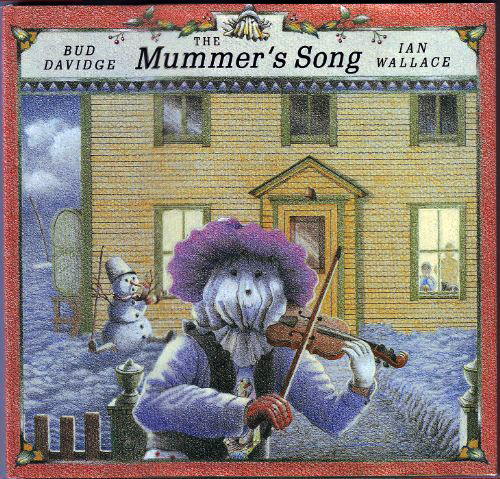
Mummering has recaptured the imagination of Newfoundlanders again in recent years.  The emergence of a Mummers Festival in St. John`s is an example of this.   The popularity of The Mummers Song by Simani as well as the book, The

mummers song book by ian wallace based upon song lyrics by bud davidge

Mummers Song Book

Mummers Song, by Ian Wallace illustrating Bud Davidge`s lyrics is another.  Look for images of mummers in paintings, sculpture, on coffee mugs, Tee Shirts, and just about any merchandise you can imagine as evidence.  Yet, even though there is always a contingent of Mummers at the Fortune Bay Dance in Mount Pearl at the end of November each year and at the English Hr. West Lions Club Mummer’s Dance on Old Christmas Day, there is limited evidence that Mummering as a social practice in communities has re-emerged in our culture.  What we seem to be witnessing is Mummering as public spectacle in the tradition of the Mummers Play.

The Mummer’s Plays have a long and deserved respect in our history reaching back to the days before our ancestors came here from England, Ireland and other parts of Europe and North America. They are traditional texts involving a short performance by a half dozen or more people playing the roles of King George, The Doctor, The Turkish Knight, and others. It was performed in communities all around the coastline for generations with adaptations to local characters and events.  Most of the time, it was performed inside the house of a host in the community as an impromptu event where those performing the play sought entry and proceeded to establish a space within the room to deliver the play.  Other times it was performed as part of a Christmas Concert in the community. The spontaneity of the Mummers Play is not something that can easily be replicated as a public event intended for subscription-based audience consumption.  Though, The Mummers Troupe, a St. John`s Theatre Troupe created a phenomenon during the seventies’ and eighties with their innovative treatment and performances of the Mummers Play, it still remained public spectacle.  Public events with a mummers theme have a legitimate history in the United Kingdom and in the United States with The Mummers Parade in Philadelphia being a long standing example. This type of event has sowed the seeds for a great deal of the current interest in Mummering as cultural expression.

My experiences and exposures to Mummering has been as social activity carried out among friends, family and community as opposed to performance of a play as such.  Throughout Newfoundland communities the practice of putting on a disguise and visiting friends and relatives existed independent of the mummer’s plays.   Known in some parts of the province as Janneying,  Fooling, or Nalujuit, we knew it simply as Mummering.  It involved dressing up in disguises intended to trick or fool your neighbour or other acquaintance in the community into thinking you were someone other than yourself.   Often this meant switching gender by disguising one’s body through wearing fake body parts and clothing of the opposite sex.  Faces were disguised by donning an old pillow case or lace curtain over the head with appropriate spaces cut for eyes to see to navigate while inside a house.  Outside, the facial disguise was raised for safety reasons when walking in the dark. Occasionally someone wore a manufactured mask or an improvised mask made from cardboard, however, that was not the norm.

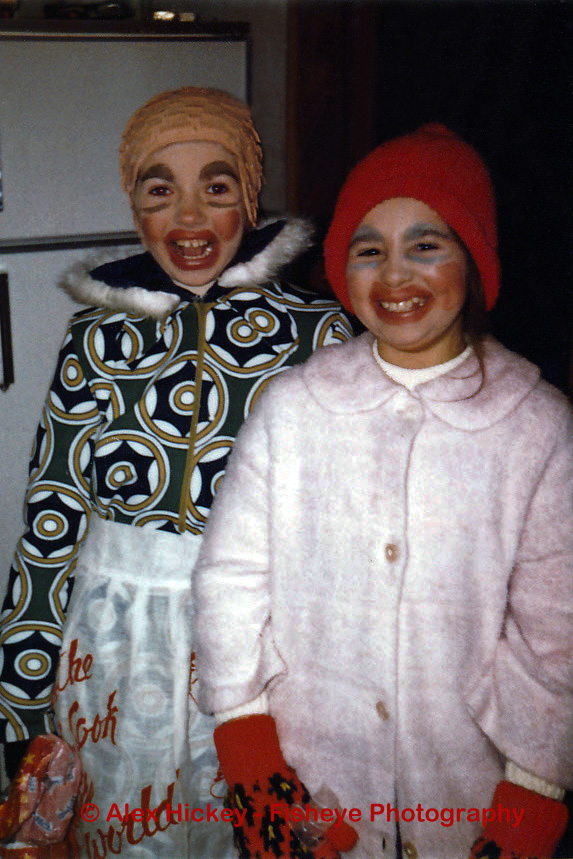
three children mummering in costume

Children Mummering

Children did their Mummering early in the evening just after the supper hour and were limited to particular sections of the community as in the parental direction, “You can go from Mrs. Whalen’s house to Mrs. Evan’s house then you must come home.   You can dress up again another night and go to some other houses.”  Beginning on the evening of Boxing Day  and on through the rest of the Christmas Holidays until Old Christmas Day, weather permitting and with parental permission, we attempted to visit every house in the harbour. Starting at the eastern end of St. Jacques where my grandparents lived we would make our way over the road parallel to the old Catholic Church, down over Clinton’s Hill and along the road to Dyett’s Hill; a side trip down the Lower Road, then across Pittman’s Brook Bridge, past Red Rail Hill, Cellar Hill and the Anglican Church until we reached the Barachoix Point. Beyond there we made our way around the Barachoix and over on the Beach.  With all variables considered we usually took the full twelve days of Christmas to achieve that visitation around the harbour.

We carried a split, a piece of dry wood used to start fires in a stove, which was used to knock on the door to each house we visited.  When someone came to the door, in your best falsetto voice or in a voice spoken on an inhaling breath, ingressive speech,  you valiantly stressed, “Any Mummers Allowed In?”  In some parts of the province this was known as mummer-talk or janny –talk.  An entry in the online version of the Dictionary of Newfoundland English has this description:

janny-talk: distorted or ingressive speech of a mummer used as a means of disguising one’s identity.

1969 Christmas Mumming in Nfld 211 When the janneys come to a house they wish to visit, they open, without knocking, the storm-door, stick their heads inside the ‘porch’ and ‘sing out’: ‘Any janneys in tonight?’ in the high-pitched, squeaky voice that janneys always use—’janney-talk.’ T 257-66 Oh yes, ’twas queer talk—janney talk. Some people can’t talk and some of ’em can, you know. Some of them make a queer talk, draw in their voice, and make a queer sound.

two children in mummering costume

Children Mummering

Rarely did you get invited into every house.  Sometimes an adult would answer the door only to be told the family wasn’t finished dinner or the baby was asleep and you cannot come in tonight.  Despite this we would manage to get inside almost every house in the community eventually for we dressed up every night we could and made our rounds, targeting houses that refused us on earlier nights.  When multiple groups were going around, it was not uncommon to maliciously drop a few hints as to who might be among the group coming behind yours.  As children we were treated to cookies, candies, and in some houses Purity Strawberry Syrup and dark fruit cake.  There are stories of mummers playing tricks on those who refused them entry; however, that was not our experience in St. Jacques.

Given the small number of children living in St. Jacques when I was a child and for every generation since then, it now seems highly probable that our hosts could determine rather quickly who we were; however, to their credit, they played along with the guessing game until all identities were learned and all faces exposed.  Such was Mummering for children in St. Jacques.

adult mummer dancing with an adult playing an accordion

Adult Mummers Dancing

Adults reflected much of the same presentations of disguise with somewhat greater emphasis on blurring gender identity.   Efforts for men to be perceived as women took on epic proportions with elaborate constructions to mimic breasts and to accentuate derrieres.  The most bizarre apparatus I ever heard of among women’s disguise efforts was the wearing of a ‘sheep’s purse” between her legs to fool even a boldly groping host.

Typical Mummer Costume

Typical Mummer Costume

Adult visitations occurred later in the evening with greater emphasis on merriment fueled by an accordion, fiddle or guitar and the consumption of either home brewed beverages or Demerara rum doled out in shot-size portions.   The guessing game was very similar to that of child mummers with a little more edginess  attached through sexual innuendo much as is seen in the Mummers Plays.   As the night wore on and the merriment levels of mummers increased it was not uncommon to see the lights suddenly go out as a group of boisterous mummers approached a house.

In every respect Mummering was about celebration of community and social interaction for all ages.  It has its origins in our European heritage and its distinctive flavour in our social nature.  As children we were provided opportunity through Mummering to interact with adults whom we would only casually encounter during the rest of the year; we learned to function as a group where everyone in the group was equal and where everyone looked out for each other. We occupied our evenings engaged in interaction and play, socializing and entertaining, and being children in a culture where a social custom transcended age and social status.

In St. Jacques, as with many rural communities around the coasts, fathers worked in the fishing industry and other occupations which took them away from home for lengthy periods of time throughout the year. However, Christmas was pilgrimage time when all roads led to home!  After being away for months Mummering offered everyone an opportunity to visit, celebrate and catch up on news and missed events as well as blow off a bit of steam in the presence of friends.

Listen to Bud Davidge sing what has become the definitive song about Mummering in Newfoundland and Labrador.

Resources you might enjoy reading.

Web Articles and Stories

Mummering Flourishes in N. L. Homes, CBC, December 23, 2010

Mummering, a Newfoundland Christmas Tradition, The Daily Planet, by Adam Carter, December 02,  2011

Mummering: A Storied Newfoundland Tradition, The Weather Network, by Daniel Martins, December 27, 2012

Mummering on the Rock : A Unique NL Tradition, by Sharon Martin, NL Interactive, December 2007

Mummers & Pagans & Wrens — Oh My!, by Christopher Simpson, Reprinted from Toronto Irish News, 1997

The Mummering Man, CBC Land and Sea Episode, January 1, 2012

Mummering and the Performing Arts in Newfoundland

Mummering in Nova Scotia, by Darcy Rhyno, Life asa Human, The Human Interest magazine for Evolving Minds, Jun 24, |

Journal Articles

 Craig T. Palmer, Mummers and Real Strangers: The Effects of Diminished Isolation on Newfoundland Christmas House Visiting, Vol 8, No 2Newfoundland Studies, Memorial University of Newfoundland, 1992

Joy Fraser, Mummers On Trial – Mumming, Violence and the Law in Conception Bay and St. John’s, Newfoundland, 1831-1863, Shima: The International Journal into Research into Island Cultures, Vol 3, No. 2. pp. 70-88  http://www.shimajournal.org/previous.html

Diane Tye, At Home and Away: Newfoundland Mummers and the Transformation of Difference, Material Culture Review, Volume 68, Fall 2008

Andrea and David Spalding, The Mummers and the Paupers, Canadian Folk Music Bulletin, Volume 28.3, September 1994

Books

Chris Brookes. A Public Nuisance: A History of the Mummers Troupe. St. John’s: Memorial University of Newfoundland 1988. 240 pp $19.95 paper, illus.

Halpert, Herbert and Story, G.M. Christmas Mumming in Newfoundland. Toronto: University of Toronto Press, 1990. , Ryan, D.W.S. (ed.)

Ryan, D. W. S. Christmas in Newfoundland and Labrador, Jesperson Press, 1988,

Margaret Robertson, The Newfoundland Mummers Christmas House Visit, A Thesis submitted in partial fulfillment of a Masters of Arts Degree, Memorial University, 1979

Pocius, Gerald L. A Place to Belong: Community Order and Everyday Space in Calvert, Newfoundland, McGill-Queen’s Press, 1991

« Newer Posts - Older Posts »

Categories